Turns out, while employers are busy trying to figure out if AI can write better emails, their workforce is quietly leveraging it to plot their next career move. A new study from the University of Phoenix Career Institute reveals a subtle but significant power shift: employees are using AI to boost their skills and confidence, not necessarily for their current gig, but for what comes next.
It's a bit like someone bringing their own high-performance tools to a job site where everyone else is still using a hammer. They're getting better, faster, and more ready to jump ship if a better opportunity sails by.
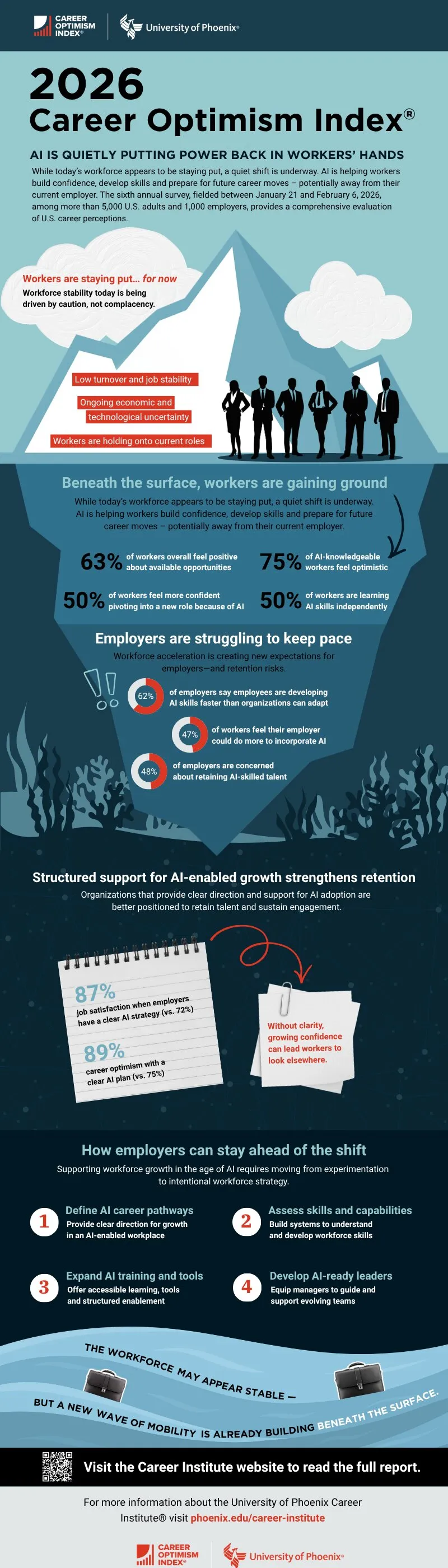
The study, which polled 5,000 U.S. workers and 1,000 employers, found that a full 50% of employees feel more confident about changing roles thanks to AI. Remember 2022, when everyone was "job hopping" for better prospects? This could be the sequel, but with robots as the co-stars.
We're a new kind of news feed.
Regular news is designed to drain you. We're a non-profit built to restore you. Every story we publish is scored for impact, progress, and hope.
Start Your News DetoxThe AI-Powered Employee
More than half of workers (53%) say AI makes them more confident in building new skills. A whopping 75% feel generally more confident at work, and 81% credit AI with helping them find new ways to apply their existing talents for future growth. Because apparently that's where we are now: your personal career coach is an algorithm.
This newfound AI-driven confidence translates directly into optimism. About 63% of workers feel good about their job prospects, a number that jumps to 75% for those who are actually comfortable and knowledgeable about AI. So, while you're still Googling "What is ChatGPT?" some folks are already using it to write their next cover letter.
Employers Face a Brain Drain
Here's the kicker: Nearly half of employers (48%) are legitimately worried they can't hold onto their AI-skilled employees. It's a double-edged sword: AI makes their teams more productive, but it also makes those team members more marketable elsewhere.
Another telling stat? 62% of employers admit their employees are learning AI faster than the company can adapt. This isn't just a knowledge gap; it's a full-blown chasm. And 60% of workers are practically begging for more guidance on AI tools from their bosses.
It seems many organizations are focused on using AI for efficiency, while their workforce is using it for personal efficiency and career advancement. John Woods, Provost at the University of Phoenix, points out that this is a critical moment for employers to get with the program. Companies that integrate AI into a clear growth strategy for their people are seeing higher satisfaction and retention.
Because if you don't give your AI-savvy employees a reason to stay, they're probably already using AI to find one somewhere else.