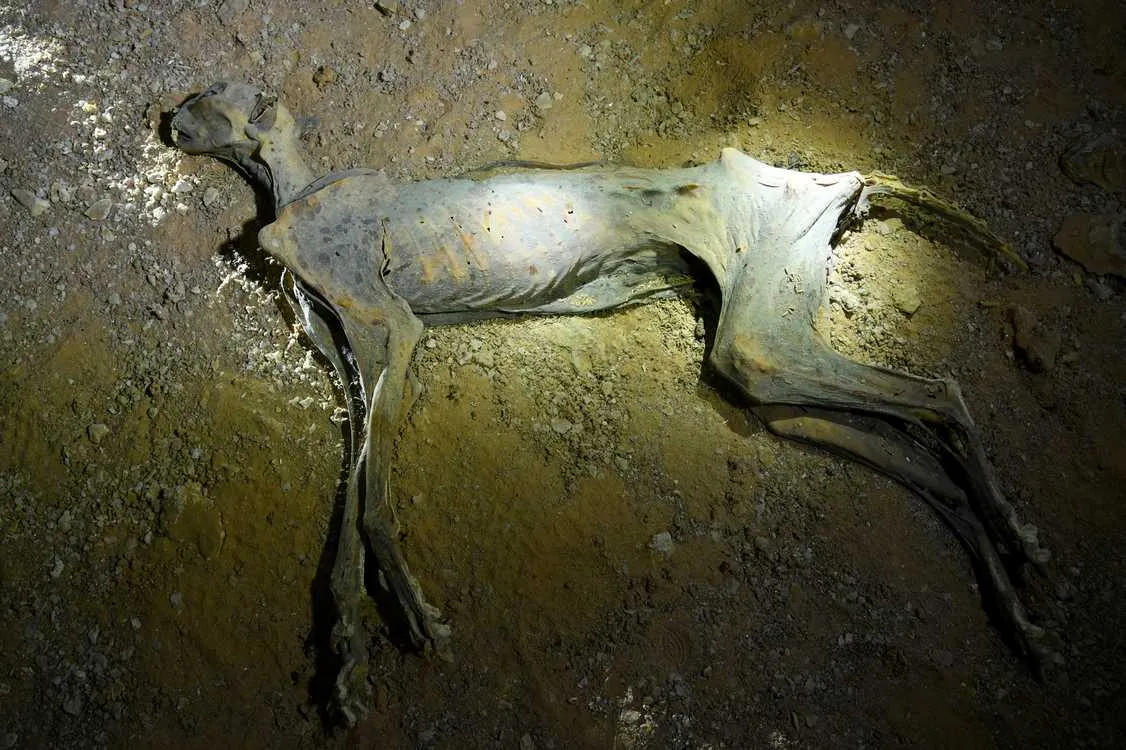
Seven naturally mummified cheetahs, preserved in the dry air of Saudi Arabian caves for up to 1,900 years, have just upended what scientists thought they knew about the region's wildlife history. Between 2022 and 2023, researchers surveying over 1,000 caves near the city of Arar in northern Saudi Arabia found something they weren't expecting: skeletons so well-preserved that genetic analysis could reveal which subspecies roamed the peninsula millennia ago.
Cheetahs vanished from the Arabian Peninsula sometime in the 1970s, their range across Asia shrinking by 98% over centuries. The conventional story was that they'd simply left, or never been particularly common there. The mummified remains—some dating back 4,000 years, others between 130 and 1,900 years old—tell a different story. They show that cheetahs didn't just pass through. At least two distinct subspecies called this region home.
Dr. Ahmed Boug and his team found the mummies alongside 54 additional cat skeletons across five caves, a cache that required careful genetic work to interpret. The most recent mummy matched the Asiatic cheetah, the subspecies still clinging to survival in Iran's protected populations. But the two older specimens were closest to the Northwest African cheetah—a critically endangered subspecies now confined to a small pocket of the Sahel and Sahara regions, thousands of kilometers away.
We're a new kind of news feed.
Regular news is designed to drain you. We're a non-profit built to restore you. Every story we publish is scored for impact, progress, and hope.
Start Your News DetoxA practical path forward
This matters because Saudi Arabia has already proven it can restore wildlife. Over the past decades, the country has successfully reintroduced Arabian oryx, gazelles, and other ungulates to protected areas, rebuilding populations from near-extinction. The habitat exists. The infrastructure exists. What's been missing is a clear historical case for why cheetahs belonged there at all.
Now they have one. The genetic evidence anchors the reintroduction idea in fact rather than speculation. But the practical challenges remain substantial. Iran's Asiatic cheetah population numbers in the low hundreds—too fragile to source animals from without risk. Partnering with West African nations to source Northwest African cheetahs would require the kind of international collaboration that conservation rarely achieves smoothly, but it's not impossible.
The discovery does something else too: it shifts how we think about extinction. These cheetahs didn't disappear because the Arabian Peninsula was always unsuitable for them. They disappeared because of human pressure—hunting, habitat loss, competition with livestock. That's a loss we created, but it's also one we might reverse.
What comes next depends on whether Saudi Arabia and West African conservation programs see the same opportunity in these ancient bones that the scientists who found them do.