
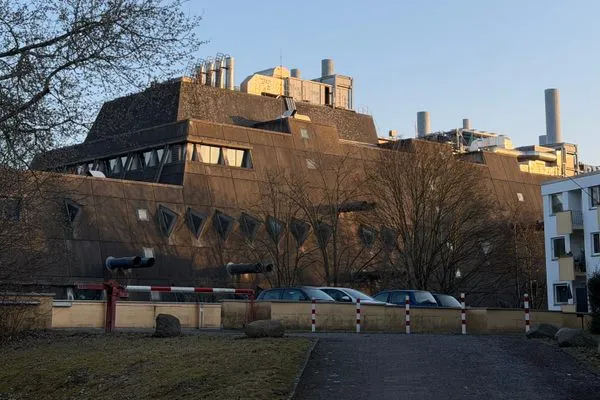
Picture a building that looks like it's ready for a zombie apocalypse, complete with tiny, defensive windows and giant pipes sticking out like some kind of industrial weapon. Now imagine that brutalist masterpiece was built in 1981, not to house secret agents or doomsday preppers, but… thousands of lab mice.
Welcome to Berlin's Mäusebunker, or "Mouse Bunker." Officially, it was the Research Facility for Experimental Medicine, and its purpose was precisely what it sounds like: a highly specialized, concrete fortress for biomedical research animals. Mice, rats, rabbits — all got the full Cold War-era architectural treatment.
German architects Gerd and Magdalena Hänska clearly weren't messing around. They designed the Mäusebunker to be a vision of pure, unadulterated Brutalism. Those narrow, triangular windows? Not just for aesthetics. They were part of a sophisticated system to maintain sterility and prevent contamination between research areas. Even the huge, protruding ventilation pipes weren't just for show; they moved air through special filters, keeping everyone and everything safe. Because apparently, even lab mice deserved a fortress.
We're a new kind of news feed.
Regular news is designed to drain you. We're a non-profit built to restore you. Every story we publish is scored for impact, progress, and hope.
Start Your News DetoxInside, it was a finely tuned machine. Separate floors, sealed hallways, and controlled airflow systems ensured that no rogue pathogen (or, presumably, particularly ambitious mouse) could mess up an experiment. It was a marvel of late 20th-century scientific infrastructure, if your idea of a marvel involves a lot of exposed concrete.
Fast forward to the 2000s, and scientific methods evolved. The Mäusebunker, like many things built for a very specific, intense purpose, became too expensive to maintain. Demolition seemed imminent. But then a funny thing happened: architects, preservationists, and people who genuinely appreciate Brutalist design stepped in.
They argued that this bizarre, imposing structure wasn't just an old lab; it was a unique piece of experimental architecture. Now, this abandoned concrete behemoth has been reborn as an unexpected cultural landmark. Guided tours, art exhibits, and public discussions have transformed it from a forgotten animal house into an architectural icon. It stands as a gloriously dystopian relic, a monument to a time when science, design, and Cold War paranoia converged in a most unusual, and very concrete, way.