For decades, scientists building things at microscopic scales have been stuck with one main tool: two-photon polymerization, a laser technique that could sculpt objects thinner than a human hair with remarkable precision. But there was a catch. The method only worked well with polymers — plastics, essentially. If you needed metal, semiconductors, or anything else functional, you hit a wall.
Researchers at the Max Planck Institute for Intelligent Systems and the National University of Singapore just broke through that wall.
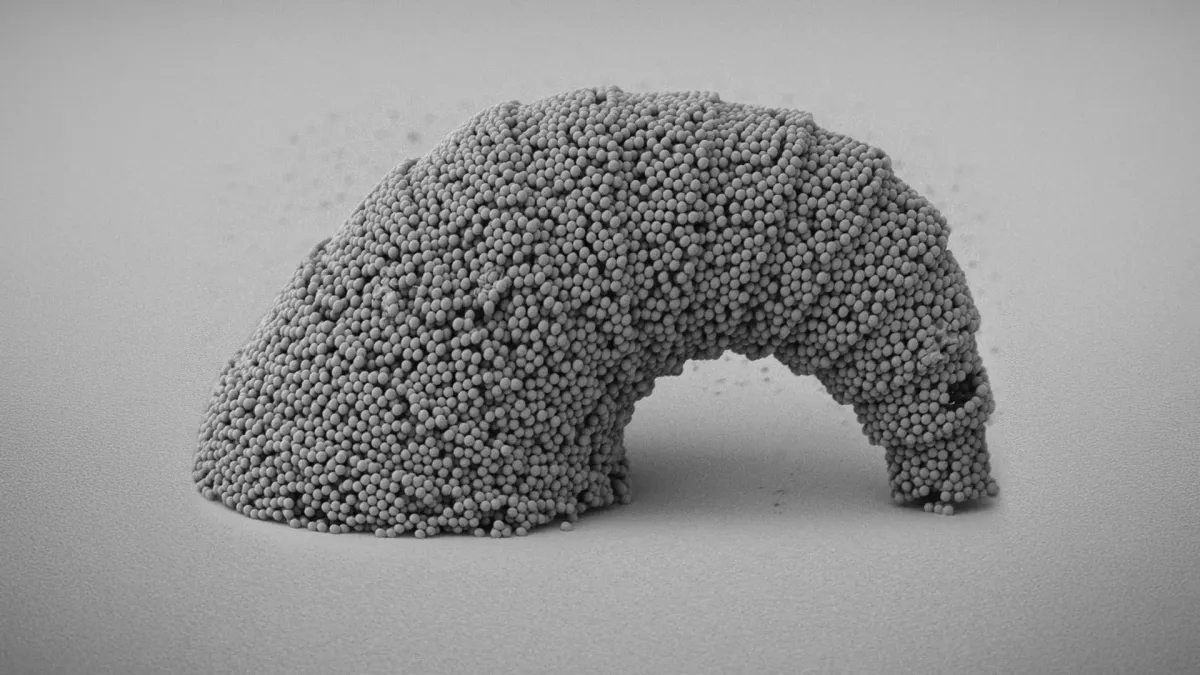
Their breakthrough uses something called optofluidic assembly — a technique that sounds complicated but works on a simple principle. A femtosecond laser (firing pulses in quadrillionths of a second) focuses on a single point inside a liquid containing suspended metal particles. The laser creates a tiny temperature spike. That temperature difference pushes the fluid itself into motion, like invisible currents in a microscopic ocean. Those currents carry particles exactly where the researchers want them — into a prefabricated mold, where they accumulate layer by layer into a solid 3D structure.
We're a new kind of news feed.
Regular news is designed to drain you. We're a non-profit built to restore you. Every story we publish is scored for impact, progress, and hope.
Start Your News DetoxNo chemical bonding needed. The particles stick together through basic physical forces — the same van der Waals interactions that hold gecko feet to walls.
"The key idea is to manipulate light-driven flow precisely, guiding 3D assembly of various micro- or nanoparticles within a confined 3D space," explains Mingchao Zhang, an assistant professor at the National University of Singapore and one of the study's leaders. "The femtosecond laser induces a localized thermal gradient which generates a strong flow that propels particles towards and into the template exactly where we want them to be."
What makes this genuinely useful is what the team actually built with it. They fabricated microvalves — tiny gates smaller than a grain of sand — that can sort particles by size inside channels narrower than a human hair. More strikingly, they assembled micro-robots made from multiple materials working in concert. Some respond to light, others to magnetic fields. A single microscopic device can now do multiple jobs, which opens up possibilities in medicine (imagine robots that could navigate inside blood vessels), engineering, and materials science.
"Optofluidic assembly overcomes the material limitations of traditional two-photon polymerization," says Metin Sitti, who led the Physical Intelligence Department at the Max Planck Institute. "Our new technology allows us to form tiny 3D objects from almost any material."
The research, published in Nature, points toward a future where microscale manufacturing isn't constrained by what materials your laser can handle — it's constrained only by imagination. That shift from "what can we make with polymers" to "what do we want to make" is the kind of constraint-breaking that tends to accelerate innovation.