Scientists have identified a previously unknown nematode living in Utah's Great Salt Lake, and they named it with help from the Shoshone Nation. The species, Diplolaimelloides woaabi — wo'aabi being the Indigenous word for worm — appears to live nowhere else on Earth, making it endemic to the lake and potentially a key player in an ecosystem we're only beginning to understand.
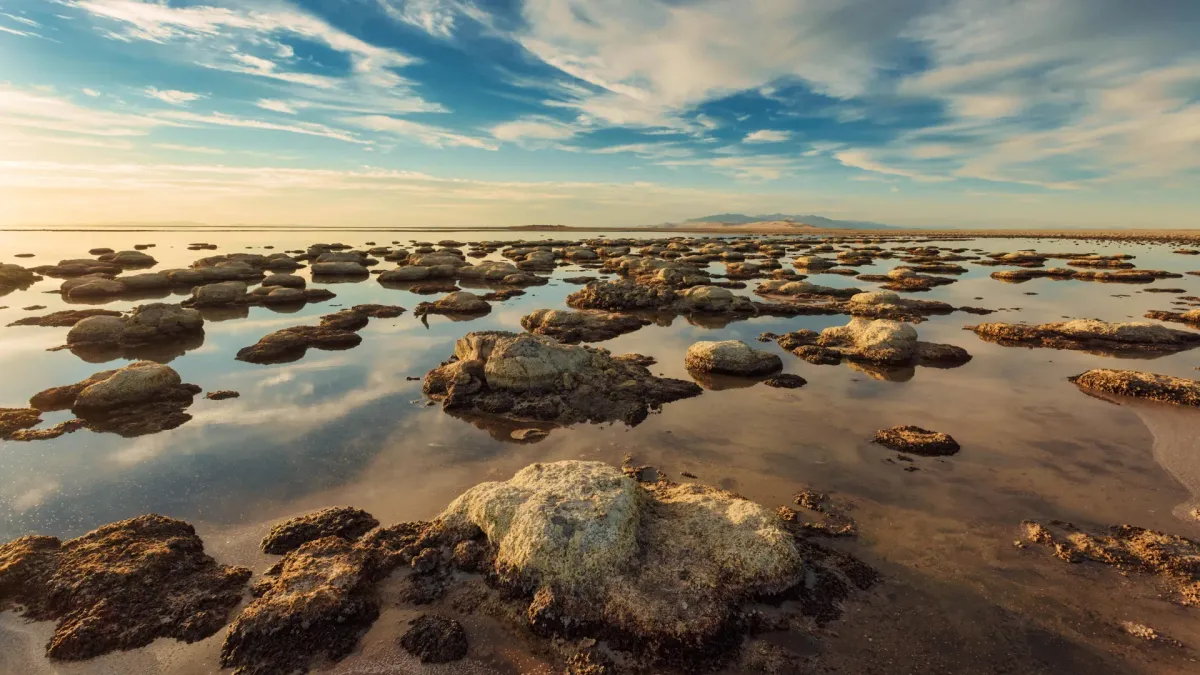
The discovery matters because it raises urgent questions about how life persists in extreme environments, and what that tells us about the lake's health. Until 2022, no nematodes had been definitively documented in the Great Salt Lake. Researcher Julie Jung, then a postdoctoral researcher at the University of Utah, found them while kayaking and cycling across the lake, collecting samples from microbialites — the hardened, mound-like structures built by microbial communities on the lakebed. Three years of genetic and physical analysis confirmed what the team suspected: a species entirely new to science.
A Puzzle 4,200 Feet Above the Ocean
Nematodes are everywhere. They're the most abundant animal phylum on Earth — roughly 80% of all animal life in soil and 90% on the ocean floor. Most are smaller than a millimeter, which is why we barely notice them. But Diplolaimelloides woaabi shouldn't exist where it does.
We're a new kind of news feed.
Regular news is designed to drain you. We're a non-profit built to restore you. Every story we publish is scored for impact, progress, and hope.
Start Your News DetoxThe genus Diplolaimelloides typically lives in coastal marine and brackish waters. The Great Salt Lake sits 4,200 feet above sea level, roughly 800 miles from the nearest ocean. Only one other member of this genus has ever been found outside coastal regions — in eastern Mongolia. So how did these worms get to Utah.
Michael Werner, the University of Utah biology professor leading the research, points to two possibilities, both strange in different ways. The first: the worms have been here for millions of years. During the Cretaceous Period, much of Utah sat along the shoreline of a vast inland sea. Streams and rivers feeding into that ancient beach would have been perfect habitat. As the Colorado Plateau lifted and the landscape shifted, these animals could have been trapped here — surviving through dramatic changes in salinity over the past 100 million years.
The second explanation is even wilder. The worms might have hitchhiked on migratory birds. Nematodes could cling to feathers after birds visit saline lakes in South America, then travel thousands of miles north to the Great Salt Lake. "Kind of hard to believe," Werner admits, "but it seems like it has to be one of those two."
A Sentinel for a Stressed Lake
What makes this discovery particularly valuable is what it might reveal about the lake itself. The Great Salt Lake is under increasing pressure from human activity — water diversion, pollution, shifting climate. Nematodes are widely used as bioindicators; changes in their populations, diversity, or distribution signal shifts in water quality, salinity, or sediment chemistry.
Because Diplolaimelloides woaabi appears to live only on microbialites, it may have unique relationships with microbes or survival strategies we haven't yet uncovered. Since microbialites are central to energy production and life support in the lake, any interactions involving these nematodes could ripple through the entire ecosystem.
Researchers also noticed something puzzling: female nematodes vastly outnumber males in lake samples — less than 1% males — but when cultured in the lab, the sex ratio evens out to about 50%. Something about the lake environment is different, and that difference might be telling us something important.
Genetic evidence suggests there could be a second, previously unknown nematode species among the samples already collected. The lake, it seems, is still revealing its secrets.