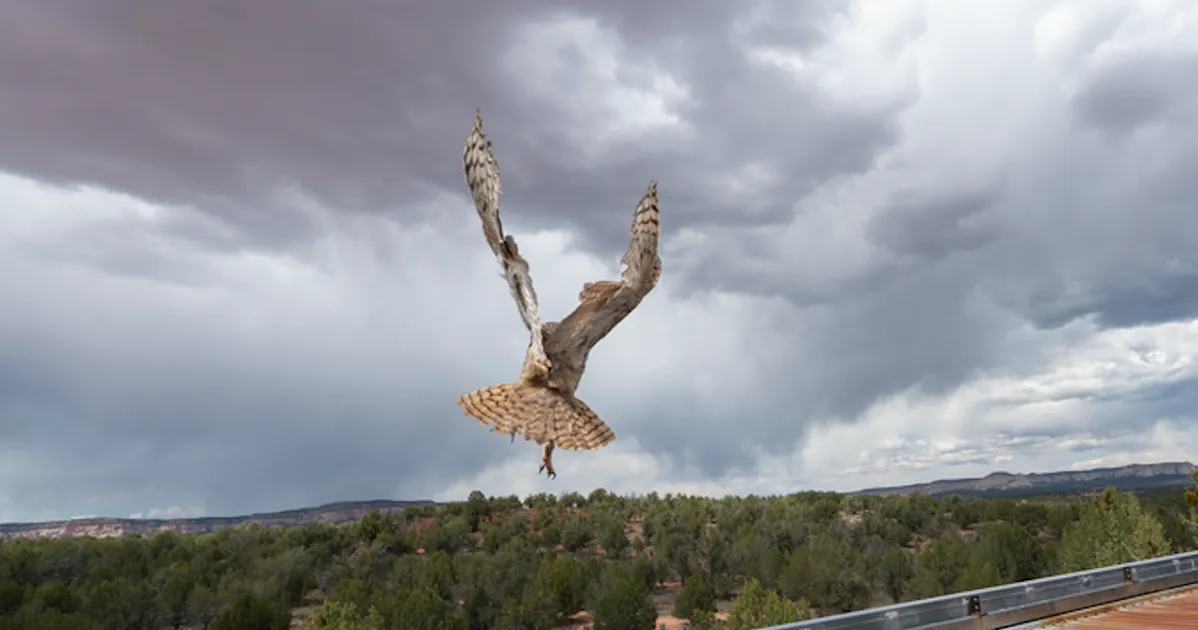
An adolescent great horned owl, once trapped in a concrete mixer and looking like it had a very bad day at the construction site, is now soaring through the Utah skies. Its journey from a cement-encrusted mess to silent predator involved dedicated humans, tiny toothbrushes, and some very precise feather surgery.
The Most Unfortunate Spa Day Ever
It all started in late October when workers at a resort site discovered the owl in a truck-mounted concrete mixer. Because apparently that's where we are now. They hosed the poor bird down, wrapped it in a towel, and called for backup. Staff from the Best Friends Animal Sanctuary in Kanab then spent days meticulously chipping away dried concrete from its face, chest, and right wing.
Imagine the scene: tiny forceps cracking debris, toothbrushes and dish soap gently scrubbing feathers. The owl, understandably, was not thrilled. After this unexpected deep clean, the hope was that the owl would just naturally grow new feathers. It did not. Because, of course, it didn't.
We're a new kind of news feed.
Regular news is designed to drain you. We're a non-profit built to restore you. Every story we publish is scored for impact, progress, and hope.
Start Your News DetoxFeather Transplants for Silent Flight
Fast forward to May, and the owl underwent a procedure called imping. This isn't just some fancy word; it's an ancient falconry technique that uses adhesive to graft donor feathers onto existing shafts. Bart Richwalski, a supervisor at the sanctuary, described the initial feather work as "nerve-wracking" – which, if you think about it, is both impressive and slightly terrifying. But they got into a rhythm.
Great horned owls need soft, downy feathers for their signature silent flight, crucial for hunting. The concrete had frayed this owl's feathers, making a tell-tale "whoosh" when it tried to fly. Not ideal for sneaking up on dinner. So, after checking feather patterns and trimming damaged shafts, the owl was anesthetized for a 90-minute procedure. Donor feathers from a similarly sized deceased owl were carefully laid out, cut, aligned, and then glued into place. Ten new primary feathers and one secondary feather on its right wing. Feather extensions, essentially.
Freedom, One Silent Whoosh at a Time
Post-op, the owl woke up in a large aviary and immediately took flight. Richwalski, who had been its primary caregiver, used a decibel meter to confirm its wingbeat was now quiet enough for a safe return to the wild. The aviary roof retracted, the owl hovered, then gained speed and vanished into the open sky. "It was a sight to see. It was so fun," Richwalski said, likely still a bit stunned by the whole concrete-mixer-to-freedom saga.
Karla Bloem of the International Owl Center confirmed that imping is a tried-and-true method, and those grafted feathers are surprisingly durable. Plus, if a few fall out, the owl will just grow new ones in the summer. Her advice for the newly freed owl? "Find a territory... find one of the opposite sex and settle down and have kids." Because apparently, after surviving a concrete mixer and getting feather transplants, dating is the next big challenge.