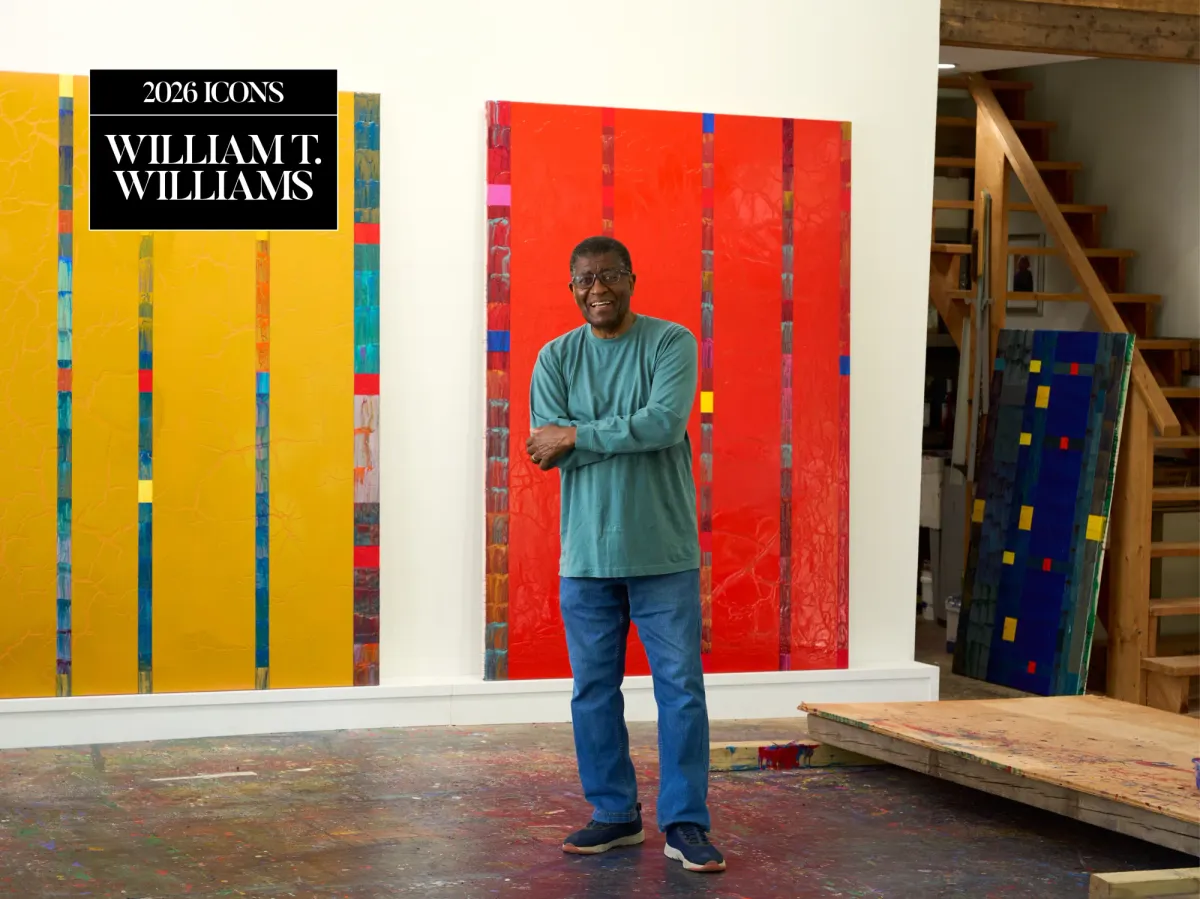
William T. Williams has been a painter for six decades. He approaches each new painting as if it's his first time. He likes to keep his process open, always thinking a few steps ahead. He follows where the paintings lead him until he feels he has explored every possibility.
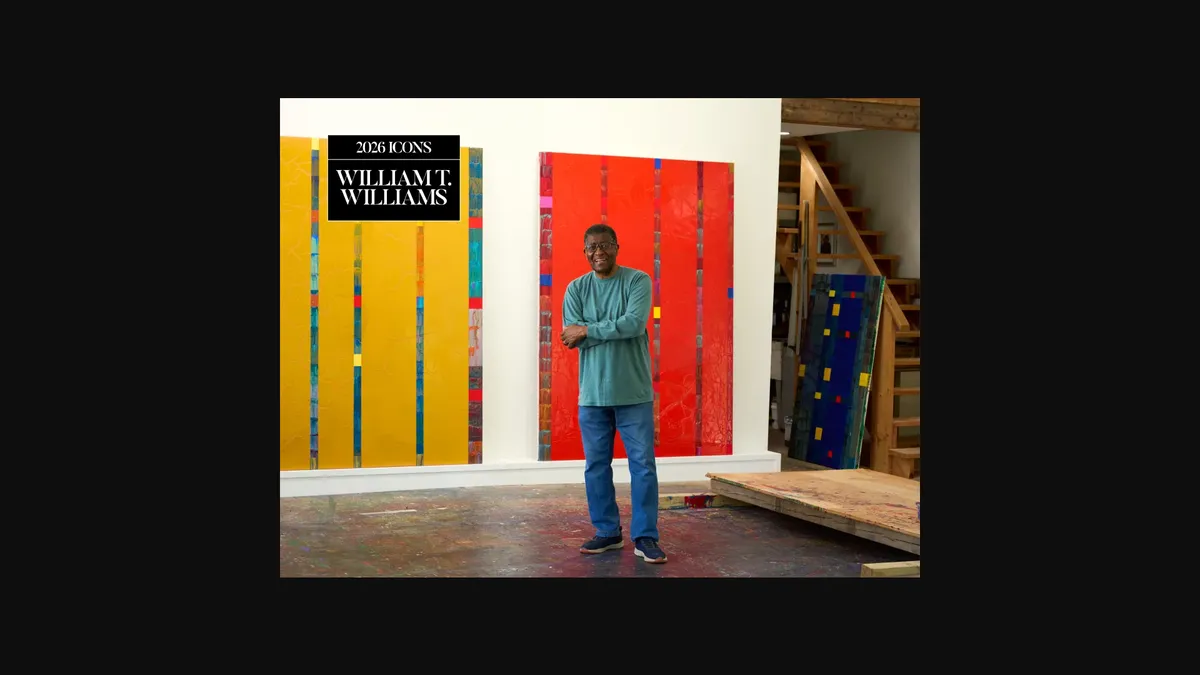
Williams works in a sun-filled studio in Connecticut. This is a big change from his New York studio, where he blocked out natural light. In Connecticut, the light influences his paintings, making them more vertical. He sometimes places canvases against windows to see how light passes through them.
His studio shows works in progress. These feature bands and rectangles of cracked paint. The floor is covered with paint drips from 15 years of work. A table holds various mixtures of Golden paint. Shelves display smaller versions of his abstract works, which he calls "the key to everything." These might be details he's working on or miniatures of larger canvases. He uses blue painter's tape or Post-its to mark where elements will go, focusing on placement rather than color. His latest abstract paintings use two-inch vertical bands made of different colored rectangles.
We're a new kind of news feed.
Regular news is designed to drain you. We're a non-profit built to restore you. Every story we publish is scored for impact, progress, and hope.
Start Your News DetoxWilliams builds his paintings in thin layers after an initial clear coat. Each new layer adds another element he must arrange. He leaves gaps between layers to create a cracked look, showing how the layers build up. Most paintings take at least six months, some even years, as he makes subtle adjustments to colors.
He uses different paint solutions, some thinned with alcohol to dry faster, others with water to reduce shine. It took years to perfect these consistencies. Drying time is important to him. Instead of a palette, he uses plastic cups for each mixture, making touch-ups easy.
A Dedication to Abstraction
Williams is dedicated to formalism but also to breaking its rules. He wants art that doesn't just sit on the wall; he wants it to be "irritable." He seeks a hidden system within his work. He explores how abstraction can express feelings of dissonance or being "off-kilter" without painting protest art or clear narratives.
He believes color is the hardest element in abstract painting. In representational art, color simulates reality. In abstraction, it's difficult to control. To achieve poetry or magic, color needs to be "offbeat" or "off-key."
His recent canvases explore the idea of figure versus ground. For example, Jonquil (2021) has a cracked yellow background with a single yellow band and a red square. Williams was interested in whether the square appeared in front of, behind, or as a hole in the plane. He sees these newer works as connected to his "Diamond in a Box" series from the late 1960s, even though the earlier works have fewer layers. Thelma Golden, director of the Studio Museum in Harlem, notes that Williams constantly asks and answers questions through his art, creating a legacy of incredible practice and commitment.
Williams was born in North Carolina in 1942 and moved to Queens, New York, at age four. He spent summers in North Carolina until he was about 14. He loved drawing as a child. Tommy Hemans at a community center gave him art supplies, and his junior high art teacher, Mrs. Ross, suggested he attend the School of Industrial Art (now the High School of Art and Design). There, he was surrounded by artists for the first time. This early training helped him understand the power of art.
He first studied advertising production at New York Community College. After a brief job at Billboard Music Week, he saw an ad for Pratt Institute. He enrolled in 1962, initially studying graphic design before switching to painting in his sophomore year. His early assignments were uninspiring, and his grades were poor. A turning point came when he took a class with painter Richard Bové, who encouraged him to see a Hans Hofmann exhibition. Williams was struck by the "exuberance and physicality of paint," realizing paint was a material with a life of its own.
In 1965, during his junior year at Pratt, Williams studied at the Skowhegan School of Painting & Sculpture in Maine. He was the only student working in abstraction. He found a mentor in Alfred Leslie, who had shifted from Abstract Expressionism to realistic figurative painting.
 Courtesy Michael Rosenfeld Gallery, New York/©William T. Williams
At Skowhegan, Williams won the Leonard Bocour Award. Bocour, who founded Bocour Artist Colors, became a key patron for about 15 years. Bocour believed in Williams as an artist and shared his knowledge of painting. If Williams had trouble with paint application, Bocour would visit his studio or connect him with a technician.
Pratt gave Williams confidence that art could be his life's work, despite his blue-collar background. His professors, including Bové, Philip Pearlstein, and Alex Katz, encouraged him to attend Yale for graduate school. There, painter Al Held told him, "I like your work, and I like you, but you're going to have to work."
After grad school, Williams started his "Diamond in a Box" series, inspired by his grandmother's quilts and his mother's phonograph. He then created his "Shimmer Series," inspired by light flickering over a lake and Jamaica Bay. These canvases use only Dioxazine Purple to create a rippling effect. By the late 1970s, he moved to his "Roller" series (1978–82), using paint rollers and a wet-on-wet technique to apply about 15 layers of paint. This was an anti-art gesture, creating textures and marks he couldn't make otherwise. By the early 1980s, his palette became richer and wider, leading to "overloading paintings with color." He sees painting as both work and play.
This playful approach has made Williams an iconoclast. Curator Eric Booker notes that Williams has stayed true to his inspirations, existing outside any single movement. His work engages with 20th-century abstraction but remains uniquely his own.
 Courtesy Michael Rosenfeld Gallery, New York/©William T. Williams
Teaching and Community Impact
Williams has taught art for almost as long as he has made it. In 1970, he began teaching at the School of Visual Arts and Pratt. The next year, he joined the faculty of Brooklyn College, invited by Philip Pearlstein. He shared an office with Pearlstein, Harry Holtzman, Allan D’Arcangelo, and Jimmy Ernst, who helped him navigate teaching by sharing their experiences from a previous generation of art. Williams taught at Brooklyn College for nearly 40 years, retiring in 2008.
One of his students at Brooklyn College was Nari Ward. Williams's "New Materials" course, where students made art from a New York telephone directory, was impactful. When Ward moved from 2D art to sculpture, Williams suggested artists like David Hammons and Martin Puryear. He encouraged Ward to consider how these artists worked and how his own engagement with materials differed. Ward also learned from Williams's painting practice, observing his balance of control and letting the material guide him.
Williams also helped artists by proposing an artist residency program in 1968. He saw a need for infrastructure to support minority artists, many of whom were self-taught or struggled after formal education. His proposal included a residency, patrons, scholars, critics, and a museum to connect everything.
He shared his idea with art historian Dore Ashton, who connected him with the Museum of Modern Art's Junior Council. They told him about a new institution in Harlem being founded to support Black artists, called the Studio Museum in Harlem. Williams met with the founding trustees, including Eleanor Holmes Norton and Betty Blayton-Taylor, and supporter Charles Cowles, who were enthusiastic. The program began in 1969 with Valerie Maynard as the first resident and continues today. Alumni include prominent artists like Kerry James Marshall, David Hammons, Simone Leigh, Lauren Halsey, Kehinde Wiley, Julie Mehretu, and Titus Kaphar. Thelma Golden, the Studio Museum's director, says the program is central to the institution's life, creating opportunities and space for artists.
Beyond the museum, Williams co-founded Smokehouse Associates with Melvin Edwards, Guy Ciarcia, and Billy Rose. Between 1968 and 1970, they created nine murals in Harlem. They involved community members, like block associations, churches, and elders, in designing and painting the murals. Curator Eric Booker, who curated a 2017 exhibition on Smokehouse, sees this project as decentralizing the arts, which aligns with Williams's ethos as an artist and educator. Art historian Mona Hadler believes these works showed that "abstraction can uplift" and that art doesn't need to be figurative to convey a message.
The murals' designs and colors responded to their specific Harlem locations. Booker notes that documentation shows children and elderly people interacting joyfully with these spaces. This social empowerment was key to the collective's mission, focusing on the process of making art and its impact on the community. Williams compared the relationship between a mural and its site to his own layered paintings, where there's a dialogue between what's underneath and what's on top.
Challenging Perceptions of Black Art
Williams worked unofficially for the Studio Museum for about a year. During this time, he organized the 1969 exhibition "X to the Fourth Power," a four-person show featuring only abstract art. He saw this as a challenge to the institution and its audience. Williams showed a "Diamond in the Box" painting alongside a chain sculpture by Melvin Edwards, a beveled painting by Sam Gilliam, and a large painting by Steven Kelsey. The exhibition was met with "bewilderment." Art historian Kellie Jones explained that abstract art didn't align with what some expected from Harlem, especially during the Black Arts Movement.
However, The New York Times review of the show stated, "To a large extent, the exhibition succeeds in making its point that art is art whether the artist is black or white, whether the work is exhibited in Harlem or in a posh downtown establishment." Williams felt this addressed the implicit racism that Black artists were not capable of abstraction. He believes the exhibition ended that discussion.
In a 1971 ARTnews essay, "It's Not Enough to Say 'Black Is Beautiful,'" artist Frank Bowling argued that discussions about Black painting and sculpture focused too much on "Black Art" rather than the works themselves. Williams and his friends Edwards, Gilliam, and Jack Whitten often discussed "what art could be instead of what it had been" and debated aesthetics. This conversation was difficult in an art world marked by racism.
 Courtesy Michael Rosenfeld Gallery, New York/©William T. Williams
Williams noted that early writings about his work assumed the dissonance was accidental, not intentional. He deliberately chose titles unrelated to his paintings' content to make viewers focus on the art itself, rather than a narrative. For example, Sister of Neckbone (1970) is an abstract painting with stacked planes of color. Valerie Cassel Oliver, curator at the Virginia Museum of Fine Arts, included it in her 2021 exhibition "The Dirty South," seeing its title as an honorific within the Black community, a way of honoring Black bodies.
Williams explained that his titles represent "events that a group of people have experienced." He wants someone who has shared that experience to see the painting and laugh, creating a shared experience rather than just looking. He believes "looking excludes people; experiencing doesn't exclude anyone." In the late 1960s New York art world, people would talk about "a good reading of that painting," implying a prerequisite to understanding it. Williams argues his paintings require no such thing: "All you have to do is stand in front of it and experience it. You don’t need a narrative. You don’t need a PhD. You don’t need previous art experiences. It’s just you and that object. That’s it."
Lasting Friendships and a Memorial
Before the "X to the Fourth Power" show, Williams and Edwards spent a day preparing the space. Williams recalls that this human energy bonded him with Edwards and Gilliam for 50 years. Their friendship, centered on their shared commitment to art, was "divine" and continued until both friends passed away—Gilliam in 2022 and Edwards in March.
These friendships were incredibly important to Williams. He feels their presence in his studio, encouraging him to keep going. He remembers visiting their studios over the years, amazed by their ideas and engagement. He emphasizes the unseen history of their interactions, discussions, and thinking.
Towards the end of a visit, a sculpture-like arrangement of dried paintbrushes caught attention. Williams explained it's a memorial. Each time a long-time friend—artists, musicians, poets—dies, he takes the brush he's working with that day, leaves the paint on it, lets it dry, and adds it to the memorial. Brushes for Gilliam, Whitten, and Edwards are among them. The memorial has become very full, but it didn't start that way. He says, "They’re always there."