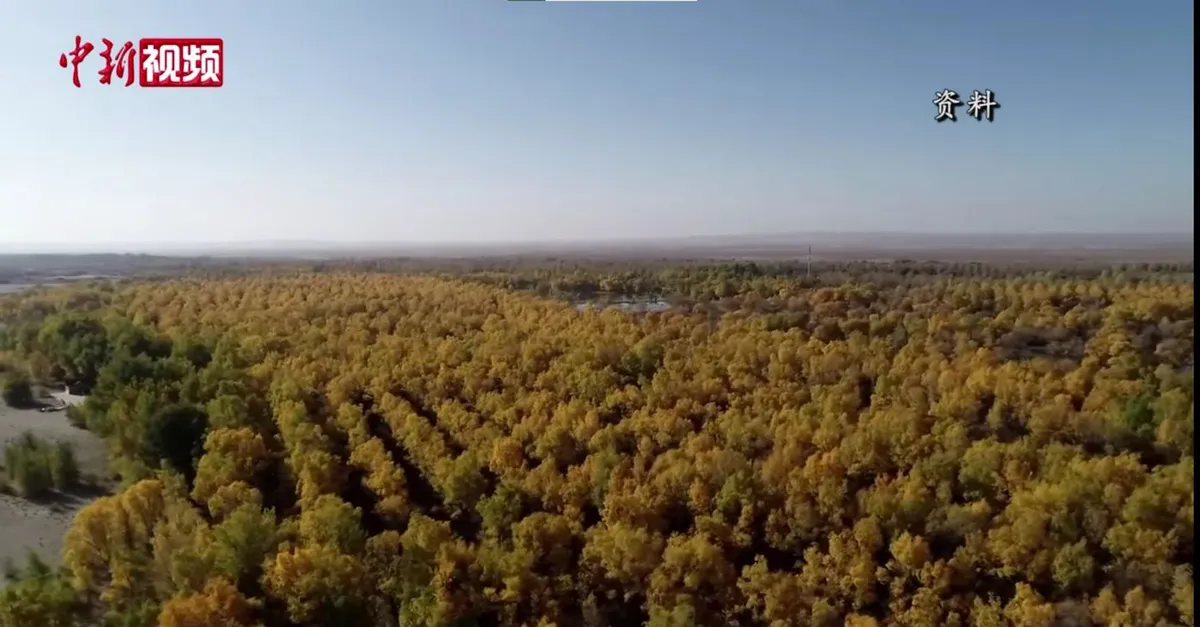
Forty-six years ago, China began planting trees in one of Earth's most punishing places. The Taklamakan Desert—a sprawl of sand and rock in western China so hostile that its name means "place of no return"—seemed an unlikely candidate for transformation. Yet by 1978, when the "Green Great Wall" project started, something had become clear: doing nothing meant watching the desert expand, swallowing productive land and destabilizing entire regions.
Today, 66 billion trees later, that barren landscape has become something scientists didn't expect to measure: a carbon sink. A study by NASA and Caltech found that the trees have lowered CO2 concentrations in the desert air from 416 parts per million to 413 ppm. That's a small number in absolute terms, but it represents the first time researchers have documented human-led tree planting actually reversing atmospheric carbon levels in an extreme arid environment.
"We found, for the first time, that human-led intervention can effectively enhance carbon sequestration in even the most extreme arid landscapes," said Yuk Yung, a planetary science professor at Caltech. The mechanism is straightforward: more trees mean more photosynthesis, more water retention in the soil, and measurably higher rainfall across the region—several millimeters annually, enough to create a feedback loop that sustains the greenery.
We're a new kind of news feed.
Regular news is designed to drain you. We're a non-profit built to restore you. Every story we publish is scored for impact, progress, and hope.
Start Your News DetoxWhat makes this remarkable isn't just the scale. It's the proof of concept. Deserts in their natural state absorb almost no atmospheric carbon. They're carbon-neutral at best, carbon sources at worst when dust storms release stored carbon. But plant a shelter belt—a strategic line of trees designed to slow wind and trap moisture—and the equation changes. The Taklamakan project didn't just halt desertification in its target zones; it converted dead land into a working climate solution.
The implications ripple outward. Similar shelter belt strategies are now being tested in other arid regions: Madrid is ringed a forest to cool the city and cut emissions, while Indian states have added half a million acres of forest cover in just two years. Each project operates at different scales and in different climates, but they all follow the same principle—that even the harshest landscapes can be restored, and that restoration can contribute to atmospheric carbon reduction.
Reforestation alone won't solve the climate crisis. The carbon sequestration from tree planting is real but modest compared to the scale of global emissions. Yet the Green Great Wall demonstrates something equally important: that large-scale ecological intervention works, that it can be sustained across decades, and that it changes not just the landscape but the air itself. As climate solutions go, that's worth paying attention to.