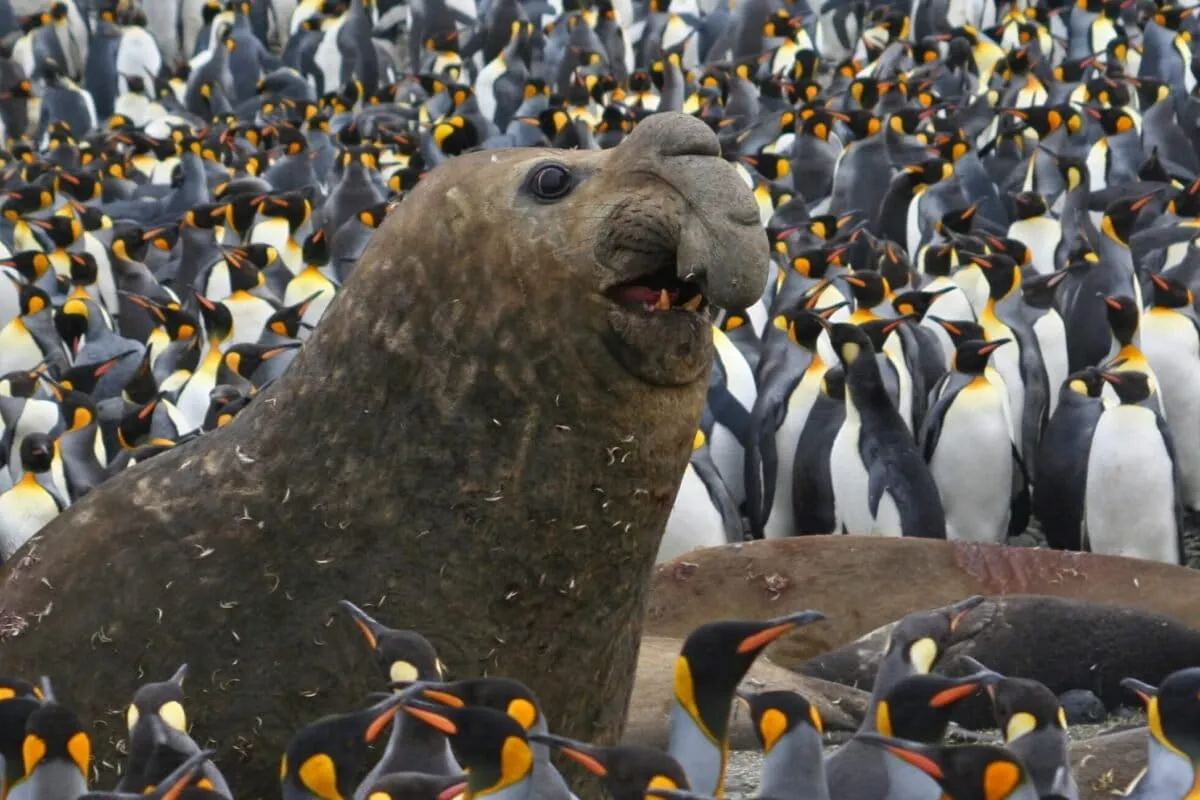
Southern elephant seals breeding on two remote South African islands have recovered enough to move off the threatened species list—a milestone that took four quiet decades of consistent protection to achieve.
Prince Edward Island and Marion Island, both sub-Antarctic outposts belonging to South Africa, have been home to stable elephant seal colonies for the past 40 years. No major threats have disrupted their breeding grounds in that time, allowing populations to climb steadily. The shift from "near threatened" to "least concern" status, announced in the 2025 Mammal Red List for Southern Africa, reflects that long, unglamorous work of simply leaving a place alone.
The assessment came from a collaboration between the Endangered Wildlife Trust and the South African National Biodiversity Institute, who brought together 163 researchers from 40 institutions to review the conservation status of 336 mammal species across South Africa, Lesotho, and Eswatini. It's the kind of comprehensive, methodical work that rarely makes headlines—but it matters. The review found that one in five of these species faces extinction, and nearly a third of the region's endemic mammals (species found nowhere else) are threatened.
We're a new kind of news feed.
Regular news is designed to drain you. We're a non-profit built to restore you. Every story we publish is scored for impact, progress, and hope.
Start Your News DetoxThe elephant seals themselves tell a smaller, more hopeful story within that larger context. These massive marine mammals—they can weigh up to 3,500 kilograms—breed only on those two islands. While the colonies are separate, seals move between them, which means genetic diversity stays healthy. That movement, and the stable conditions that allow it, has been key to their recovery.
But the global picture is more complicated. The IUCN's 2022 assessment of elephant seals worldwide found the overall population holding steady, but some subpopulations are declining. Fishing nets still entangle seals. Tourism pressure disrupts breeding sites. And climate change is altering the conditions of their ocean habitat in ways we're still learning to measure.
What happened in South Africa—sustained, unsexy protection—is exactly what works. It's also exactly what's hardest to fund, hardest to celebrate, and hardest to maintain. The seals thriving off Marion Island aren't a solved problem. They're a reminder that recovery is possible when we commit to it, and that the commitment has to outlast any single news cycle.