Avant-garde dance doesn't have to be serious. That's the delightful secret at the heart of Set and Reset, a 1983 collaboration between Trisha Brown (choreography), Laurie Anderson (music), and Robert Rauschenberg (sets and costumes) that's returning to the Brooklyn Academy of Music this weekend as part of an international tour celebrating Rauschenberg's 100th birthday.
The piece works because each artist insisted on independence. Brown's dancers do their own thing most of the time—breaking into trios and duets only occasionally, their movements creating a kind of productive chaos that never quite resolves into harmony but never becomes uncomfortable either. At one point the ensemble lines up tidily before dissolving into shambles. About fifteen minutes in, a prolonged duet emerges where the dancers find unison that feels almost shocking after the free-for-all that came before. Then they split apart again, mirroring each other instead of dancing side-by-side.
Anderson's score—peppy, staccato, synthy—chants "long time no see" with exaggerated rhythm, almost like a slightly spooky G-rated haunted house. As it begins to sound like a train whistle, pique turns end in trust falls and arabesques give way to playful kicks before dancers somersault backward offstage one-by-one, looking like babies curled up on the floor. Rauschenberg designed translucent scrims at the stage's wings instead of the usual opaque velvet curtains, letting audiences linger on those delightful somersaults a little longer. The dancers wear loose, sheer, printed ensembles whose gridded geometries create surprisingly befuddling anatomies.
We're a new kind of news feed.
Regular news is designed to drain you. We're a non-profit built to restore you. Every story we publish is scored for impact, progress, and hope.
Start Your News DetoxThe score as choreography
Also returning is Travelogue, choreographed by Merce Cunningham in 1977 and now being restaged by the Trisha Brown Company for the first time by a professional dance company since 1979. This piece operates on radically different logic. Using a random number generator, musicians play either bird calls or phone calls—the latter dialed live to any number they choose. The calls go to voicemail, elaborate phone trees, a wildlife clinic. The results are different every performance.

Watching it requires using both the verbal and body-language parts of the brain simultaneously, which is harder than it sounds. But something clicks when a call reaches a wild bird clinic and the dancers' wiggly arms and stunted arabesques suddenly read as injured birds. Their trust falls, ending on the ground with arms crossed like sarcophagi, deepen the metaphor. The score interpreter seems deliberately choosing endangered things—phoning the Museum of African American History and Culture, then public libraries, then the National Weather Service. Government shutdowns and weather emergencies close lines, but once you hear the suggestion in the music, it's hard to unsee.
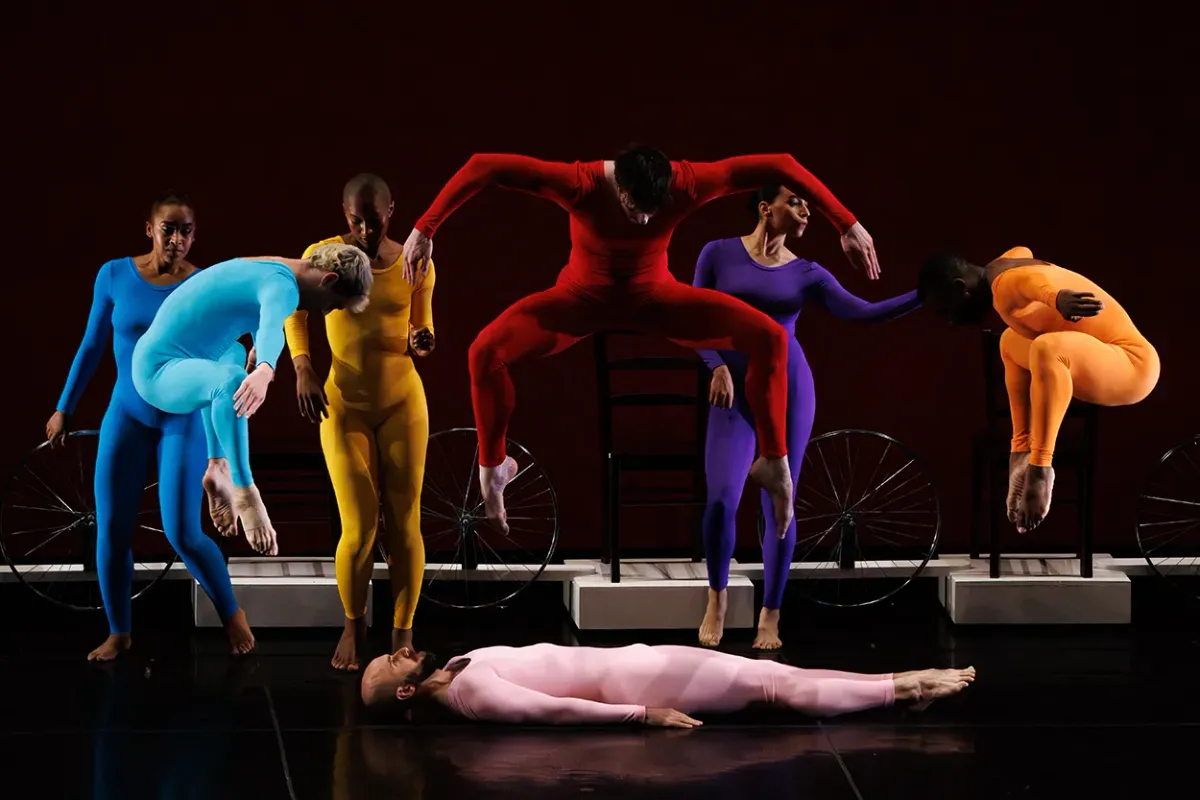
Rauschenberg dressed the dancers in color-blocking unitards that unfold into delightful surprises. For the set, Cunningham asked him to make something "freestanding," and the result—dangling from the ceiling—is considered one of his first "combines," those signature combinations of painting and sculpture that made him famous.

These collaborations didn't always last. A rift eventually came between Rauschenberg and the Cunningham company when a newspaper quoted him calling the dancers his "biggest canvas." The company replaced him with his ex, Jasper Johns—the ultimate revenge. It's rare for creative partnerships to endure, but these works prove what becomes possible when visionary artists trust each other enough to play.