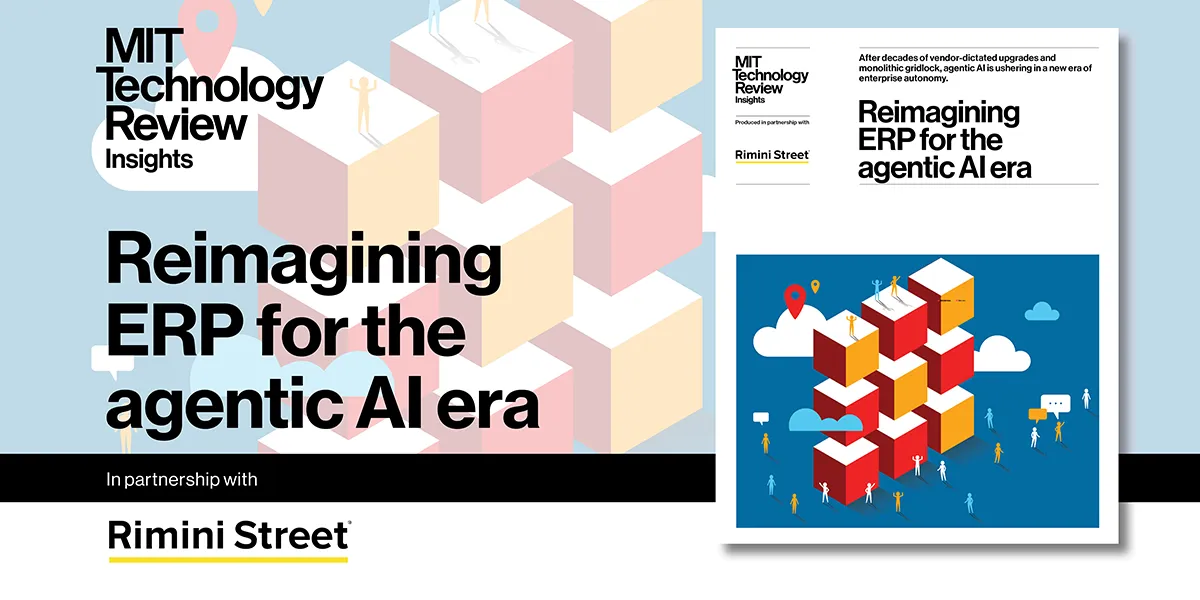
For sixty years, enterprise software has followed the same pattern: a new technology emerges, and businesses reorganize themselves around it. Mainframes centralized the filing cabinets. Client-server networks brought work to the desktop. Cloud and SaaS made it mobile. Each shift promised liberation. Each one, eventually, created a new kind of lock-in.
Now something different is happening. Two architectural shifts are colliding—composability and agentic AI—and they're pointing toward a future where software finally organizes around the business instead of the other way around.
Breaking the monolith
Composable architecture is the simpler concept: instead of buying one massive ERP system that does everything poorly, companies assemble best-of-breed modules from different vendors. Think of it like replacing a bloated all-in-one kitchen appliance with a set of tools you actually want to use. You can swap one module without ripping out the whole system. You're not hostage to a vendor's roadmap anymore.
We're a new kind of news feed.
Regular news is designed to drain you. We're a non-profit built to restore you. Every story we publish is scored for impact, progress, and hope.
Start Your News DetoxBut here's where it gets interesting. Those modules weren't designed to talk to each other. They have different languages, different logic, different speeds. Agentic AI—software that can plan, decide, and act across systems without human intervention at each step—becomes the translator and orchestrator. It watches a purchase order move from one system to another, notices when something doesn't fit, and figures out the next step without waiting for a human to write a custom integration.
Early data suggests this combination works. A 2024 study found organizations implementing AI-enabled ERP solutions reported 30% gains in user satisfaction and 25% productivity improvements. Another found processing times dropping by up to 45%, with decision accuracy improving by 60%. These aren't incremental gains—they're the kind of numbers that get board attention.
What makes this different from previous ERP eras is what's actually being unlocked. For decades, companies accepted massive inefficiencies because ripping out an ERP system meant ripping out everything. You were stuck with the vendor's vision of how your business should work. Composability lets you keep what works (the stable core for essential transactions) and swap out what doesn't. Agentic AI handles the coordination layer that makes it all function as one system.
The result: companies can modernize in place instead of betting the company on a multi-year upgrade cycle. They can experiment faster. They can adopt new capabilities without waiting for their ERP vendor to build them.
It's still early. Most organizations are in the pilot phase, figuring out what agentic AI can actually do in their specific workflows. But the pattern is clear: the businesses that move first—that start composing modular systems and letting AI coordinate across them—will have a structural advantage. They'll be faster to change. More resilient to disruption. Less dependent on any single vendor's decisions.
For the first time in ERP's history, the technology is starting to get out of the way.