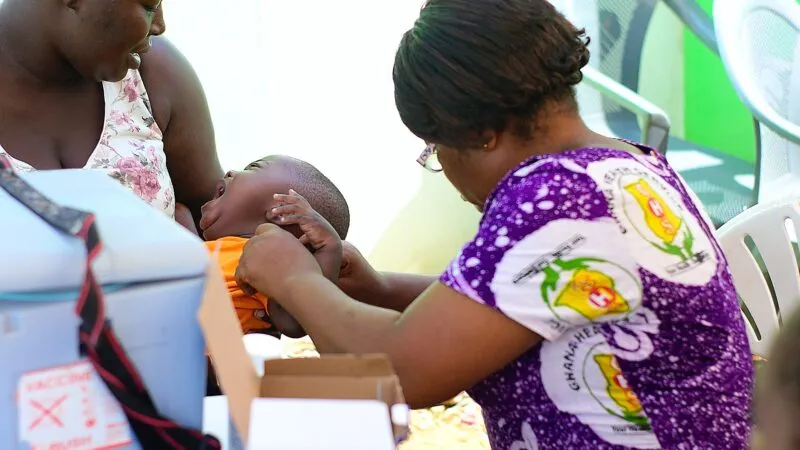
A 28-year-old maize farmer in western Kenya walked into a small clinic with a fever. Ten years earlier, he would have waited weeks for a diagnosis. In 2024, a community health worker took a photo of his blood sample through a $50 portable microscope clipped to a smartphone, and an AI algorithm returned an answer in 90 seconds: malaria, with 98.5% accuracy.
He left that afternoon with the correct medication.
This isn't a prototype or a promise. The Kenyan Ministry of Health, working with startup Ubenytics, now runs this system across 420 health facilities in eight counties. The numbers are already shifting: 31% fewer inappropriate antibiotics prescribed, 19% fewer severe malaria complications.
The gap AI is filling
Sub-Saharan Africa carries 24% of the world's disease burden but has only 3% of its health workers. Nigeria has roughly one pathologist for every 500,000 people. Compare that to the global average of one per 25,000. The specialist shortage isn't a policy problem waiting for funding—it's a structural reality that AI tools are starting to work around.
We're a new kind of news feed.
Regular news is designed to drain you. We're a non-profit built to restore you. Every story we publish is scored for impact, progress, and hope.
Start Your News DetoxIn Ghana, Chestify AI is using algorithms to read chest X-rays in under-resourced clinics where radiologists don't exist. Their software flags tuberculosis and pneumonia, delivering diagnoses in 3 hours instead of days. In 25 facilities, they've cut diagnostic turnaround time by 40%.
Uganda is using AI to guide obstetric ultrasounds for non-specialists. Zambia deployed a deep learning model for diabetic retinopathy screening that matched human graders. These aren't isolated experiments—they're documented, peer-reviewed deployments running right now.
The cost curve has collapsed faster than most policymakers realize. In 2022, training and running a high-performing malaria AI model cost around $180,000. By late 2025, the marginal cost per test in large-scale deployments dropped below $0.30—cheaper than rapid diagnostic tests in many places.
The real limitations
AI won't conjure more doctors. It can't replace clinical judgment, and the risks are real: algorithmic bias, hallucinations, lack of contextual understanding. These tools need human oversight, rigorous validation, and robust safeguards. They work best as decision-support aids, not autonomous replacements.
But the trajectory is clear. By 2030, a child born in a village outside Kisumu or Kumasi won't need to travel 200 kilometers to find out whether a skin lesion is cancerous or a cough is tuberculosis. A trained community health worker, a $120 smartphone, and an AI model updated over 5G will provide an answer in minutes.