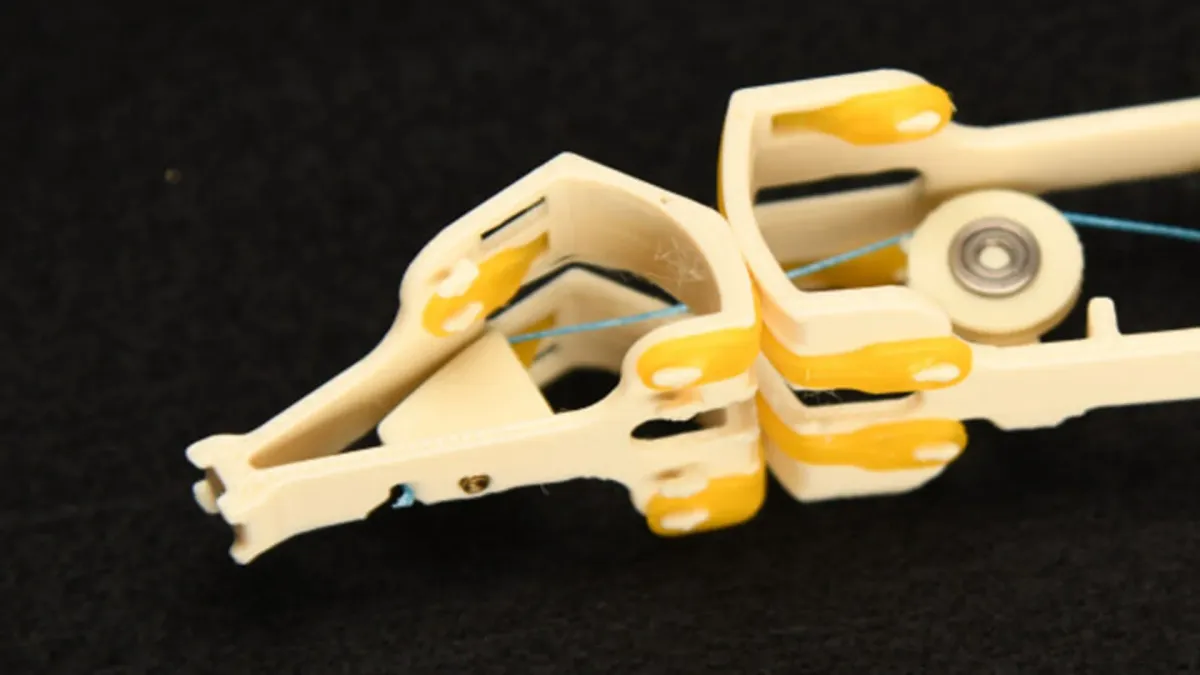
Engineers at Harvard have figured out how to build robotic joints that work more like human knees than mechanical hinges—and the results are striking. A gripper built with these new joints can hold three times more weight using the same motor power. A knee-like joint corrected its own misalignment by 99% without needing extra sensors or software fixes.
The breakthrough comes from rethinking how joints are shaped. Instead of using standard circular surfaces that roll against each other, the team designed irregular curved surfaces tailored to specific tasks. Think of it as embedding the solution into the joint itself rather than having a computer constantly adjust and compensate.
How it works
The method builds on rolling contact joints—pairs of curved surfaces that roll and slide against each other while held together with flexible connectors. The key innovation is optimizing the exact shape of each surface based on what the robot needs to do. A walking robot needs different joint geometry than a gripper. A jumping robot needs something else entirely.
We're a new kind of news feed.
Regular news is designed to drain you. We're a non-profit built to restore you. Every story we publish is scored for impact, progress, and hope.
Start Your News DetoxColter Decker, the Ph.D. student who led the work, describes it this way: "If you know what a robot needs to do, you can figure out the best places to push force. If we build those decisions into the mechanics, the robot becomes more efficient. It can use smaller motors because the energy goes exactly where it's needed."
This matters because most robots today rely on powerful actuators and clever software to compensate for inefficient mechanics. It's like asking a truck engine to do the work of a precision tool. The Harvard approach flips that: make the mechanics smart enough that the control system can focus on the actual task instead of constantly fighting physics.
The team tested their method on soft robotic grippers—the kind that need to wrap gently around fragile objects while still squeezing hard. By combining rigid links with flexible joints shaped for maximum force transmission, a two-finger gripper designed this way outperformed conventional designs built with circular joints and pulleys. Same motor input. Three times the grip strength.
Robert J. Wood, who oversaw the research, sees the broader implication: "We're trying to move as much motion control as possible into the robot's mechanics and materials, so the control system can focus on what the robot is actually trying to accomplish." It's an elegant shift—let the shape of the joint do the heavy thinking.
The approach opens doors across robotics. Exoskeletons could become lighter and more responsive. Prosthetic limbs could move more naturally. Humanoid robots could walk with less computational overhead. Even studying how animals move becomes easier when you can build joints that naturally follow biological patterns.
The work, published in the Proceedings of the National Academy of Sciences, represents a step toward robots that move less like machines and more like living things—not through software complexity, but through smarter mechanical design.