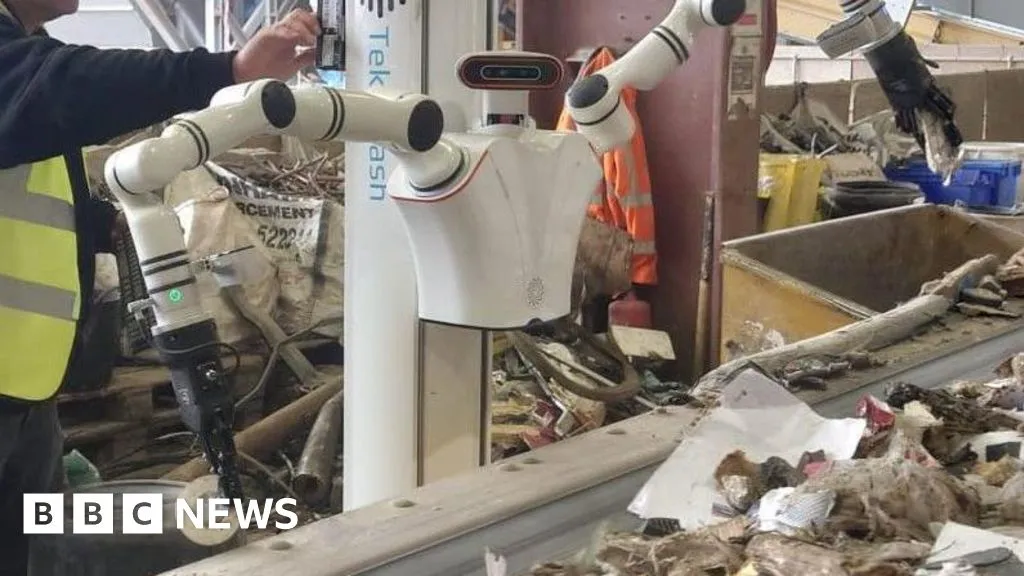
The recycling plant in Rainham, east London, is a challenging place to work. It's dusty and noisy, with a constant stream of hoppers and conveyor belts. Sharp Group, a family-run waste management firm, owns the facility.
Workers here sort through about 280,000 tonnes of mixed recycling each year. They handle everything from shoes to concrete blocks. This work is hazardous, with injury rates 45% higher than other industries and a much higher fatality rate than the national average. These tough conditions lead to a 40% staff turnover each year.
Ken Dordoy, a line supervisor, noted that the belt moves constantly, requiring non-stop picking. Workers are rotated every 20 minutes and the belt is stopped periodically for breaks.
We're a new kind of news feed.
Regular news is designed to drain you. We're a non-profit built to restore you. Every story we publish is scored for impact, progress, and hope.
Start Your News DetoxRobots Step In to Help
To address the high staff turnover, a robot named Alpha (Automated Litter Processing Humanoid Assistant) is being trained at the plant. Built by RealMan Robotics in China, Alpha is being adapted by British firm TeknTrash Robotics for real-world recycling.
While automated robots are not new to the sector, using a humanoid robot is unusual. Al Costa, CEO of TeknTrash, explained that Alpha's human-like movements allow it to fit into existing plants without needing major redesigns.
Alpha is currently in training. A plant worker wears a VR headset to record their movements, showing Alpha how to pick and sort successfully. The robot learns in two ways: first, by identifying items on the conveyor, and second, by practicing lifting them.
Costa emphasized that robots need extensive data to be effective. A system called HoloLab uses multiple cameras to feed data to Alpha, guiding its arms and reporting any missed items. Thousands of items passing by generate millions of data points daily.
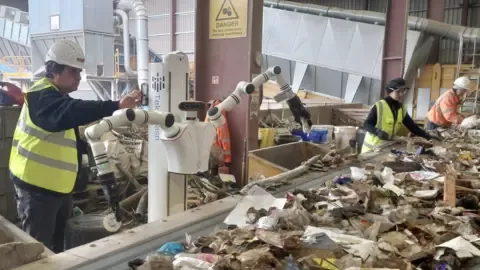
Chelsea Sharp, the plant finance director, highlighted the benefits of a humanoid robot. It can work 24/7 without needing holidays or sick days. This offers a solution to the challenges of human labor in such an environment.
Other Robotic Solutions
Another approach comes from Colorado-based AMP, which uses AI and air jets to sort items into chutes. CEO Tim Stuart noted that AMP's robots are much more efficient than humans, working eight to ten times faster. Their AI technology constantly improves the system's ability to identify and sort materials.
California-based Glacier, co-founded by Rebecca Hu-Thrams, also uses mounted robotic arms and AI. Hu-Thrams explained that the wide variety of trash, from leaky beer cans to firearms, poses a significant challenge. However, their AI models improve as they learn from billions of items. Glacier's technology is designed for both large urban plants and smaller, rural facilities with tighter budgets.

The Future of Waste Sorting
All three companies agree that the current human-intensive model is not sustainable. Academics studying waste processing believe that automation is not only inevitable but necessary. Professor Marian Chertow of Yale University stated that robotics combined with AI vision systems offers the best potential for improving material recovery, worker experience, and economic competitiveness in recycling.
Chelsea Sharp acknowledged the "unappealing" worker experience at the Rainham plant due to dust, noise, and heavy lifting. Robots are unaffected by these conditions. Sharp believes that as technology scales up, human workers will be upskilled to maintain and oversee the robots, moving them away from dangerous and unpleasant tasks.