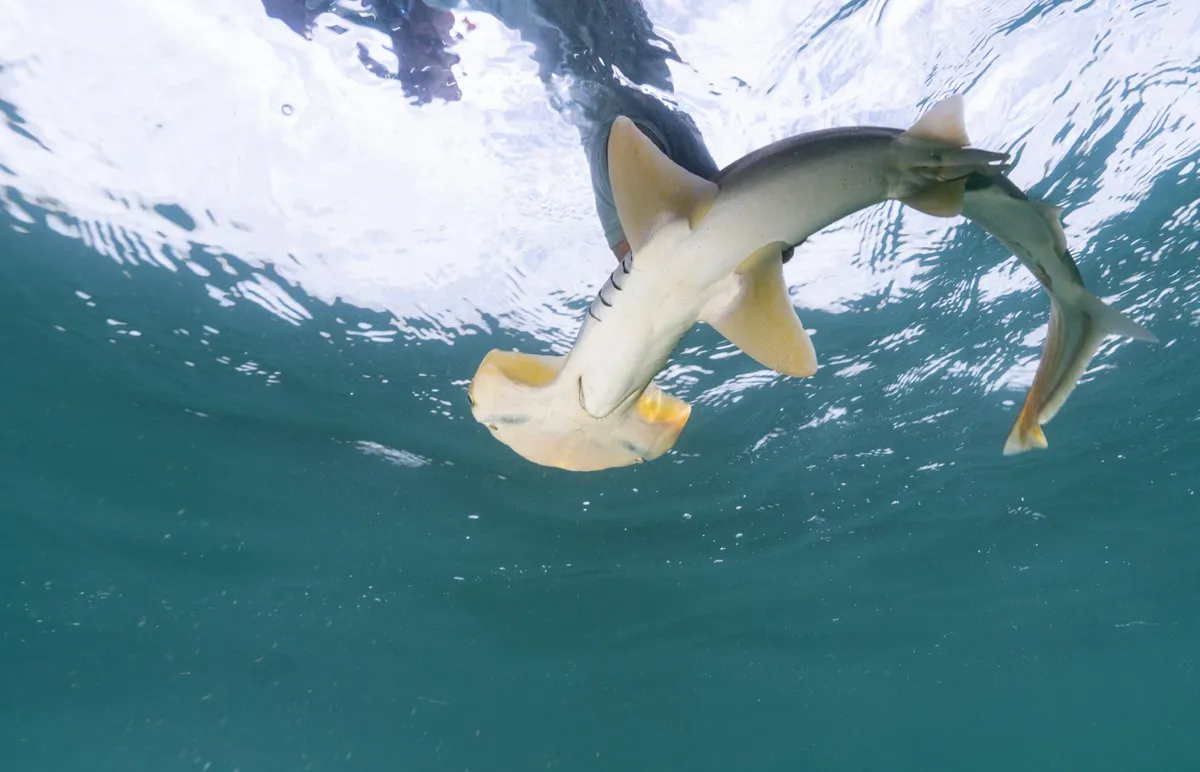
A marine biologist at Florida International University has cracked a problem that's stumped conservation efforts for years: how to find sharks that have become so rare, they're nearly impossible to locate. The answer turned out to be simpler than expected — just take a water sample.
Diego Cardeñosa developed an environmental DNA test that detects hammerhead sharks by analyzing genetic fragments they leave suspended in seawater. The method works without capturing, disturbing, or even observing the animals. It's like reading an invisible trail the sharks leave as they move through the ocean.
Three small hammerhead species — the scalloped bonnethead, scoophead, and Pacific bonnethead — have been hunted so heavily that they've nearly vanished. Their populations dropped so low that scientists struggled to study them at all, which meant conservation efforts were essentially flying blind. The scalloped bonnethead hasn't been documented in Mexico since 1994. The scoophead disappeared from Mexican waters in 2007. One species in Honduras went undetected for decades before being rediscovered.
We're a new kind of news feed.
Regular news is designed to drain you. We're a non-profit built to restore you. Every story we publish is scored for impact, progress, and hope.
Start Your News Detox"That's how hard it is to find them," Cardeñosa said. "It's on us if we want to act to protect them or if we just let them slip away."
A New Way to Locate the Last Survivors
These hammerheads now survive mainly in shallow, isolated coastal areas where scientific surveys rarely happen and fishing oversight is minimal. One refuge is Colombia's Uramba/Bahía Málaga National Natural Park, where Cardeñosa tested his method. The waters there are so rich with these sharks that you can catch one or two within minutes — a reminder of how abundant they once were before overfishing decimated their numbers.
By screening water samples from different locations along their range from Mexico to Northern Peru, researchers can now identify where these sharks still exist and where conservation resources would have the most impact. This matters not just for the sharks themselves, but for what they represent. "A lot of these are some of the most derived or newest shark species on the evolutionary scale," Cardeñosa explained. "If they disappear, we're also losing a piece of our planet's evolutionary history."
The technique offers another advantage: water samples and their extracted DNA can be stored in laboratories for years, allowing future researchers to investigate not just hammerheads but other species that may have passed through the same waters. The research, published in Frontiers in Marine Science, suggests that eDNA technology could become a standard tool for tracking elusive species across vast geographic ranges — a shift that could reshape how conservation priorities get decided.
For Cardeñosa, the stakes are clear. "It's fascinating that you can take a simple water sample and know whether a species was there or not." Now comes the harder part: using that knowledge to actually protect them.