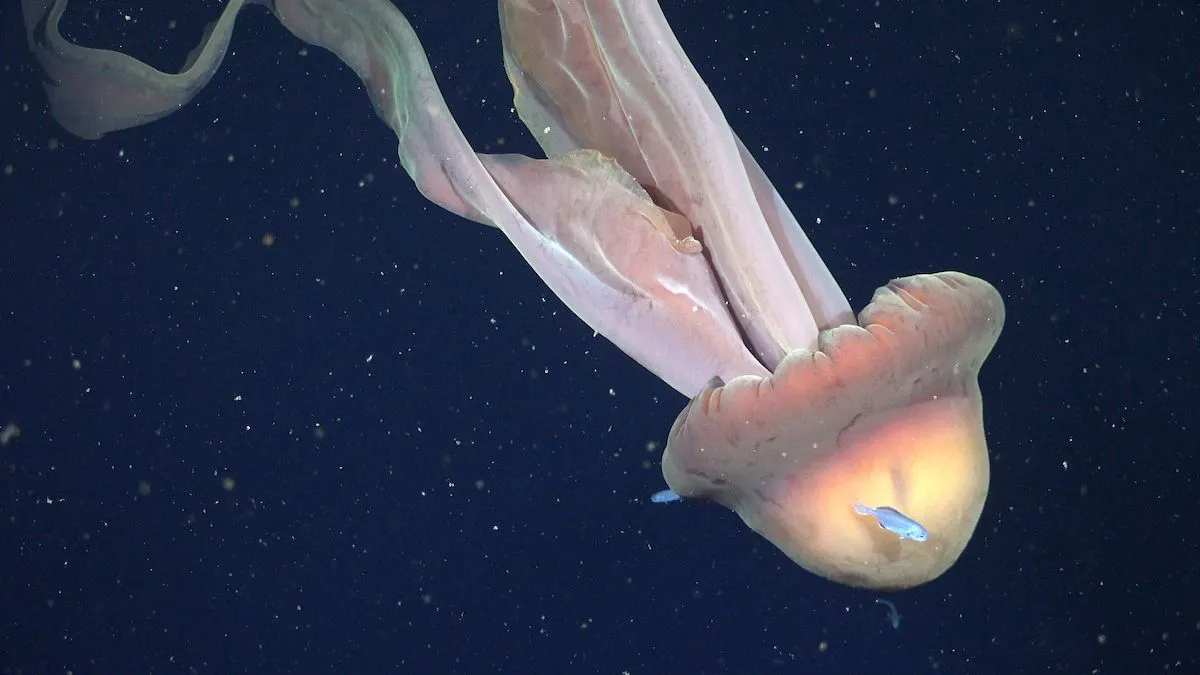
A jellyfish the size of a school bus drifted through the Atlantic darkness off Argentina last year, and a team of marine scientists got to witness it. The giant phantom jelly—a creature so elusive that it's been spotted only about 120 times since 1899—moved through waters 820 feet below the surface with what María Emilia Bravo, the expedition's chief scientist, described as an "ethereal and delicate presence."
"There was a mixture of excitement and disbelief," Bravo, a marine biologist at the University of Buenos Aires, recalls. These animals prefer the ocean's "midnight zone," a pitch-black region between 3,300 and 13,100 feet deep, which is why they remain so mysterious. Giant phantom jellies can stretch to 33 feet long with bells wider than 3 feet across—yet until recently, no one had ever seen one alive in its natural habitat.
The sighting came during an expedition operated by the Schmidt Ocean Institute that used a remotely operated vehicle called SuBastian to map Argentina's entire coast. Unlike stinging jellyfish, giant phantom jellies hunt with ribbon-like arms that grab plankton and small fish and pull them toward their mouths. The creatures drift through the deep ocean almost undetected, which makes encounters like this one genuinely rare.
We're a new kind of news feed.
Regular news is designed to drain you. We're a non-profit built to restore you. Every story we publish is scored for impact, progress, and hope.
Start Your News DetoxA Window Into Hidden Biodiversity
But the giant jelly was just one discovery. The expedition's main goal was to locate cold seeps—places on the ocean floor where methane and hydrogen sulfide escape through cracks, fueling entire microbial communities that form the base of deep-sea food webs. The team found one active seep covering just under half a square mile.
What surprised them most was the sheer abundance of life. They documented the largest known Bathelia candida coral reef, spanning 0.15 square miles—nearly the size of Vatican City—and found it 370 miles farther south than its previously known range. They spotted a whale carcass at 12,800 feet below the surface, Argentina's first recorded deep-water whale fall. These carcasses become temporary ecosystems, feeding and sheltering deep-sea animals for years.
The researchers identified 28 potential new species: worms, sea urchins, corals, sea snails, and anemones. "We were not expecting to see this level of biodiversity in the Argentine deep sea," Bravo says. "Seeing all the biodiversity, ecosystem functions and connectivity unfolding together was incredible. We opened a window into our country's biodiversity only to find there are so many more windows left to be opened."
Each expedition into the deep ocean reveals how much remains unknown about life on this planet. The phantom jelly, drifting through the darkness, is a reminder that we're still discovering neighbors we never knew we had.