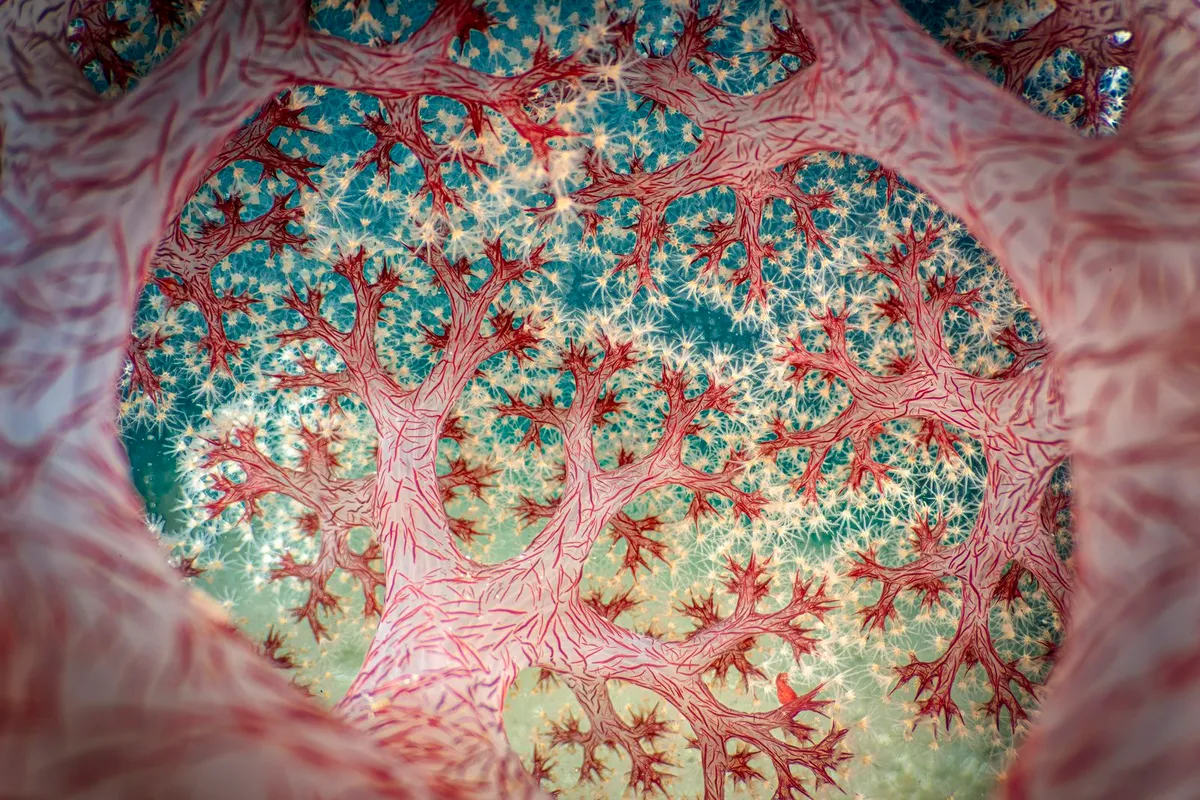
A cauliflower coral photographed from the inside looks like a forest of pink trees. A cluster of tadpoles suspended in gel resembles a galaxy. A mushroom's underside—the delicate gills that release spores—becomes abstract architecture.
This is what happens when 12,000 photographers from 63 countries point their lenses at the small, the overlooked, the invisible-to-the-naked-eye. The seventh annual Close-up Photographer of the Year awards drew entries so compelling that a 22-person panel of judges spent 20 hours selecting winners across 11 categories. The grand prize winner—Ross Gudgeon's "Fractal Forest," the coral image—takes home about $3,400.
"This was the toughest competition yet," says Tracy Calder, the competition's co-founder. "The winning image shows us a perspective we've never seen before and reveals hidden beauty in a familiar subject."
We're a new kind of news feed.
Regular news is designed to drain you. We're a non-profit built to restore you. Every story we publish is scored for impact, progress, and hope.
Start Your News DetoxWhat these images reveal
Beyond their visual beauty, many of these photographs document something urgent. The cauliflower soft coral that Gudgeon photographed in Indonesia's Lembeh Strait has lost more than 90 percent of its population since 2011. In Hungary, photographer Imre Potyó captured endangered Danube mayflies swarming toward city lights during a summer festival—a comeback story complicated by the fact that billions of the insects perish when attracted to artificial light, their eggs drying out on asphalt.
Yet the competition also captures resilience and quiet wonder. Filippo Carugati spent six months in Madagascar's Maromizaha rainforest documenting Malagasy frogs for his doctoral thesis. When he photographed their egg clutches—thousands of tadpoles suspended in gelatinous substance—he saw something cosmic. Using backlighting, he transformed the mundane into the celestial.
A Camberwell beauty butterfly in Norway defended its feeding ground by flashing its wings at competing insects—a behavior most of us will never witness unless someone zooms in close enough to show us. A lynx spider in Hong Kong caught termites mid-swarm during a rainstorm, its meal captured mid-struggle. A silkworm moth in Costa Rica, with its oversized eyes and fuzzy antennae, looked back at the camera with what photographer Laurent Hesemans calls "a somewhat melancholy feeling."
Minghui Yuan found decay and renewal in the same frame: lotus leaves skeletal and dark, floating ferns bright green and thriving in the same water. "Finding it here amongst these skeletal leaves felt like the rebirth of hope," Yuan said.
The eighth CUPOTY awards open for submissions in May. For anyone who's ever wondered what a tadpole's first home looks like, or why a mushroom's underside matters, the answer is now visible—if you're willing to look closer.