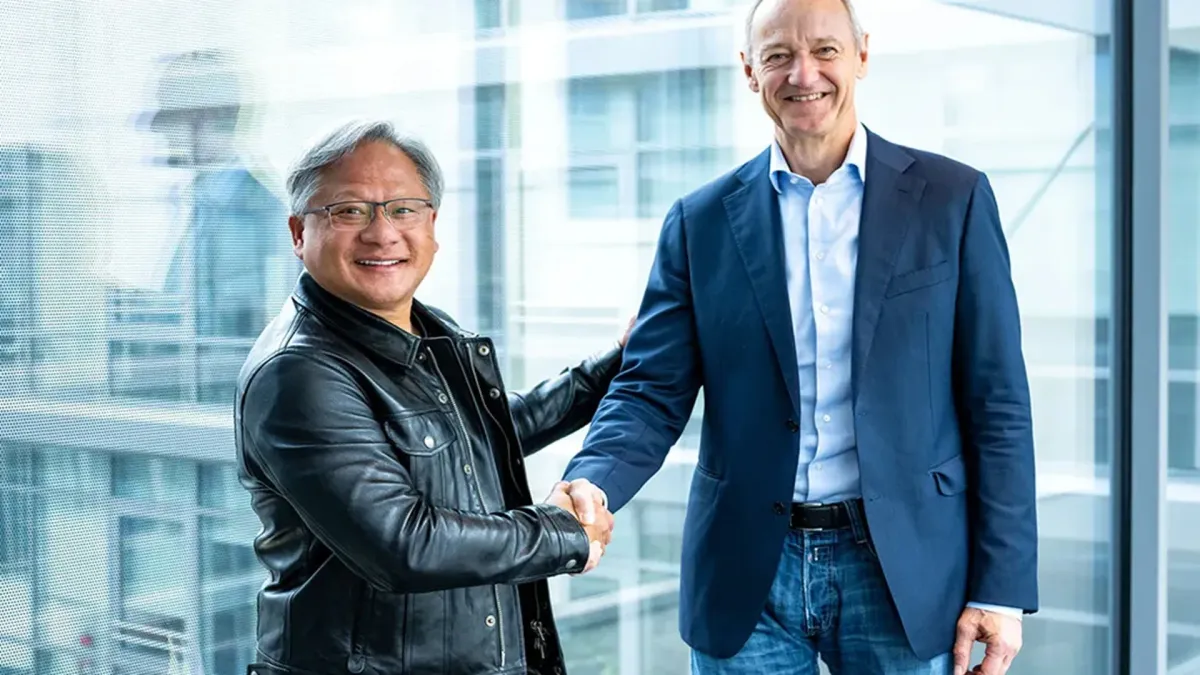
In 2026, a factory in Erlangen, Germany will do something factories have never done before: run itself smarter tomorrow than it did today. Siemens and NVIDIA are building what they're calling an "Industrial AI Operating System" — a platform that embeds artificial intelligence across the entire lifecycle of manufacturing, from the moment a product is sketched to the moment it ships.
The partnership is ambitious because it's not just bolting AI onto existing systems. Instead, it's redesigning how factories think. At the core is the idea of the digital twin — a virtual replica of a physical factory that can be tested, tweaked, and optimized before any real change happens on the shop floor. Powered by NVIDIA's computing infrastructure and Siemens' industrial software, these digital twins become what the companies call an "AI Brain" — a system that continuously watches its own performance and suggests improvements.
This matters because manufacturing is expensive and risky. A single miscalibration can waste materials, halt production, or create safety issues. By testing changes virtually first, factories can move faster and fail cheaper. The simulation tools are getting dramatically faster too. Siemens is accelerating its entire portfolio of design and simulation software using NVIDIA's GPU technology, which means engineers can run simulations that used to take hours in minutes, and test far more complex scenarios than before.
We're a new kind of news feed.
Regular news is designed to drain you. We're a non-profit built to restore you. Every story we publish is scored for impact, progress, and hope.
Start Your News DetoxFactories That Think
The real shift is toward what the companies call "autonomous digital twins" — systems that don't just simulate what might happen, but actively optimize what should happen next. Imagine a factory floor that spots a bottleneck in real time, models three different fixes, runs them through simulation, and recommends the best one — all before a human supervisor notices the slowdown. That's the direction this is heading.
Siemens and NVIDIA aren't starting in a vacuum. Customers like Foxconn, Hyundai, KION Group, and PepsiCo are already evaluating the technology. The companies plan to deploy these systems in their own operations first — using themselves as proof points — before scaling across industries. There's also a practical layer: AI-powered "copilots" for design and manufacturing, and even integration with Meta Ray-Ban smart glasses so workers on the shop floor get real-time guidance and safety alerts without stopping to check a screen.
The partnership extends into the semiconductors themselves. Siemens is integrating NVIDIA's acceleration libraries into its electronic design tools, targeting 2x to 10x speed-ups in critical workflows. That means the tools that design the chips that power the AI that runs the factories are all getting faster in lockstep.
What's significant here isn't the partnership itself — it's the scale and specificity. This isn't a vague commitment to "explore AI." It's two industrial giants with decades of manufacturing expertise saying: we're building the blueprint for the next generation of factories, and we're starting in 2026. The first fully AI-driven, adaptive manufacturing site is coming to Erlangen. After that, the question isn't whether factories will adopt this approach, but how quickly.