A UC Berkeley PhD candidate watched coffee dry on a table and saw the future of medical testing.
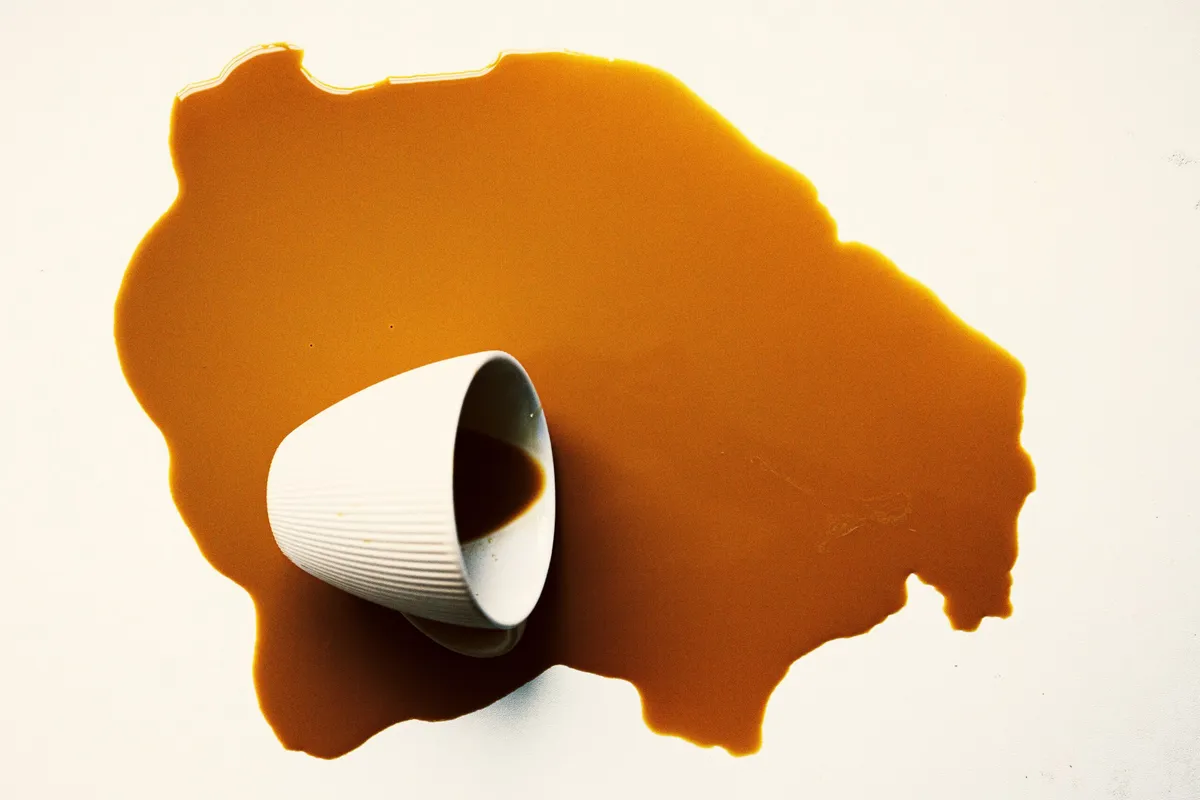
When liquid evaporates, particles don't spread evenly — they migrate toward the edges, leaving that familiar dark ring around the cup. Kamyar Behrouzi realized this "coffee-ring effect" could solve a real problem in diagnostics: how to concentrate disease markers enough to detect them quickly and reliably.
His team developed a test that works almost like reversing that coffee stain. A patient swab gets applied to a special membrane. As the liquid dries, particles naturally gather into a concentrated ring. Then comes the key step: researchers add a solution containing plasmonic nanoparticles — tiny particles that interact with light in specific ways. If disease biomarkers are present in the sample, the nanoparticles bind to them, creating visible patterns that change how light moves through the membrane.
We're a new kind of news feed.
Regular news is designed to drain you. We're a non-profit built to restore you. Every story we publish is scored for impact, progress, and hope.
Start Your News DetoxThe result is a readout in as little as 12 minutes. Early testing shows it's far more accurate than existing rapid COVID tests, which often struggle with false negatives. The same principle scales. Researchers have already shown it can detect sepsis, influenza, and certain cancer markers — diseases where speed matters as much as accuracy.
What makes this work is pure physics meeting practical need. The coffee-ring effect isn't new to science, but applying it to disease detection at this scale and speed is. It's the kind of insight that only comes from asking "what if" about everyday observations, then having the engineering chops to build something real from the answer.
The test doesn't require expensive lab equipment or trained technicians. A pharmacy, clinic, or even a home could theoretically run it. That matters most in places where access to rapid diagnostics is the bottleneck — rural areas, low-resource settings, or the next pandemic's early weeks before supply chains catch up.
Behrouzi's work is moving toward real-world deployment. The next phase involves scaling production and running larger validation studies. If those go as expected, this could become one of those technologies that feels obvious in hindsight: of course we can use the physics of drying liquid to make better tests. Why didn't we think of this sooner.