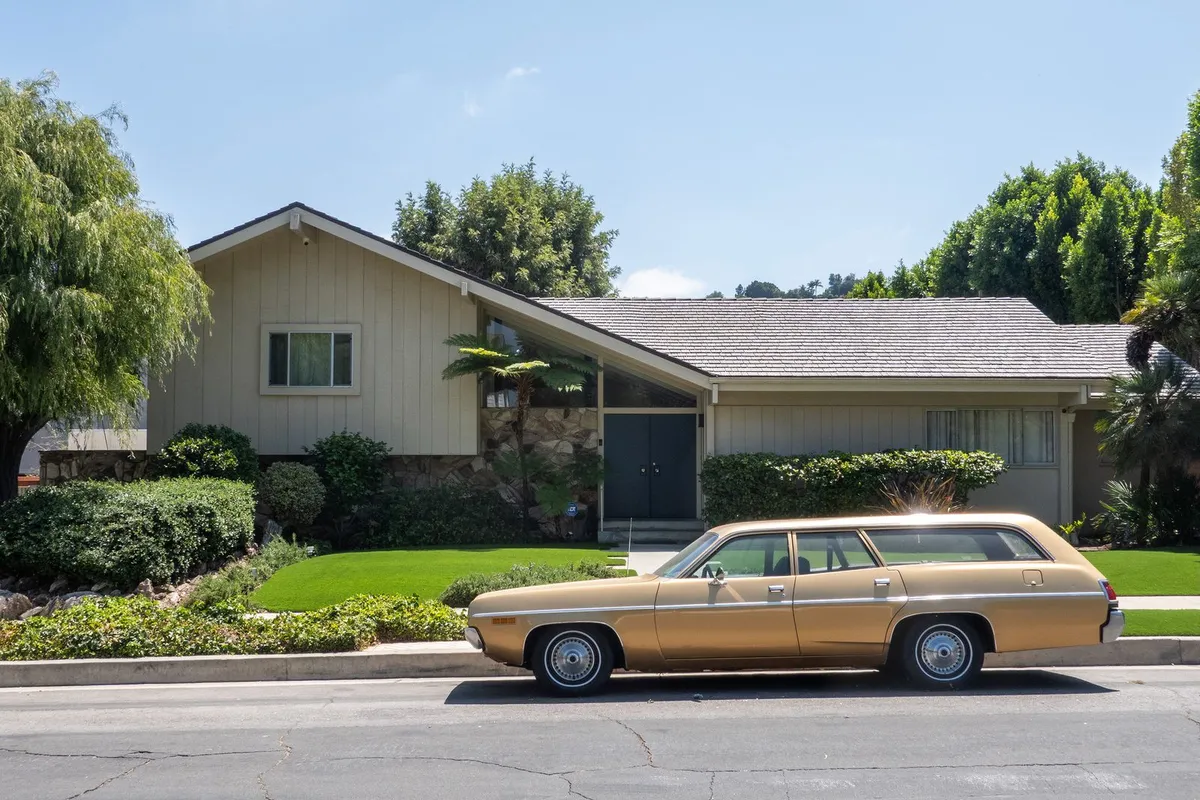
A tan-sided mid-century home on Dilling Street in Studio City has just joined Los Angeles's official list of Historic-Cultural Monuments. The L.A. City Council voted unanimously on March 4 to protect the exterior that millions of viewers recognized as the Brady family residence from 1969 to 1974.
The house itself predates the show by a decade. Architect Harry M. Londelius designed it in 1959, a straightforward example of mid-century residential design. When "The Brady Bunch" premiered in 1969, the show's creators needed an exterior that felt like an ordinary American home—which is exactly what they found. The pilot episode used a different house, but starting with episode two, the Dilling Street location became the visual anchor for the series. Inside, though, everything was filmed on soundstages. The actual interior bore no resemblance to what viewers saw on screen.
That gap between exterior and interior reality lasted for decades—until 2018, when HGTV bought the house for $3.5 million and decided to make it whole. The network's four-part miniseries "A Very Brady Renovation" documented the transformation: the original interior was demolished, and the home was rebuilt to match the TV set designs, down to the furnishings and color schemes. By the time the project finished, stepping inside meant stepping into the fictional Brady home.
We're a new kind of news feed.
Regular news is designed to drain you. We're a non-profit built to restore you. Every story we publish is scored for impact, progress, and hope.
Start Your News DetoxWhen HGTV sold the house in 2023 to Tina Trahan and her husband Chris Elbrecht (former CEO of HBO) for $3.2 million, Trahan inherited something unexpected: a house where nothing actually worked. The decorative appliances—the stove, oven, range—were props, not functioning kitchen equipment. She discovered this only after purchase, but it didn't diminish her vision. Trahan opened the home for limited tours at $275 per visit and simultaneously filed for historic landmark status.
What This Preservation Means
The landmark designation protects more than nostalgia. City planners noted that the house represents a specific cultural moment: the late 1960s and early 1970s vision of the American blended family. At a time when divorce rates were rising and family structures were shifting, "The Brady Bunch" offered a template for how step-siblings could become genuine siblings, how a blended household could feel like home. The house—even just its exterior—became the visual shorthand for that possibility.
Vince Bertoni, L.A.'s planning director, framed the designation as preservation of "the iconic aesthetic of 1970s California living." That's partly true, but it's also something subtler: the city is protecting a location where popular culture shaped how ordinary people imagined their own families could be.
The house remains open for tours, and its new status as an official landmark means the exterior will be protected from demolition or significant alteration. For a property that spent years as a studio set, then decades as a private home, then briefly as a TV renovation project, and is now a pilgrimage site, the designation feels like an acknowledgment that some places matter not because of what they are, but because of what millions of people believed they represented.