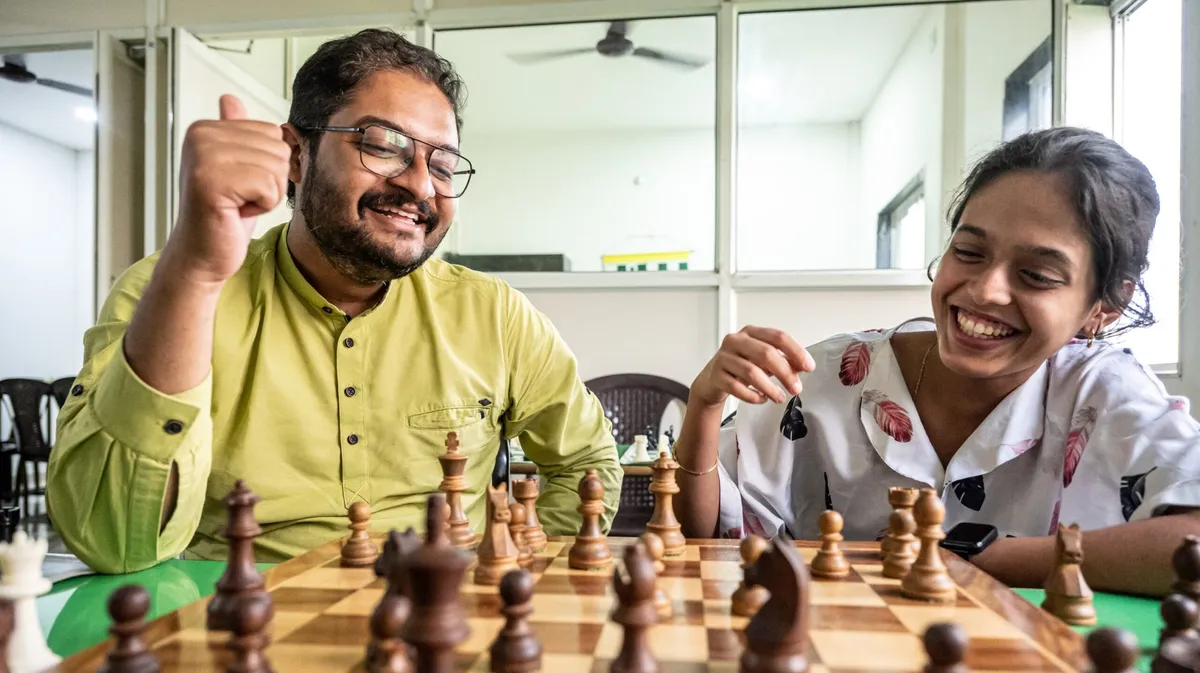
It's 9 a.m. on a Sunday in Chennai, and hundreds of children are streaming toward Marina Beach carrying water bottles and chessboards instead of towels. They're heading to a nearby college for one of hundreds of tournaments that happen almost daily in what may be the world's most chess-obsessed country.
India's relationship with chess rivals the United States' passion for basketball or England's devotion to Premier League football. But what started as elite competition has become something larger: a pathway out of poverty, a tool for academic transformation, and a way to rebuild entire communities.
From Five Grandmasters to Ninety
The numbers tell the story of a country that has decided chess matters. In 2000, India had five grandmasters. Today it has around 90, with over 30,000 players rated by the International Chess Federation. The country's top 10 male players average a rating of 2,714—competitive with the world's very best.
We're a new kind of news feed.
Regular news is designed to drain you. We're a non-profit built to restore you. Every story we publish is scored for impact, progress, and hope.
Start Your News DetoxThis explosion started with Viswanathan Anand, who became India's first grandmaster in 1988 and went on to win the world championship five times. His success opened a door. Then came Gukesh Dommaraju, who claimed the world title at 18 in 2024, and Praggnanandhaa Rameshbabu, who defeated Magnus Carlsen at the same age that same year. In 2025, Vaishali Rameshbabu won the FIDE Women's Grand Swiss for the second time. These aren't isolated talents—they're part of a wave.
Chess as an Escape Route
But the real transformation is happening beyond the elite academies. In Pune, Kapil Lohana grew up on a cotton farm in a drought-prone region where farmer suicides were common. Chess got him out. Now he runs the Victorious Chess Academy, offering discounts to talented kids who can't afford tuition. One of his students, 12-year-old Om Ramgude, is already working toward the grandmaster title.
In the remote Kerala village of Marottichal, something even more striking happened. In the 1970s and 80s, the community was known for illicit alcohol production and gambling—the kind of place where futures looked predetermined. Then a former Maoist rebel named Charaliyil Unnikrishnan introduced chess as an alternative. Over 75% of the village's population now actively plays. Addiction rates dropped. School dropouts fell. The game gave people something to focus on, a reason to think several moves ahead.
The Quieter Victories
Research has shown that chess training significantly boosts math and science scores in rural Indian schoolchildren. The game teaches strategy, adaptation, and decision-making under pressure—skills that transfer to classrooms and beyond.
Rajesh Oza is a blind chess coach who credits the game with pulling him out of depression after losing his sight at 15. He now teaches students to visualize the board in their minds, the way he does. In Chennai, Krithika has spent years teaching chess to students with mental and physical disabilities, watching them develop confidence and clarity through competition.
These aren't feel-good sidelines to India's chess story. They're the core of it. As the country continues producing world champions, chess is quietly reshaping what's possible for communities that were told their options were limited. A game invented centuries ago is becoming a tool for reinvention.