From Silence to Sound
During a concert in 2009, something shifted. Satoshi Yamaguchi, drummer for the Japanese rock band RADWIMPS, lost his place mid-song—a bridge he'd played hundreds of times suddenly felt foreign. "The sound stopped suddenly," he recalled years later. "My brain really drew a blank."
It would take five years to understand why. Yamaguchi had musician's dystonia, a neurological condition that causes involuntary muscle spasms. The diagnosis arrived like a verdict: roughly 1 percent of professional musicians experience this, and for Yamaguchi, it meant stepping away from the band he'd co-founded in 2003. At 28, his identity as a performer seemed finished.
But loss, it turned out, could redirect him toward something unexpected.
The Research
In 2021, Yamaguchi arrived at Keio University as a visiting researcher and met Shinya Fujii, a drummer-turned-neuroscientist at the NeuroMusicLab. Together, they began investigating the condition that had silenced him. Their 2024 paper documented something precise: when Yamaguchi's symptoms appeared, he fell measurably out of sync with a metronome—subtle to an audience, but scientifically undeniable.
We're a new kind of news feed.
Regular news is designed to drain you. We're a non-profit built to restore you. Every story we publish is scored for impact, progress, and hope.
Start Your News DetoxFor Yamaguchi, the validation mattered. "When I was still active in the band, I had no way to share the struggle with people around me," he told an audience at Smith Campus Center. "But through science, I was finally able to reveal the true nature of that ghost."
He expanded the inquiry into a large-scale survey of Japanese musicians, both professional and amateur. The results revealed that dystonia strikes professionals more frequently, with the right lower limbs most affected. The research also surfaced something unexpected: a potential link to in-ear metronomes, those click tracks that modern live performance has made standard. These devices deliver rhythm directly to the eardrum with absolute precision—but perhaps that exactitude comes at a neurological cost.
Finding Sound Again
In 2023, Yamaguchi moved to Stanford University's Center for Computer Research in Music and Acoustics. There, he discovered taiko drumming, the traditional Japanese percussion art taught through oral transmission rather than sheet music. The whole-body approach sparked a question: what if his voice could become his instrument?
Working with Yamaha, he developed VXD—a bass-drum interface controlled by vocal cues and a throat sensor. The system translates the human voice into percussion sound, giving him a way back to live performance.
In 2024, nearly a decade after leaving RADWIMPS, Yamaguchi performed publicly with the voice-activated kit for the first time. "My children had only ever seen me play the drums on the screen," he said, showing a photo of his family. "This was the first time they heard me perform live."
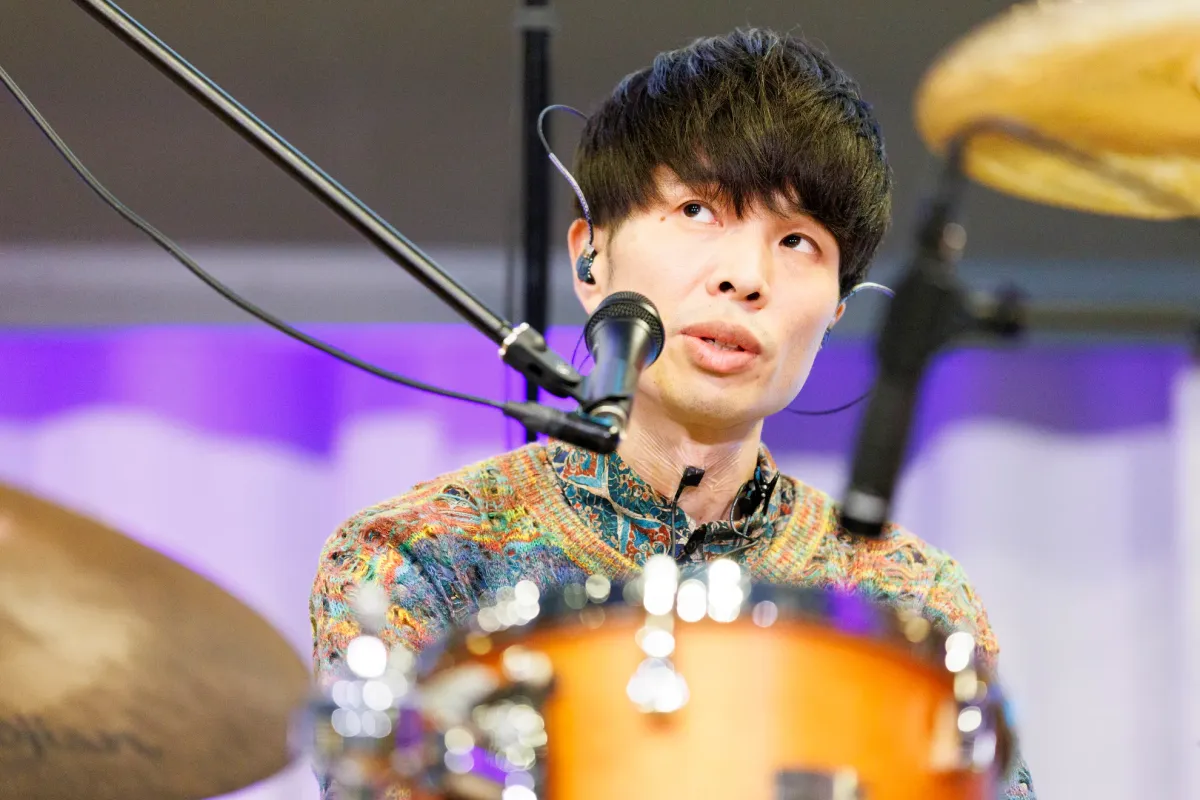
At a recent Harvard event, he demonstrated VXD by performing RADWIMPS songs, including "Sparkle" from the 2016 anime film "Your Name." As he pursed his lips into the microphone, repeating the "don" syllable that triggers the bass drum, his body lifted with the beat—his right foot anchoring, the rest of him freed.
"Music has given me life," Yamaguchi said. "Music has also caused me pain. I lost it once, and then I found my way back to it—and it saved me."
His next chapter isn't about returning to what was. It's about discovering what becomes possible when you're forced to listen differently.