Harvard's libraries don't just hold books — they hold experiments in how humans understand the world. A 1619 medical textbook with ornate anatomical drawings. A 2003 cardboard memorial to the Twin Towers. Landscape designs that let 18th-century homeowners preview changes before a single tree was moved. These objects sit quietly on shelves, but each one represents someone solving a problem: how do you show something that doesn't exist yet? How do you make knowledge accessible to people who can't see? How do you preserve a moment?
Objects That Teach
Johann Remmelin's "Catoptrum Microcosmicum" (Mirror of the Microcosm), published in 1619, was designed for people encountering the human body for the first time — whether curious laypeople or medical students. The ornate drawings weren't decoration. They were the point. Before photography, before digital imaging, an artist's hand was the fastest way to show what was inside.
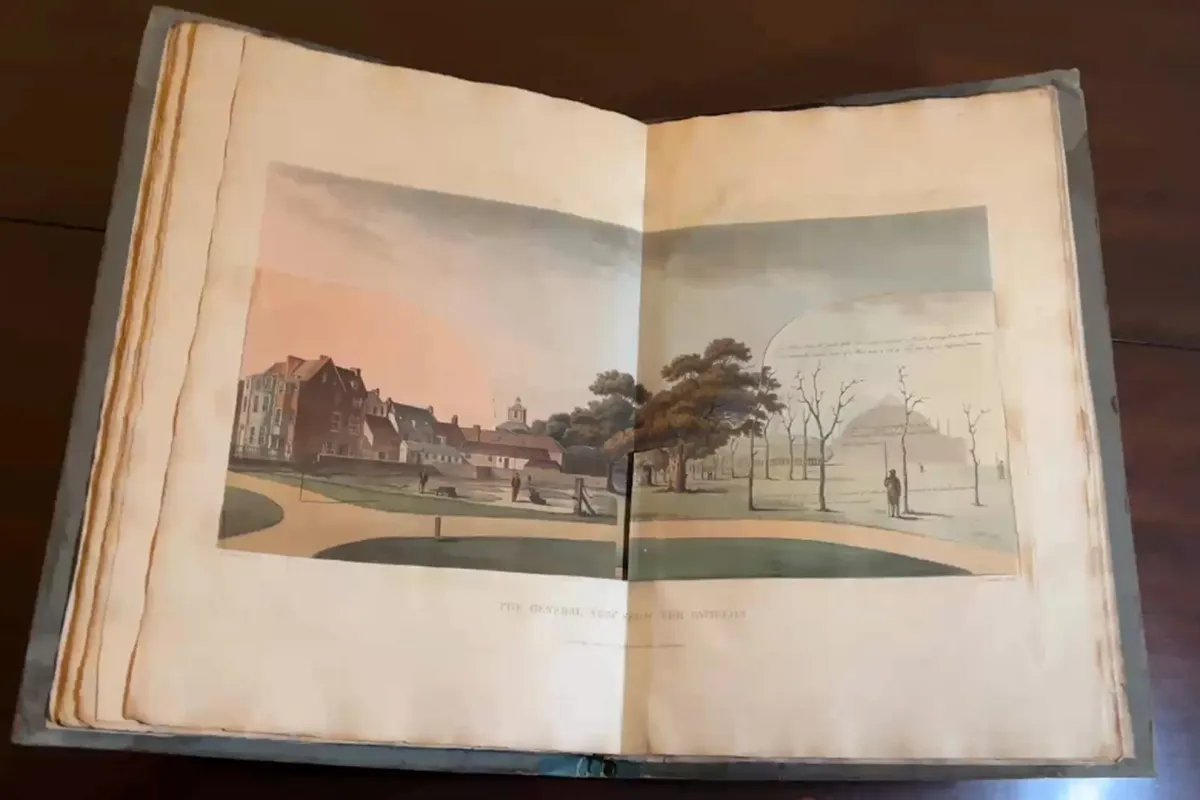
A century later, English landscape designer Humphrey Repton faced a different problem: how do you convince a wealthy homeowner to trust your vision for their estate? He created over 400 books featuring layered images — the landscape as it was, then the landscape as it could be. Flip the page, and the Prince of Wales could see his Brighton estate transformed. John Taylor could walk through his Mosely Hall proposal before hiring Repton. These weren't portfolios. They were previews.
We're a new kind of news feed.
Regular news is designed to drain you. We're a non-profit built to restore you. Every story we publish is scored for impact, progress, and hope.
Start Your News DetoxThe Victorian era brought another innovation: stereoscopic views. Brothers Charles and Edward Bierstadt photographed New Hampshire's White Mountains from two slightly different angles. When viewed together through a special lens, the images created an almost 3D effect. Travelers who couldn't afford the journey could experience the landscape from their living room. It was virtual reality for the 1800s.
Access Before Technology
Before braille, before digital screens, people were already asking: how do we make knowledge accessible? John Alston, director of Glasgow Asylum for the Blind, invented a system of raised Roman letters in 1838. William Moon, who lost his sight later in life, created an alphabet in 1847 loosely based on Roman characters but with divergent symbols for different sounds. Harvard's collection includes "The Glasgow Cathedral," printed around 1840 in Alston type with an embossed image of the cathedral itself. These weren't perfect solutions, but they were attempts — proof that accessibility was a design problem worth solving.
Memory and Transformation
Architect Jeannie Meejin Yoon's 2003 book "Absence" works differently. Each of its 120 cardboard pages represents a story of the Twin Towers, including the antenna mast. It's a memorial that fits in your hands.
More recently, architects Michael Meredith and Hilary Sample created "Everything is in the Process of Becoming Something Else" for the 2025 Venice Biennale. The book is actually 12 separate volumes — 11 pop-up books showing unrealized designs by architect James Stirling from the late 1980s, plus one volume of explanatory text and drawings. The designs were never built. But by preserving them as pop-ups, Meredith and Sample turned architectural failure into something tactile, something you can hold and manipulate. "Architecture is a performance of constant transformation, always becoming something else," they write.
Each of these books solved a real problem for its moment: how to teach anatomy without a corpse, how to preview a landscape without construction, how to see without sight, how to remember what's gone. They're reminders that design thinking isn't new — it's just the latest chapter in a very long story about humans trying to show each other what we can't yet see.