Maren Hassinger has spent decades making art that reminds us we're all, you know, people. And that we share a planet. Which, if you think about it, is a pretty solid foundation for getting along. Her work, now on glorious display in Berkeley, takes the everyday — industrial cables, pink plastic bags, even trash — and transforms it into something that makes you stop and actually feel something.
Born in 1947 in Los Angeles, Hassinger burst onto the scene in the 1970s, a key figure in Black conceptual art. She’d take industrial steel cables, unbraid them, and then shape them into things like rain or grass. Because what’s more human than finding the organic in the utterly industrial? Margot Norton, chief curator at the Berkeley Art Museum and Pacific Film Archive (BAMPFA), calls it "inspiring" how Hassinger turns "simple materials into something monumental yet intimate." Which, frankly, sounds like a magic trick.
Hassinger hasn't just been making pretty things; she's also been shaping minds. She spent two decades running the Rinehart School of Sculpture, guiding young artists. Her pieces live in the permanent collections of heavy hitters like the Museum of Modern Art and the Guggenheim. So, yeah, she's kind of a big deal.
We're a new kind of news feed.
Regular news is designed to drain you. We're a non-profit built to restore you. Every story we publish is scored for impact, progress, and hope.
Start Your News DetoxA Five-Decade Journey, Reimagined
Norton, a long-time admirer, teamed up with BAMPFA senior curator Anthony Graham to create Maren Hassinger: Living Moving Growing. This isn't just a "walk through time" kind of show. It’s a carefully curated journey through Hassinger's five-decade career, from those early wire-rope pieces to her latest community installations. Think landscapes made from hand-twisted newsprint and, yes, pink plastic bags filled with people's actual breath.
The curators dove deep for three years, unearthing 50 years of performance records, commissioning a 344-page catalog (for the serious art nerds), and even recreating her early, temporary installations. Because some art, like a good joke, is fleeting.
The exhibition, which is the largest show of Hassinger's art to date, is open now at BAMPFA and even spills over into the UC Botanical Garden. Instead of a strict timeline, the curators organized the show by themes: nature, community, equality, and the interconnectedness of all living things. Norton believes each artwork is alive, and her job was simply to let them "sing."
In one room, you'll find "Birthright," a video exploring Hassinger's family history and the echoes of slavery. Across from it? "Love," that installation of pink plastic bags, each holding a breath and a note saying, well, "love." Norton imagines these two pieces having a quiet, profound conversation.
Hassinger's genius is in using everyday, often industrial materials to tell these massive, human stories. And she invites everyone to join in. For "Pink Trash," she's working with Berkeley students in September to collect garbage, paint it pink, and spread it on Crescent Lawn. A rather pointed way to highlight human waste, don't you think? Another project, "Wrenching News," invites the community to twist newsprint into an evolving installation. Because if you can't make sense of the news, you might as well make art out of it.
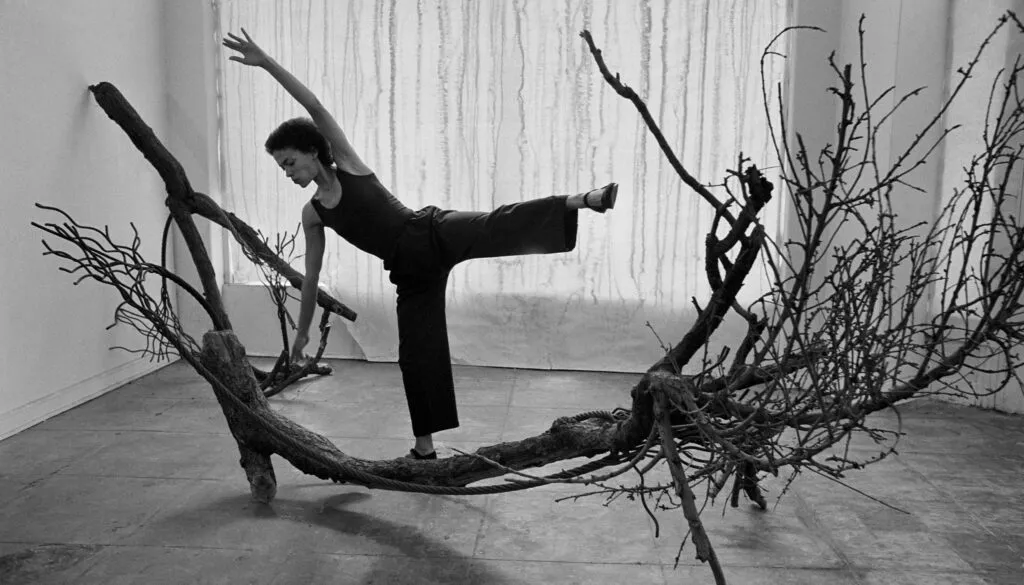
She also brings nature into the museum. With the UC Botanical Garden, curators used branches from a felled cherry tree to recreate her late-1970s sculptures like "Pas de Deux." It’s a beautiful, slightly unsettling mix of organic branches and industrial wire rope, showing how effortlessly one adapts to the other.
The exhibition also stretches into the UC Botanical Garden itself, where "Monument (Pyramid)," a 10-foot-tall public sculpture, stands proudly. Made entirely from fallen redwood branches, it took a week for Garden and BAMPFA staff and volunteers to weave it together. This massive piece offers a view of San Francisco's Golden Gate Bridge. Two "monuments," one natural, one industrial, both sculpted by human hands, looking at each other.
Norton hopes the exhibition sparks a vibrant conversation between our natural and industrial worlds, and between people and art. By inviting us to interact with her work, Hassinger encourages us to reflect on our rather temporary place in this grand, messy environment. And to celebrate the potential within our brief existence.
Living Moving Growing is on display through November. Go see it. And then tell someone about it.