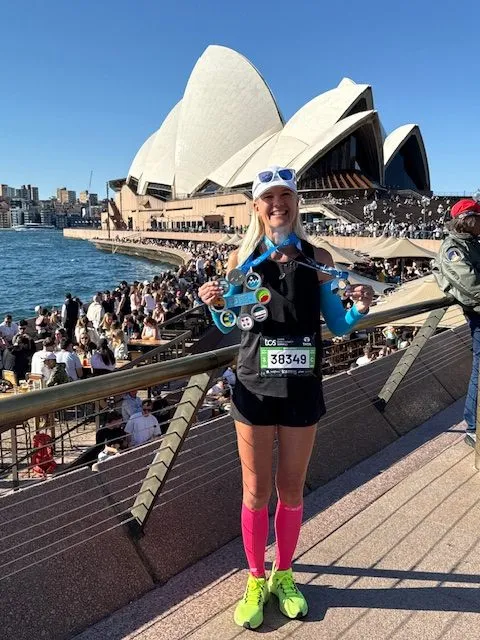
AnneMette Bontaites went to New York to run one marathon. She thought it would be a box checked, a story to tell, then back to her normal life in Boston.
It didn't work out that way.
The whole thing started as a joke with her best friend. Bontaites, who moved to Boston from Denmark, had run two half marathons and casually said, "Well, two halves make a whole—I've basically done a marathon." Her friend, also a runner, called her bluff. The deal: her friend would fly from Copenhagen to New York, and they'd run Bontaites's first full marathon together.
By mile 18, they'd already made their next plan. They were going to run Copenhagen together, too.
We're a new kind of news feed.
Regular news is designed to drain you. We're a non-profit built to restore you. Every story we publish is scored for impact, progress, and hope.
Start Your News DetoxThe List Kept Growing
Then Copenhagen led to Paris. Paris led to the Marine Corps Marathon. And somewhere in there, Bontaites got serious about the Abbott World Marathon Majors—the circuit everyone talks about in running circles. Seven races in seven cities: Berlin, Boston, Chicago, London, New York, Sydney, and Tokyo.
She finished the full series in August 2025 when she crossed the finish line in Sydney. At that point, she thought about calling it done. But then Athens came up. The birthplace of the marathon itself. A race in November felt like the natural ending. "I thought, 'Let's end where it all began,'" she said.
What 26.2 Miles Teaches You
Here's what's interesting: Bontaites doesn't talk much about her times or her splits. She talks about what running eight marathons actually changed in her head.
"Before you actually run one, I think in the back of your mind, most people think, 'There is no way I could ever run a marathon,'" she reflected. "And then when you do, it's this really fulfilling feeling of, 'Wow, I really did this.'"
But the bigger shift happened after that first finish line. She realized something about how she approaches hard things—not just running, but work, projects, anything that looks too big to start.
"It helps when you actually break down the 26.2 miles into five-mile increments," she says. "Because then it becomes less daunting mentally. I take that to work with me."
That's the real lesson. Not that she's fast or tough or special. It's that every overwhelming goal—whether it's eight marathons or one massive project—becomes manageable the moment you stop looking at the whole distance. You just run the next five miles. Do the next chunk. Repeat until you're done.
She'll probably keep running marathons. But the person who runs them now is different from the one who showed up in New York thinking this would be a one-time thing.