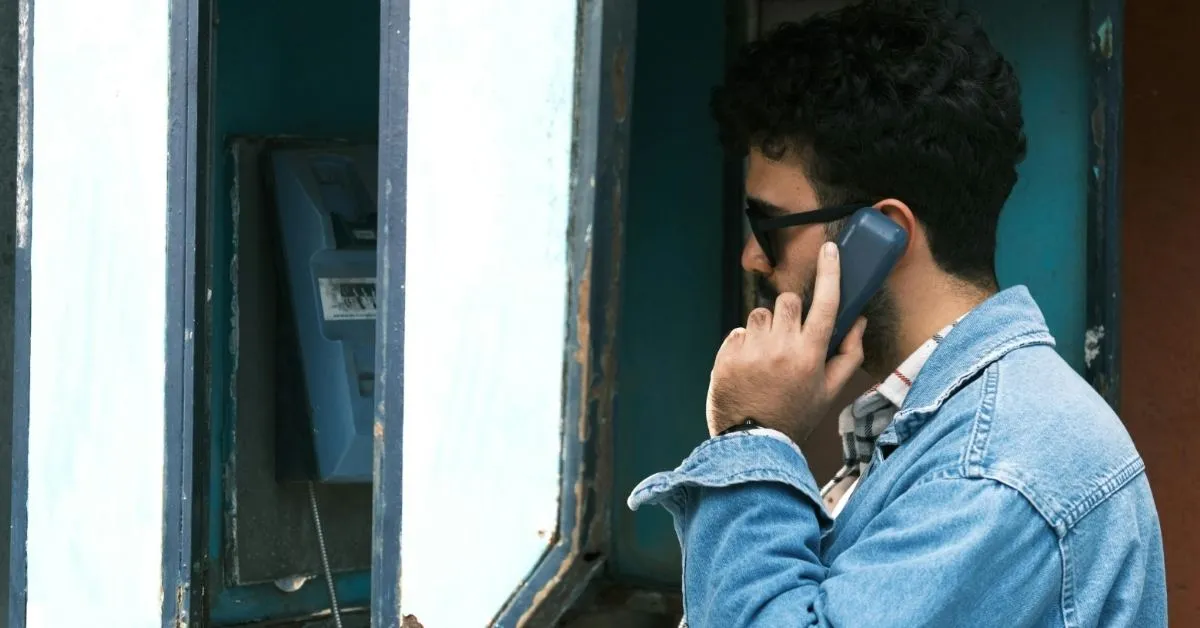
A blue payphone sits on a corner in Abilene, Texas. Press the button and you're connected to a red payphone 1,500 miles away in San Francisco. The sign reads "Call a Republican" to "Call a Democrat." What happens when you pick up is less predictable than politics usually allows.
Matter Neuroscience, a startup focused on human connection, installed these refurbished phones to test something straightforward: can people from opposite ends of the political map actually talk. Not debate. Not perform. Just talk.
The setup feels designed to maximize friction. Abilene is one of Texas's most conservative cities. San Francisco is reliably its opposite. Yet when recordings of the conversations surfaced, something unexpected emerged. The callers weren't rehearsing talking points. They were discussing cybertrucks and traffic, complaining about annoying coworkers, debating the merits of classic novels. One caller mentioned an AI data center coming to town and asked for an outsider's perspective.
We're a new kind of news feed.
Regular news is designed to drain you. We're a non-profit built to restore you. Every story we publish is scored for impact, progress, and hope.
Start Your News DetoxWhat stands out isn't the disagreement — it's the reluctance to fully claim a political identity at all. A San Francisco caller said, "I'm not a Democrat per se, but I am a resident of San Francisco. I kind of abandoned the Democratic Party." An Abilene resident replied, "I'm not necessarily a Republican, but I'm not a Democrat either. I just feel like there's so many good points on both sides." These aren't fence-sitters or the politically exhausted. They're people who've actually thought about it.
The science behind the project is straightforward. Political disagreement triggers stress responses — elevated cortisol, suppressed happiness markers. Positive conversation does the opposite. The brain chemistry of connection is identical across political lines. What changes is whether we give ourselves permission to find it.
What's quietly remarkable is how the project has reframed the cities themselves. Abilene has a reputation as uniformly conservative, yet 500 people gathered outside city hall to protest something they believed in. San Francisco's liberal monolith cracks when you listen to actual residents. Communities painted as ideological monoliths turn out to contain multitudes — people with genuine disagreement but also genuine nuance.
The payphone conversations have circulated partly because they demonstrate something people hunger for: civility without surrender. "A conversation. No yelling, no screaming, no shouting — just plain conversation between two individuals," one commenter wrote. It's not a revolutionary insight. It's the baseline for how humans can interact. That it feels novel enough to record and share says something about where we are.
Matter Neuroscience's co-founder Ben Goldhirsh frames it simply: "I think our thesis is that humans are pretty awesome and — if given the opportunity — will really look to find common ground because biologically that actually gives us a lot more happiness." The experiment suggests he might be right. The payphones are still there, still connecting strangers across the country.