You know that feeling when you buy something in plastic packaging, use it for five minutes, and then remember it'll outlive your great-grandchildren? Yeah, scientists are tired of that too. So they invented "living plastic" — a material that literally eats itself on cue, leaving nothing but its original building blocks.
Think of it as plastic with a built-in self-destruct button, pressed by tiny, hungry microbes. A team of scientists, clearly channeling their inner MacGyver, engineered two types of bacteria to work in tandem. The result? A complete plastic vanishing act in a mere six days. And the best part? Zero microplastics left to haunt our oceans.
The Absurdity of Forever Plastic
Zhuojun Dai, one of the lead authors, put it simply: we make plastic that lasts for centuries, then use it for things like a single-serving yogurt cup. The math just doesn't add up. So, the question became: what if plastic's durability wasn't a problem, but a feature we could program? What if it knew when to check out?
We're a new kind of news feed.
Regular news is designed to drain you. We're a non-profit built to restore you. Every story we publish is scored for impact, progress, and hope.
Start Your News DetoxThe answer, apparently, involves embedding plastic-munching microbes directly into the material. Because, as Dai notes with a delightful understatement, that's what makes the plastic "come alive." And then, of course, self-destruct. Which, if you think about it, is both impressive and slightly terrifying.
How the Self-Destruct Sequence Works
Previous attempts at this kind of thing often used just one enzyme. But Dai, Jin Geng, and Dianpeng Qi — clearly not ones to half-ass a plastic-devouring mission — decided two enzymes were better. They engineered Bacillus subtilis to produce a tag-team of plastic destroyers.
One enzyme acts like a tiny, indiscriminate chopper, hacking long polymer chains into smaller, more manageable bits. The second enzyme then swoops in, meticulously breaking down those smaller pieces from each end until nothing but the basic components remain. It's like a microscopic demolition crew, but way more eco-friendly.
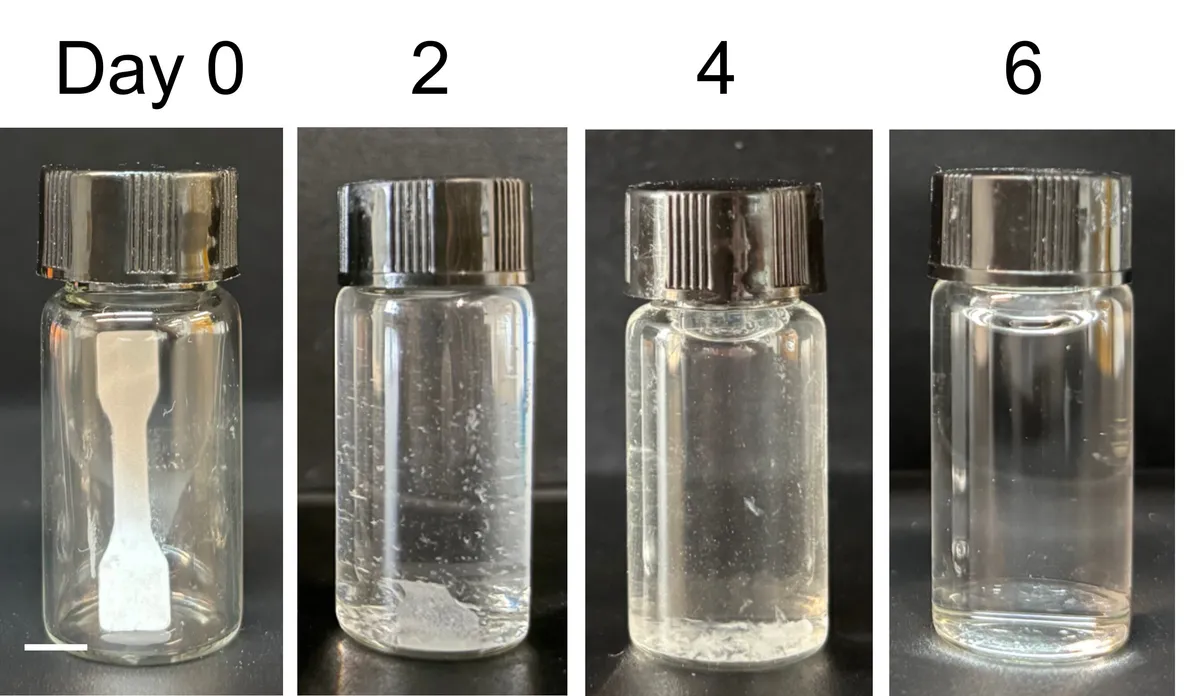
The team mixed dormant B. subtilis spores into polycaprolactone, a polymer often found in 3D printing and even surgical sutures. This kept the microbes safe and sound until their moment to shine. The resulting "living plastic" felt and acted just like the regular stuff. But when a nutrient broth at a balmy 122 degrees Fahrenheit (50 degrees Celsius) was added, the spores woke up, stretched, and got to work. Six days later, the plastic was gone. Poof. And crucially, no microplastics were formed during the entire process, thanks to that efficient enzyme duo.
For a real-world test, they even made a wearable plastic electrode out of their new material. It worked perfectly, then degraded completely within two weeks. Because apparently, that's where we are now: making electronics that can just… disappear.
Next up, the researchers want to figure out how to trigger these spores in water, since, you know, that's where a lot of plastic ends up. And while this particular magic trick was for one type of polymer, the method could potentially work for other plastics, especially those pesky single-use items. Meaning one day, your plastic takeout container might just politely dissolve when you're done with it. Let that satisfying thought sink in.