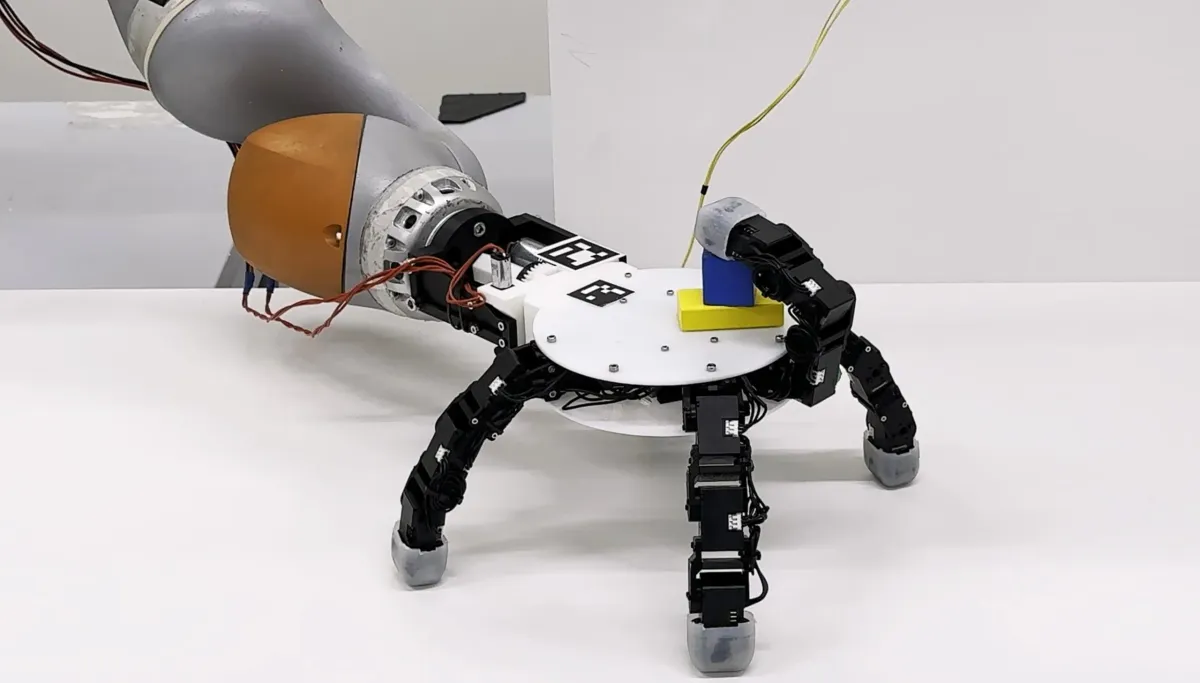
Engineers have built a robotic hand that does something human hands cannot: detach from its arm and scurry across the floor like a six-legged creature, then crawl back with objects clutched in its fingers.
The hand's trick is radical symmetry. Every finger is identical and can bend both forwards and backwards — a flexibility that would shatter human joints. This means any two fingers can pinch an object as a thumb would. Pick up a tube of mustard and a Pringles can simultaneously with one hand. Grab three separate objects at once. The hand doesn't need to choose which finger plays which role.
"The human hand is often viewed as the pinnacle of dexterity," the research team wrote, "but by departing from anatomical constraints, the robot is both a hand and a walking machine capable of tasks that elude our hands."
We're a new kind of news feed.
Regular news is designed to drain you. We're a non-profit built to restore you. Every story we publish is scored for impact, progress, and hope.
Start Your News DetoxWhen mounted on a robotic arm, the hand operates like you'd expect. But when the wrist joint releases, something stranger happens. The six fingers become six legs. The hand transforms into a spider-like crawler that can navigate tight spaces — under furniture, through rubble, into gaps a traditional gripper could never reach. In tests, the detached hand grabbed three blocks that were impossible to reach without leaving the arm behind, then skittered back with its prize.
Why this matters for real work
The implications ripple outward quickly. In disaster response, a robot could send its hand into collapsed buildings to locate survivors or retrieve critical objects. In warehouses, it could reach items wedged on high shelves or deep in narrow racks. Industrial inspection becomes possible in spaces too cramped for a full robot body.
There's also a stranger possibility: the research team is exploring prosthetics. Neuroscience shows the human brain adapts remarkably fast to control extra limbs or digits — people can learn to operate additional fingers within hours. A prosthetic hand with this kind of flexibility and multi-object capability could restore or exceed what biological hands can do.
"The symmetrical, reversible functionality is particularly valuable in scenarios where users could benefit from capabilities beyond normal human function," said Aude Billard, the lead researcher.
The work represents a shift in how engineers think about robotic design. Rather than copying human anatomy — the standard approach for decades — this team asked: what if we abandoned our constraints entirely. The answer was a hand that's simultaneously more capable and more alien, a tool that works alongside humans while doing things no human hand ever could.