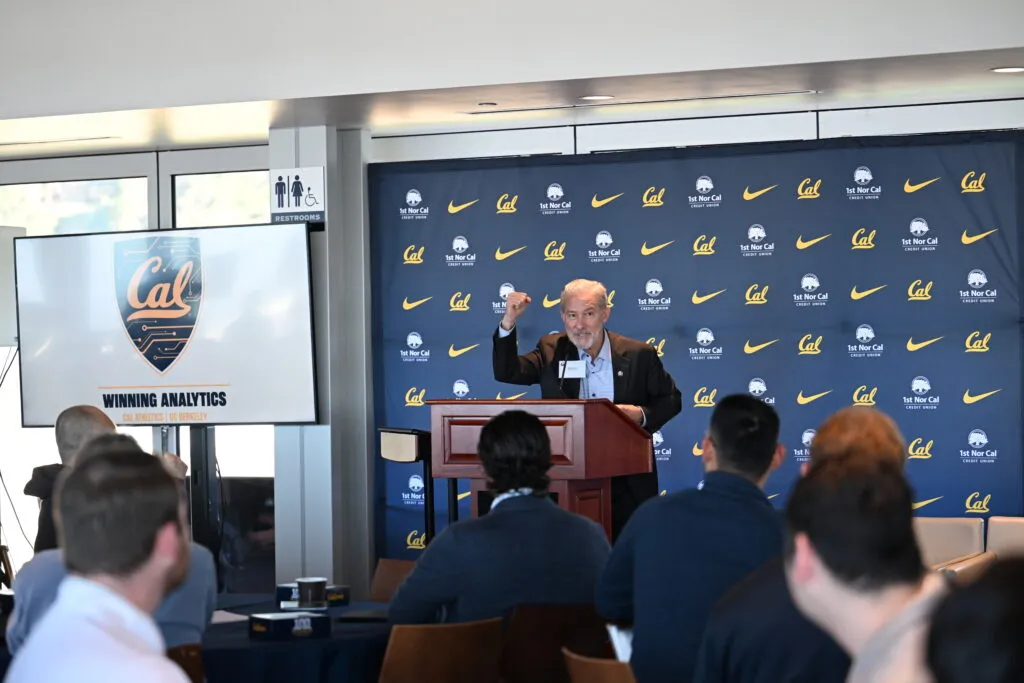
More than 100 people gathered at California Memorial Stadium in February for something that shouldn't have felt unusual but somehow did: a room full of coaches, computer scientists, and statisticians all focused on the same problem.
The Winning Analytics Summit marked the launch of UC Berkeley's attempt to do something most universities haven't quite figured out: actually use the data science expertise sitting in the campus computer labs to help the athletes competing down the street.
It sounds straightforward. Berkeley has 30 varsity sports, 850+ student-athletes, and a computer science department that ranks among the world's best. The athletes won 23 medals at the 2024 Paris Olympics — enough to place 12th if they were their own country. And yet, according to an audit the athletic department ran recently, data across those 30 sports lived in dozens of separate systems, most of it managed by assistant coaches juggling spreadsheets alongside their actual jobs.
We're a new kind of news feed.
Regular news is designed to drain you. We're a non-profit built to restore you. Every story we publish is scored for impact, progress, and hope.
Start Your News Detox
A panel of speakers pictured before an audience at the Winning Analytics summit.
The gap between data and decisions
The real problem wasn't that data didn't exist. It was that coaches needed answers in real time — whether a recruit's injury history predicts future risk, how a particular training load affects both athletic performance and academic workload, whether a player is recovering properly — but the insights were locked away in systems that didn't talk to each other.
That's where the Winning Analytics framework comes in. It's built around three pillars: recruiting (using predictive models to identify talent more accurately), performance (turning training data into actionable insights about recovery and workload), and engagement (using data to deepen relationships with donors and fans, which funds the whole operation).

A group sits at a table to brainstorm during Cal Athletics' Winning Analytics summit.
What makes Berkeley positioned for this is almost unfair. The university has world-class faculty in data science and machine learning. It's minutes from Silicon Valley. And it has coaches and athletic directors willing to admit they need help. Co-Athletic Directors Jenny Simon-O'Neill and Jay Larson have made clear this isn't a side project — it's central to how athletics will function going forward.
The summit itself generated dozens of potential projects, but the real test comes now. Turning a room full of good intentions into systems that actually work means solving the unglamorous parts: capturing clean data consistently across 30 different sports, building infrastructure that integrates instead of fragments, and finding people who can speak both the language of statistics and the language of coaching.
If Berkeley pulls this off, it won't just help its athletes. It'll probably set a template that other universities will spend the next few years trying to copy.