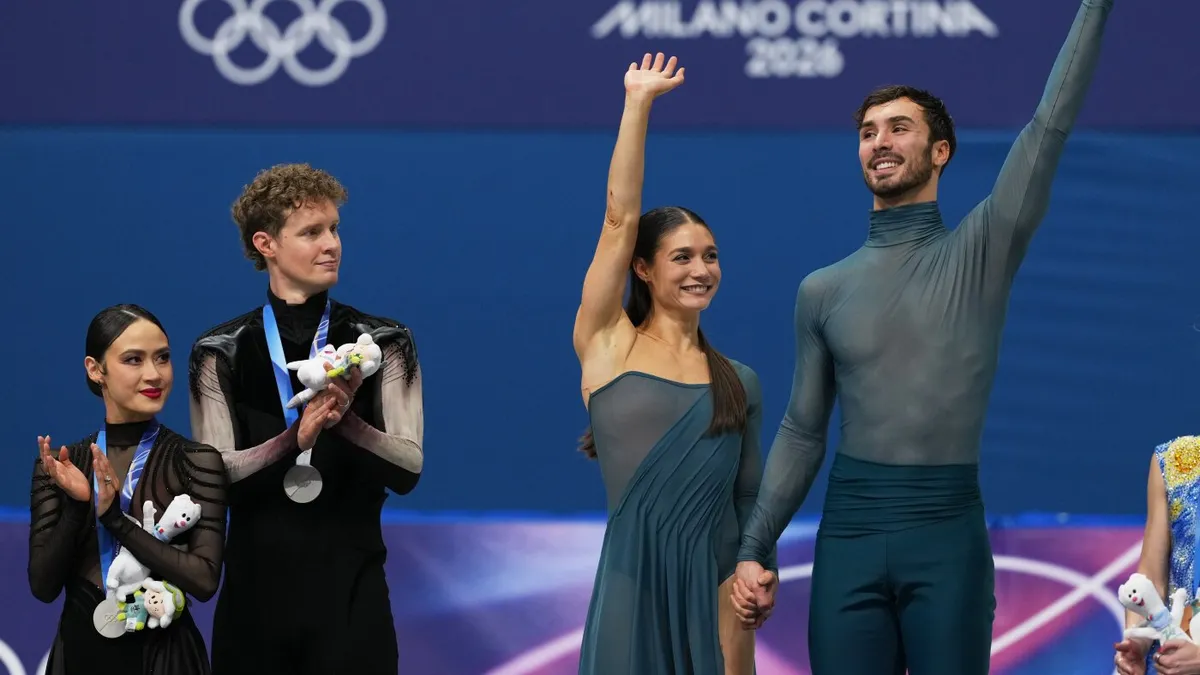
Madison Chock and Evan Bates have spent fifteen years building something most athletes never get: a partnership that works both on and off the ice. On February 11 at the 2026 Milan Cortina Olympics, they proved it one more time, delivering a season-best performance of their flamenco-inspired "Paint It Black" program to claim silver in ice dancing.
The heavily favored American duo finished just over a point behind France's Laurence Fournier Beaudry and Guillaume Cizeron, who took gold. For Chock and Bates—now four-time Olympians—the result felt bittersweet. They'd executed their routine flawlessly. They'd given everything. Yet it wasn't quite enough.
"We really gave it our all, and I wouldn't change anything about how we approached each performance," Chock told reporters, her voice breaking with emotion. "We've had an incredible career, so well-supported by our families, and our coaches, by each other."
We're a new kind of news feed.
Regular news is designed to drain you. We're a non-profit built to restore you. Every story we publish is scored for impact, progress, and hope.
Start Your News DetoxWhat makes their achievement striking isn't just the medal itself. It's the durability of what they've built. Chock and Bates began skating together in 2011, when ice dancing partnerships were often fragile, high-pressure arrangements that dissolved under the weight of Olympic cycles. They married in 2024—the same year they were still competing at the highest level, a rarity in a sport where personal and professional lives rarely coexist so openly. They've become mentors to younger U.S. figure skaters, the kind of steady presence that changes a team's culture.
Bates, now 36, has been candid about the physical toll. "The skating career is something short and finite, and the relationship is much, much longer," he told NPR months before the Games. That perspective—treating the partnership as the main thing, the medals as chapters in a longer story—might be why they've lasted this long.
Their future on the ice remains unwritten. Bates has acknowledged the "mileage on the body." But whether they skate again or step away, Chock and Bates have already demonstrated something rarer than gold: what it looks like when two people choose each other, year after year, through the pressure of Olympic cycles and the simple, grinding difficulty of getting better at something impossibly hard.