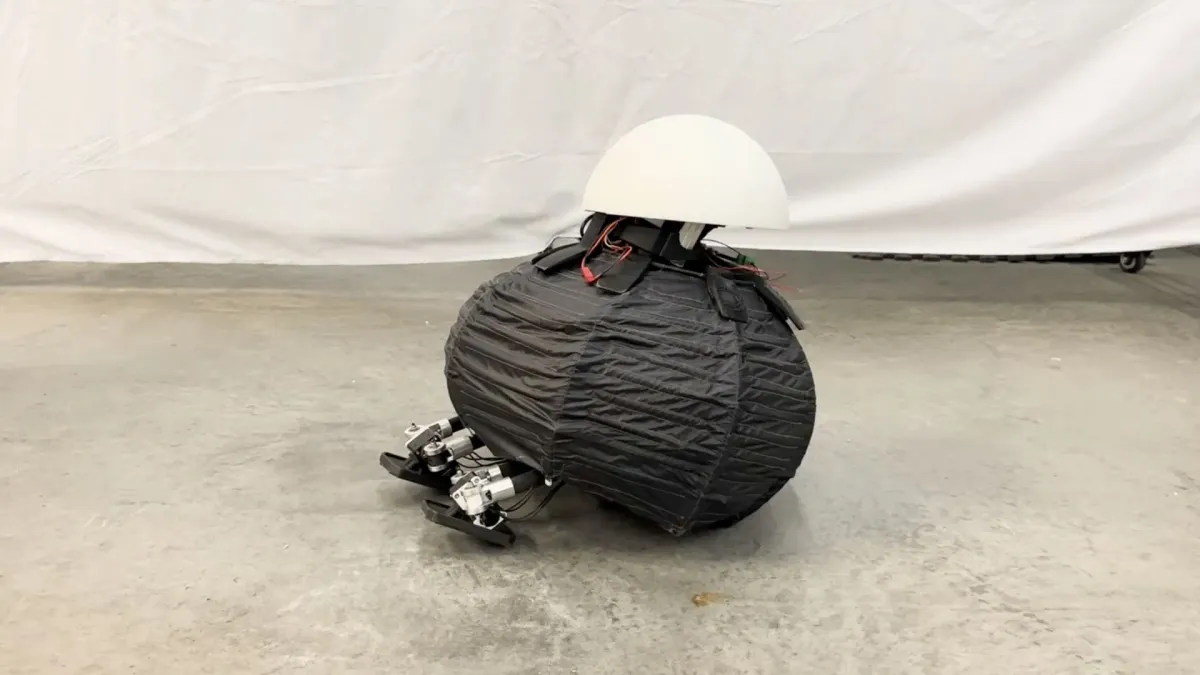
Engineers at the University of Illinois just built a bipedal robot that can take a tumble and get back up — a seemingly small detail that unlocks something bigger: the ability to teach robots how to move through trial and error, in the real world, without destroying themselves in the process.
The robot, called HybridLeg, stands 1.84 meters tall and weighs just 29 kilograms. What makes it different isn't that it walks like a human — it doesn't, quite. It's that the engineers rethought the entire mechanical architecture from the ground up.
A Different Kind of Leg
Most humanoid robots mimic human anatomy pretty directly: bones, joints, muscles. HybridLeg takes a hybrid approach. Each leg uses a five-bar linkage system — think of it as a more complex mechanical arrangement than the simple serial chains you'd find in a traditional robot limb. The payoff is significant: faster motion, lower inertia (the robot's limbs don't swing wildly), and the ability to carry more weight relative to its own mass.
We're a new kind of news feed.
Regular news is designed to drain you. We're a non-profit built to restore you. Every story we publish is scored for impact, progress, and hope.
Start Your News DetoxThe design concentrates most of the motors — 10 out of 12 — near the pelvis, with only two at the ankles. This means the heaviest components stay close to the center of the body, and the legs themselves stay light. That matters enormously for physics modeling and for teaching the robot to walk autonomously.
The entire system is self-contained: onboard computer, sensors, batteries, all packed into the frame. There are no cables tethering it to external power or control systems. It's genuinely untethered, which means it can actually move through real spaces and learn from real interactions, not just simulations.
Learning by Falling
Here's where the fall-safe design enters. Teaching a robot to walk using reinforcement learning — basically, trial and error with rewards — is messy. The robot will lose balance. It will tip. In traditional setups, each fall means repairs, downtime, recalibration. The cycle becomes prohibitively slow.
The HybridLeg team built in impact mitigation and the ability to autonomously recover to standing posture after a fall. Paired with multimodal fall detection and improved tracking during the stance phase, the robot can reset itself and try again. Dozens of times. Hundreds of times. Without human intervention.
This is the kind of detail that sounds mechanical but is actually philosophically important. Real-world learning requires real-world failure. The robot can now experience that failure, absorb it, and keep going.
The engineering choices compound: carbon fiber tubes for structural rigidity, high-precision bearings, a pelvis design with a slight toe-out angle (borrowed from human biomechanics) to expand how far the feet can reach and improve stability. Simulation models match what actually happens in hardware — that agreement between theory and practice is how you know the design is sound.
What comes next is the harder part: what can this platform actually learn to do. The researchers have built the foundation. Now they'll push it toward dynamic gaits, adaptive balance, and movement patterns that emerge from the learning process rather than being pre-programmed. The fall-safe design isn't the endpoint — it's permission to experiment.