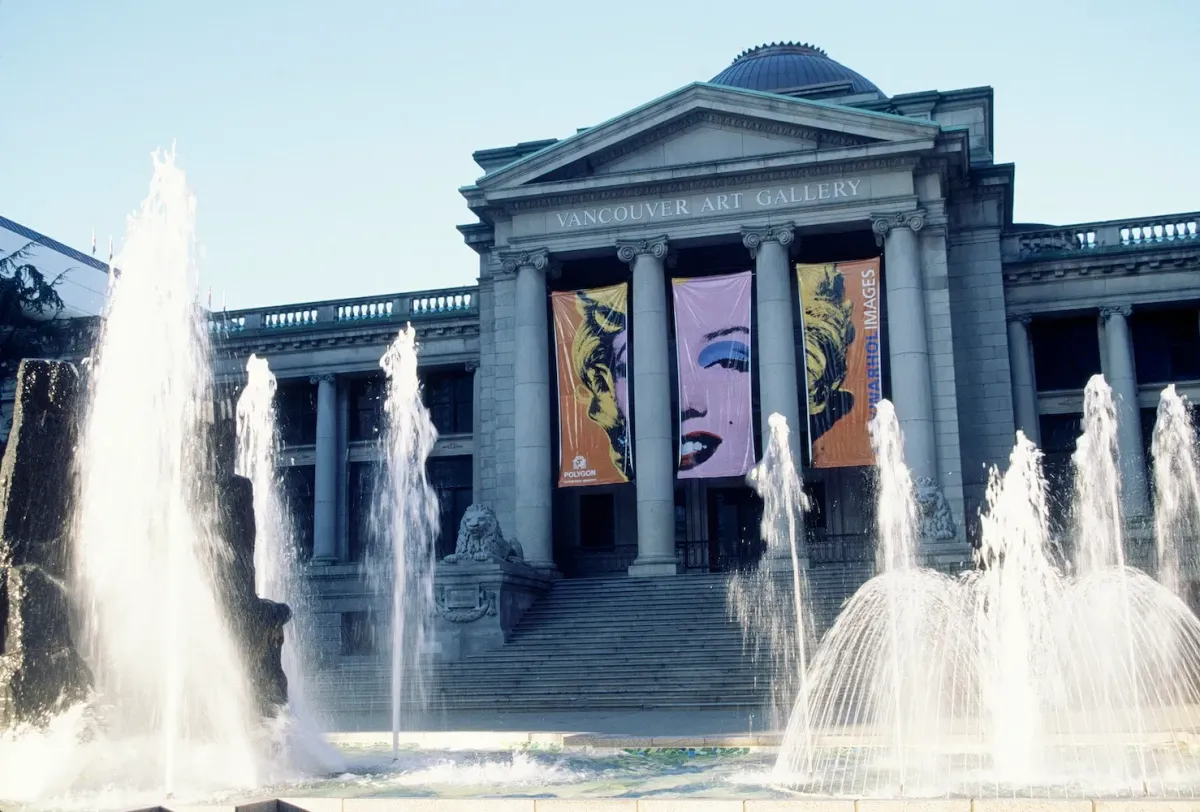
A Vancouver family just handed the Vancouver Art Gallery a gift that reshapes how the institution can tell the story of modern photography: more than 800 photographs from Stephen Shore's "Uncommon Places," the series that convinced the art world color film was worth taking seriously.
Shore spent the 1970s driving across North America with large-format cameras, stopping to photograph gas stations, diners, parking lots, and highway intersections. What made these ordinary scenes matter wasn't novelty—it was the way he composed them. Shot with view cameras that rendered everything with sharp, almost architectural clarity, the photographs flattened the world into geometric patterns. A street doesn't recede into the distance; it locks into the frame like a painting.
"Uncommon Places" arrived at a specific moment. In the early 1970s, color photography was still fighting for legitimacy in fine art. Black and white was serious. Color was commercial, snapshot territory. Shore's work—alongside William Eggleston's—helped dismantle that hierarchy. The series influenced a generation of photographers who came after, including Andreas Gursky, who encountered Shore's work in art school and built a career on similar formal precision applied to contemporary landscapes.
We're a new kind of news feed.
Regular news is designed to drain you. We're a non-profit built to restore you. Every story we publish is scored for impact, progress, and hope.
Start Your News DetoxWhat's striking about Shore's trajectory is how early he arrived at mastery. At six, he received a darkroom. At 14, MoMA bought three of his pictures. By 23, he had a solo show at the Metropolitan Museum. In his late teens, he was documenting Andy Warhol's Factory, absorbing Warhol's fascination with the banal—the everyday treated with the same intensity as the extraordinary. That sensibility carried through everything that followed.
A Shift in Approach
Before "Uncommon Places," Shore made "American Surfaces," a series of small, flash-lit photographs of diners and motels taken with a 35mm camera and displayed as grids of three-by-five-inch prints. It had the feel of casual documentation. "Uncommon Places" kept the same subject matter but formalized the language. The larger format, the depth of field, the compositional control—it transformed a road trip into an argument about how we see ordinary space.
The Chan family's donation means the Vancouver Art Gallery now holds a comprehensive archive of this work. In March, the museum will open "Stephen Shore: Uncommon Places," featuring 50 photographs from the gift. For researchers, students, and visitors, that means access to one of contemporary photography's defining bodies of work without traveling to New York or Los Angeles.
There's a practical dimension here worth noting: major photography collections anchor institutions. They become research destinations. They shape how curators think about exhibition and acquisition. A gift of this scale—800 works—doesn't just add to a collection; it repositions what an institution can do.