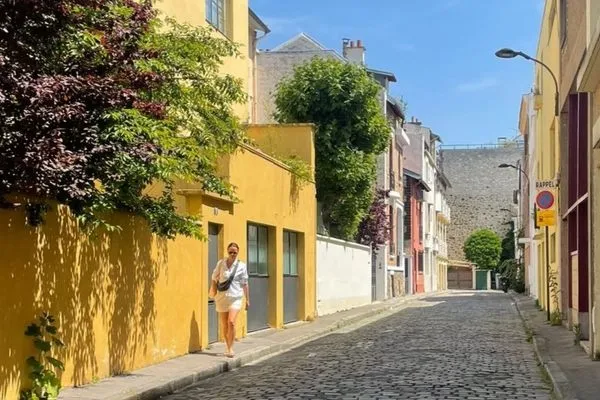
Tucked into the 14th arrondissement of Paris—the neighborhood tourists rarely reach—sits Villa Seurat, a cul-de-sac that looks nothing like its grand name suggests. There's no villa here, no sprawling country estate. Instead, there are eight modest artist studios, each one a small revolution in how creative people could live and work.
Built between 1920 and 1926 on land that once held stables and sheds, Villa Seurat was designed by architect André Lurçat for his artist friends. He understood what they needed: studios weren't just rooms with walls. They were spaces engineered for creation. High ceilings to accommodate sculpture. Enormous bay windows flooding the studios with northern light. Minimalist modernist shells of reinforced concrete and exposed brick—honest materials that let the art be the point.
The street was named after Georges Seurat, the painter who invented pointillism, and it became a magnet for some of the 20th century's most restless creators. Salvador Dalí arrived in 1932 with his muse Gala, renting No. 1. For two years, he painted here—including his unsettling masterpiece "The Enigma of William Tell," where Dalí reimagined the famous archer as something darker, more psychologically complex. Down at No. 7, sculptor Chana Orloff had carved out a double-height studio with wooden doors wide enough to move the massive stone blocks she worked with. And at No. 18, Henry Miller sat down in 1931 and began writing "Tropic of Cancer," the novel that would scandalize France so thoroughly it remained banned there until 1964.
We're a new kind of news feed.
Regular news is designed to drain you. We're a non-profit built to restore you. Every story we publish is scored for impact, progress, and hope.
Start Your News DetoxA Street That Remembers
What strikes you walking Villa Seurat now is how little has changed. The studios are still there, still modest, still radiating that particular quiet that happens when a place has held serious work. In spring, the street fills with flowers—roses climbing walls, wisteria spilling over gates—which softens the industrial architecture without erasing it. It's the kind of place where you can almost feel the concentration of decades past, the intensity of people who had something to say and found the exact right corner of Paris to say it.
After you've walked the villa, the nearby Parc Montsouris is a natural next step—another pocket of the 14th that most visitors miss. But by then, you'll have already understood what the neighborhood knows: the best Paris isn't always where the crowds are.