On April 23, 2005, Jawed Karim stood at the San Diego Zoo, pointed a camera at himself, and said: "The cool thing about these guys is that they have really, really, really long trunks." He was talking about elephants. The video lasted 19 seconds. It would become the first thing ever uploaded to YouTube.
That grainy clip, titled "Me at the zoo," has now been acquired by the Victoria and Albert Museum in London. It's been viewed more than 380 million times and collected over 18 million likes. But what makes this moment worth preserving isn't the video itself—it's what it represents about how we decided to share our lives.
YouTube launched on February 14, 2005. Two months later, Karim's elephant commentary went live. Within eight months, the site was processing 25 million video views per day. By the end of 2006, Google had bought the whole platform for $1.6 billion. The speed of that growth still feels almost impossible.
We're a new kind of news feed.
Regular news is designed to drain you. We're a non-profit built to restore you. Every story we publish is scored for impact, progress, and hope.
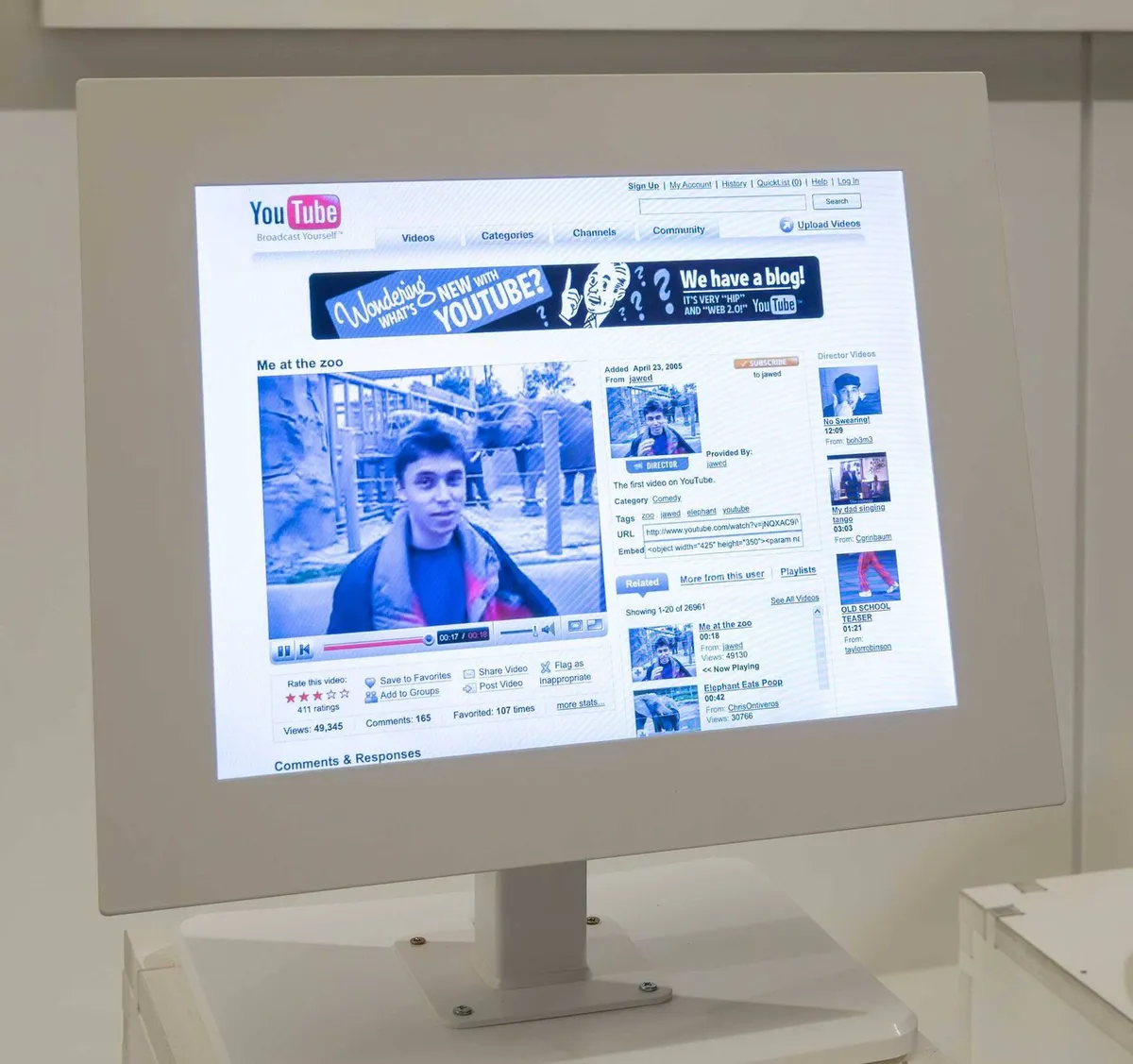
Start Your News DetoxReconstructed YouTube watch page from December 8, 2006
What's remarkable about preserving "Me at the zoo" is how the V&A and YouTube went about it. Curators didn't just save the video file. They worked with the Internet Archive's Wayback Machine to reconstruct the entire 2005 watch page—the player, the banner ads, the whole early-internet aesthetic. They partnered with the design studio oio to rebuild the interface as it existed in late 2006, capturing not just what was uploaded, but how people experienced it.
YouTube watch page banner ads
Corinna Gardner, the V&A's senior curator of design and digital, called it "forging new ground in how we collect and preserve complex digital objects for the future." That's the real story. Museums have always preserved artifacts—paintings, sculptures, manuscripts. But how do you preserve something that only exists as code, interface, and cultural moment. How do you save not just the thing, but the context that made it matter.
The New York Times' Virginia Heffernan wrote in 2009 that Karim's video "makes and repeats a larger point: Video—trivial or important—can now quickly and at no cost be published, broadcast and shared." That was the genuine revolution. Not the technology itself, but the democratization of it. Before YouTube, publishing video meant equipment, distribution channels, gatekeepers. After "Me at the zoo," it meant a camera and an internet connection.
YouTube's early "Wild West feel" began shifting after Google's acquisition, and some worried about what would happen to the platform under corporate ownership. Twenty years later, the question feels almost quaint. YouTube became exactly what Karim's elephant video promised: a place where anyone could share anything, instantly, with the world. The museum acquisition of that first clip is less about nostalgia and more about recognition—that moment mattered because it changed how we communicate.