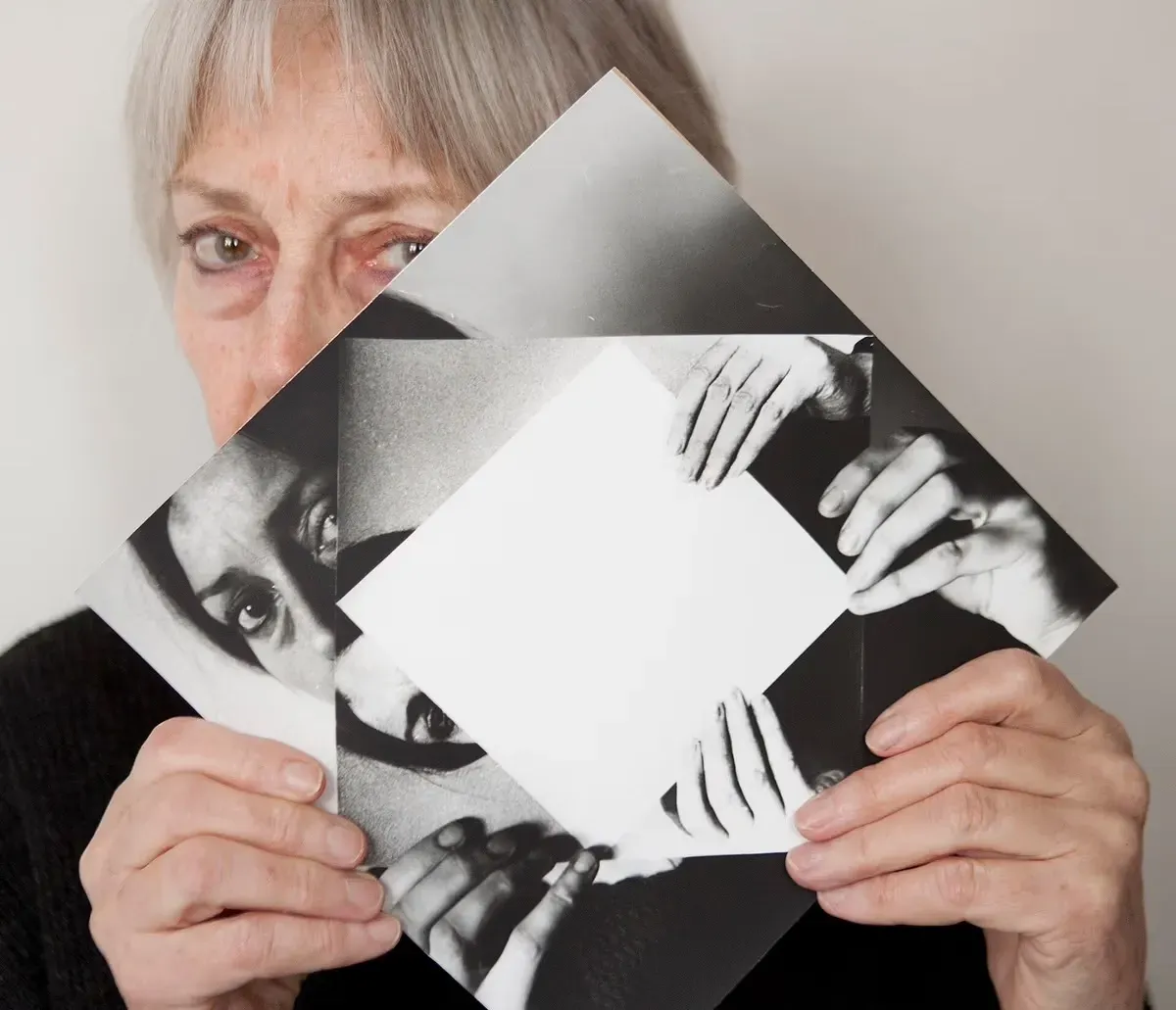
Dóra Maurer spent decades making art about how meaning changes depending on when you look at it, where you stand, and what you already know. On Tuesday, the Hungarian conceptual artist died at 88, leaving behind a body of work—films, photographs, paintings—that quietly rewrote what was possible under Soviet rule and beyond.
Maurer was born in Budapest in 1937 to a cartographer father she never knew; he died six months before her birth. Her mother raised her in a residential building where her aunt also lived, and she found herself drawn to ink sticks her father had left behind. During the 1945 siege of Budapest, she spent her childhood copying illustrations from books—a practice that would shape everything she made later. She studied graphic arts at the Hungarian Academy of Fine Arts, graduating in 1961.
By the 1970s, working in a country where state-controlled galleries dictated what art could exist, Maurer began making photographs and films that seemed deceptively simple. In Mit lehet egy utcakővel csinálni? (What Can One Do with a Paving Stone?), a 1971 piece, she caressed, threw, and carried around a paver. The work hovered between the personal and the political—paving stones had been weapons during the May 1968 Paris protests, but Maurer was more interested in how narrative shifts when you see the same object photographed differently. "It is ambivalent," she said. "You can consider it as political."
We're a new kind of news feed.
Regular news is designed to drain you. We're a non-profit built to restore you. Every story we publish is scored for impact, progress, and hope.
Start Your News DetoxA year later, Reversible and Changeable Phases of Movement presented grids of photographs showing her throwing and catching a ball. Depending on the order you viewed them, the same sequence suggested motion forward or backward. Time became material. Meaning became something you could rearrange.
"Since 1969-70, my work has been based on change, shifting, traces, temporality from various perspectives," she told Studio International. That obsession carried through everything—her experimental films of the '70s, the Handmade Fractal Paintings she began in 1988 with lines so fine (3mm wide) they seemed to vibrate across the canvas, the Overlappings series from 1999 where squares of color stacked on top of each other to create entirely new hues at their intersections.
For decades, Maurer remained largely unknown outside Hungary. The art world didn't really notice her until 2019, when Tate Modern in London mounted a survey of her work. She was 82. After that, blue-chip galleries like White Cube began showing her paintings. When asked about this late-career visibility, Maurer was characteristically unmoved. "I don't want to be a star or suchlike," she told ArtReview in 2012. "I'm not the type."
She taught at the Hungarian University of Fine Arts for years, stopped making films in the 1990s, and served as president of the Széchenyi Academy of Literature and Arts. She left behind work that proved you could make rigorous, playful art under constraint—and that the most radical gesture sometimes looks like the simplest thing.