Mia Westerlund Roosen walked into the Leo Castelli gallery's 25th anniversary show in 1982 with sculptures that looked unmistakably like phalluses—a deliberate act of feminist refusal at a moment when the art world had decided bodies had no place in sculpture. She was one of four women among 29 artists. The men got the attention. She got dismissed as "reductive" and "eccentric."
That was over four decades ago. Roosen is still making work. Still experimenting. Still, mostly, overlooked.
The Long Refusal
What's striking about Roosen's career isn't that she persisted despite indifference—though she did. It's that she never let the indifference define what she made. When she realized early on that working in resin would forever tether her to Eva Hesse's shadow, she simply moved on. Concrete. Cement. Materials nobody else was using to depict the body. Over the decades, she added steel, copper, lead—always asking the same question: how can something hard carry something vulnerable?
We're a new kind of news feed.
Regular news is designed to drain you. We're a non-profit built to restore you. Every story we publish is scored for impact, progress, and hope.
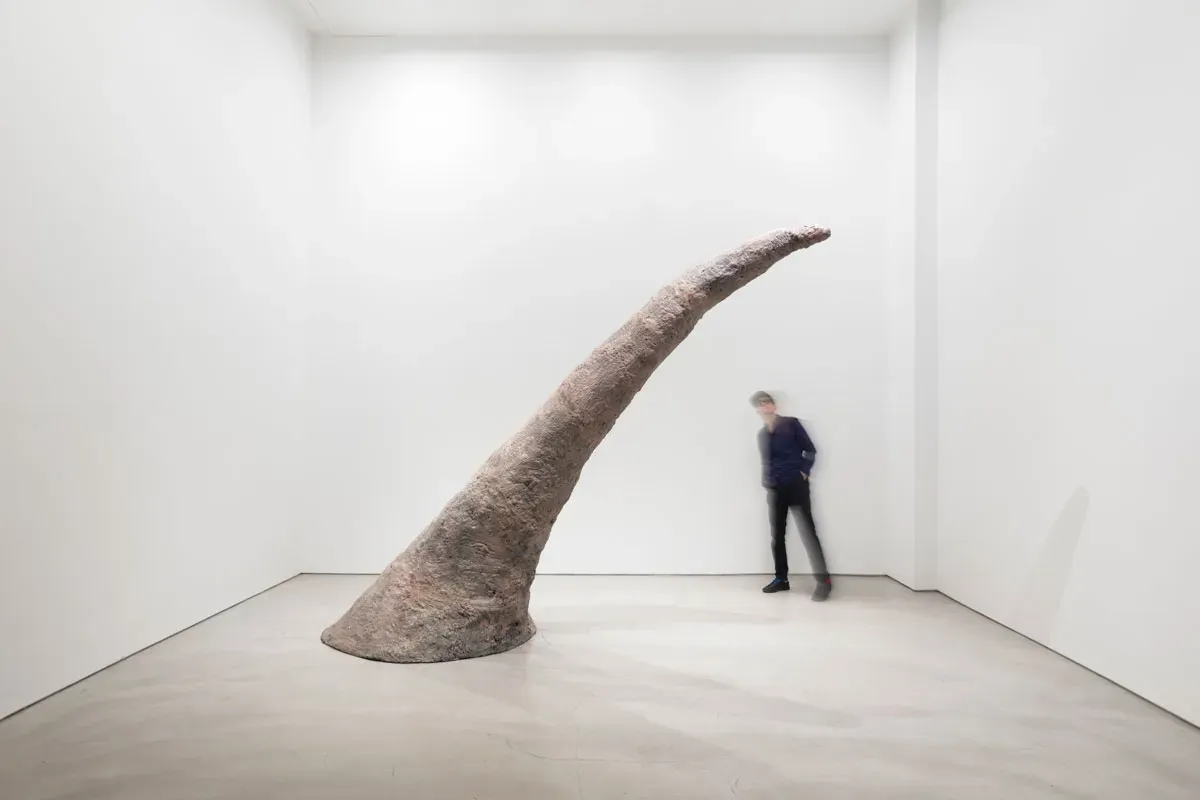
Start Your News DetoxThat question runs through "Then and Now," her current exhibition at Nunu Fine Art in New York (through February 21), which spans five decades of sculpture and drawing. Heat, from 1981, rises nearly 13 feet from the floor—a muscular, tapering form that extends outward like a curved penis, its concrete surface coated in encaustic wax, yellowed and pink and streaked with darker marks that look less like artistic intention than bodily bruising. Conical, made the same year, stretches 5 feet at its widest. Both sculptures seem less made than grown, their scale amplifying vulnerability rather than monumentality.

Then there's Sac, from 2019. Wrapped in pale flannel and resin, it's slumped and elongated—a comically flaccid form that muddies everything Heat and Conical asserted. Gone is the aggressive extension. What remains is fragility drawn inward. "My work is often comic and threatening," Roosen told ARTnews recently. "I find the grotesque beautiful."

The Market That Forgot Her
Roosen has exhibited consistently in New York since the early 1990s. She produces large-scale epoxy sculptures that are physically demanding and technically complex. She shows every two years. By any reasonable measure, she never stopped working. But attention—that's a different thing entirely. Attention drifted. The art world moved on to the next thing, the next name.
A 2022 report in the Journal of Cultural Economics puts numbers to what Roosen has lived: art by male artists commands prices 18.4 percent higher than comparable works by women. Heat, a monumental sculpture that would fetch significantly more if a male peer had made it, is currently priced at $10,000—a figure that reflects where Roosen's market currently sits, not where it should be.
Nunu Hung, the gallery director now representing Roosen, was direct about this: "She is undoubtedly one of the most respected artists of her generation. And yet she does not receive the recognition she deserves, given the quality and scope of her career."

Duration Over Visibility
But Roosen herself is less concerned with market recalibration than with what her art can do. "The materials matter," she said. "Concrete isn't supposed to be tender, and that's exactly why I use it. I like pushing something hard into carrying something vulnerable."
That sentence contains the whole practice: the refusal to monumentalize, the commitment to process, the belief that duration and touch and care over time matter more than immediate legibility. In an art world calibrated toward constant visibility and quick consumption, Roosen's work insists on something slower. She's been insisting on it for 50 years.

When asked if she might finally get the recognition she deserves, Roosen laughed. "Maybe I'll get popular when I'm 85, and that's two years from now." She said it lightly, but there's a truth underneath: she's already won. She never stopped making. That's the endurance that actually matters.