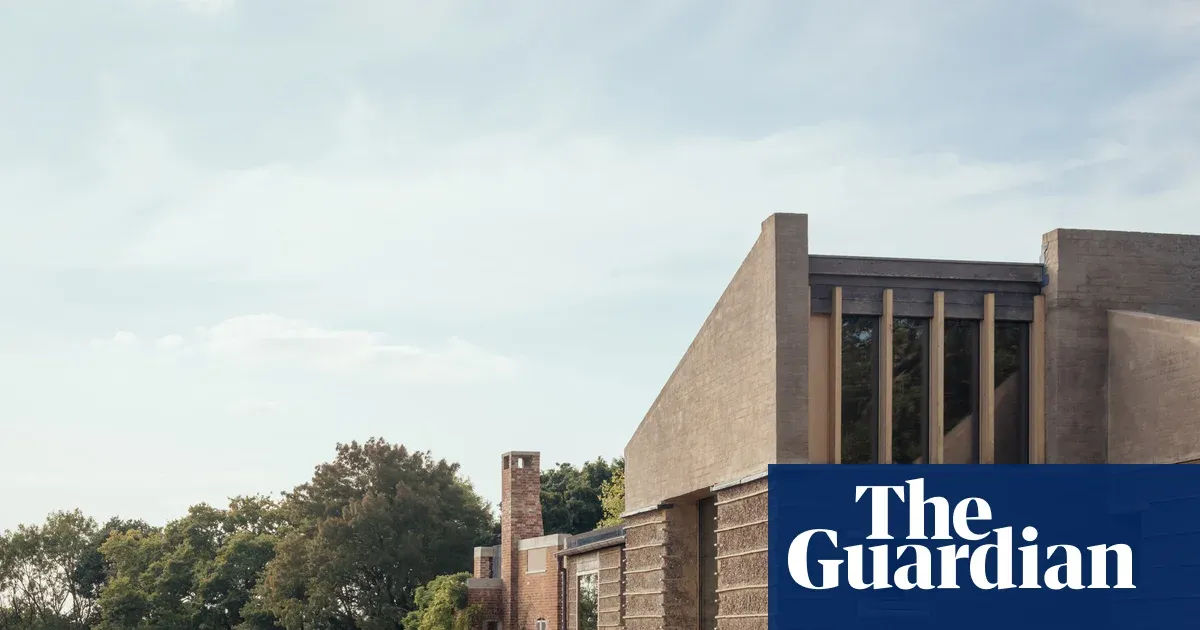
A low-rise homestead in Wiltshire's Cranborne Chase looks unremarkable from the road until you touch the walls. They're not brick or concrete—they're rammed earth, compacted soil that's been holding up buildings since the Neolithic period and is now quietly reshaping how we think about sustainable construction.
The Rammed Earth House is one of the first UK projects built entirely from unstabilised rammed earth, a material sourced directly from or near the building site itself. It exists at the intersection of two pressing realities: the building sector produces more than a third of global carbon emissions, and architects are running out of time to fix it.
What makes rammed earth compelling isn't nostalgia. It's physics. "Climate change makes it even more important that rammed earth is framed as a mainstream material," says Emaad Damda, lead architect at Tuckey Design Studio, which worked on the Wiltshire project. "Rammed earth offers thermal mass, temperature regulation and moisture control." In a warming climate, a material that naturally moderates temperature swings without mechanical intervention becomes genuinely valuable.
We're a new kind of news feed.
Regular news is designed to drain you. We're a non-profit built to restore you. Every story we publish is scored for impact, progress, and hope.
Start Your News DetoxThe practical advantages are equally straightforward. The Rammed Earth House was built on a former brickworks site, meaning architects could recycle demolished outbuildings and tap the clay-rich soil already beneath their feet. Nothing shipped in. Nothing wasted.
The friction points
But there's a catch. Rammed earth's inconsistency—the fact that each batch is slightly different—creates headaches with building regulations and home insurance. "The enemy of rammed earth is water and low temperatures," notes Antonio Moll, a tutor at the Architectural Association. In Britain's damp climate, rain can erode the finer particles and leave gaps in exterior walls over time.
One fix is adding stabilisers like lime or cement, but that undermines the whole low-carbon argument. It's a trade-off that defeats the purpose.
Architects are now pivoting to prefabricated rammed earth blocks—made in controlled factory conditions, then delivered to site. Moll's studio is working on Orchard House in Dartford using prefab blocks manufactured in Spain. Swiss architect Roger Boltshauser is even more ambitious: he's proposing localised factories producing blocks within a 300km delivery radius to minimise transport emissions. His practice has converted old cement and brick factories into production facilities, which feels appropriately cyclical.
Boltshauser draws inspiration from medieval structures in Morocco and other building cultures that have mastered earth construction over centuries. "We can learn from the old," he says. "The quality of rammed earth is clear." His work shows the material isn't confined to rural cottages either—his studio has blended rammed earth with glass and timber in urban projects that fit seamlessly into city landscapes.
What strikes people who spend time in rammed earth buildings isn't just the carbon savings. "The atmosphere is so different," says Jonathan Tuckey. "Acoustically, in terms of the softness of sound and light, the filtering of air. It produces incredibly beautiful spaces to live in, to work in, and to be in."
The material is still niche in the UK, but the trajectory is shifting. As building codes evolve and prefabrication scales up, rammed earth is moving from architectural curiosity toward viable alternative—especially as the sector faces mounting pressure to decarbonise.