Before the pyramids, before even the wheel got really good at, you know, wheeling, ancient Egyptians were busy in their labs. Not for eternal life potions, but for something arguably just as magical: the world's first synthetic pigment. A vibrant, glowing blue.
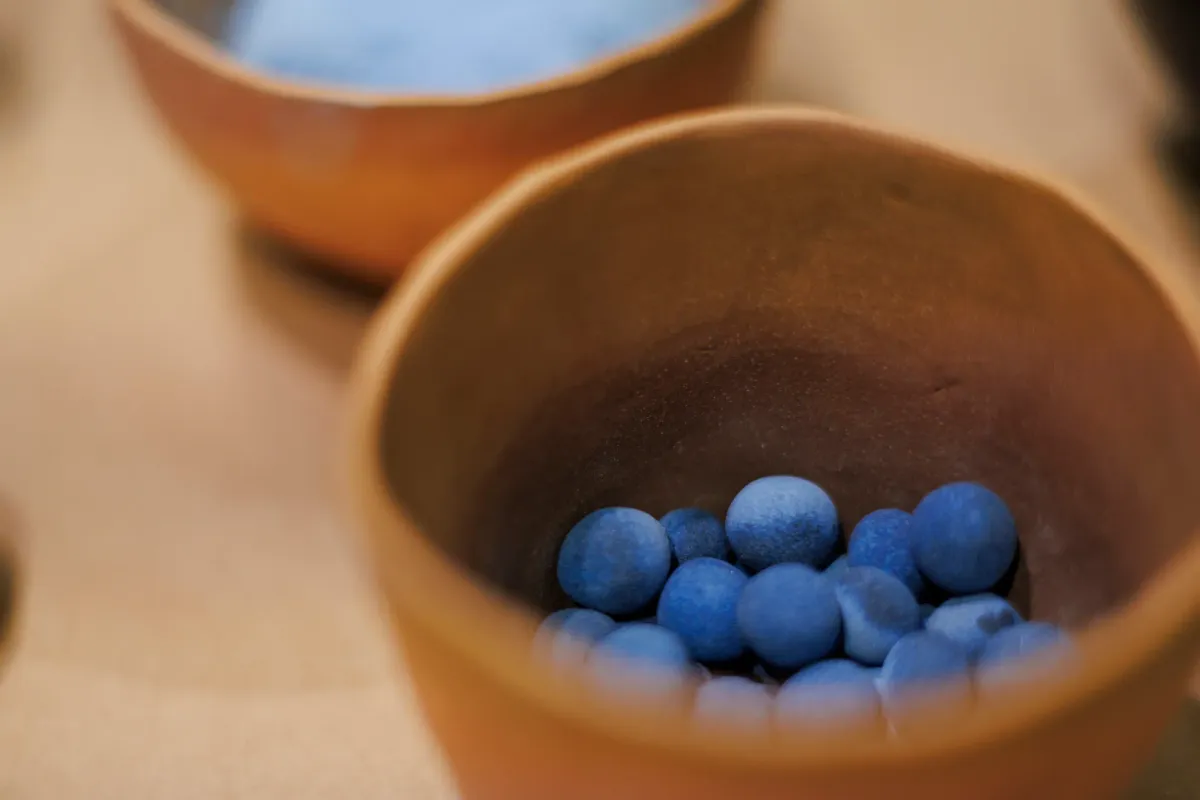
For millennia, artists were stuck with whatever nature offered — ground-up rocks, charcoal, the occasional berry. Then, around 3100 B.C., a group of Egyptian alchemists (let's just call them that) figured out how to combine silica, copper, calcium, and sodium salt at high heat. The result? Egyptian blue. It was cheaper than mining rare lapis lazuli and, crucially, it opened the floodgates for thousands of other synthetic colors down the line. Take that, beige cave paintings.

The OG Synthetic
At a recent Harvard Art Museums workshop, conservators and adjunct professor Lisa Barro dove into the history and making of this foundational color. Because, as Barro points out, pigments are everywhere now — in your pastels, your plastics, even your phone screen. Egyptian blue was the OG, the granddaddy of them all.
We're a new kind of news feed.
Regular news is designed to drain you. We're a non-profit built to restore you. Every story we publish is scored for impact, progress, and hope.
Start Your News DetoxBut how do you know if you're looking at the real deal, especially when it's thousands of years old? Before 2007, it involved scraping off tiny samples and running chemical tests. Which, for a priceless artifact, is less than ideal. Thankfully, science found a better way.
Enter Visible-Induced Luminescence imaging, or VIL. Researchers shine visible light on an artwork, then use an infrared camera (think night vision goggles for art nerds). If Egyptian blue is present, it glows in the otherwise black-and-white image. It's like a secret message only certain light can reveal. Turns out, this particular blue has a unique crystal structure that makes it luminesce under infrared. Handy.

Barro and conservator Carolyn Riccardelli have used VIL to spot Egyptian blue in everything from a fifth-century B.C. Persian relief to Roman Egyptian funerary portraits. It's helping rewrite the timeline of the pigment's use, too. Barro remembers being taught in school that its use stopped around 780 B.C. Nope. New imaging techniques keep pushing that date further and further, even finding it in Italian Renaissance works like Raphael’s Roman frescoes.
Beyond just identifying colors, this tech helps historians understand ancient life. MIT researchers recently used Egyptian blue detection to analyze a small blue room in Pompeii, preserved by Mount Vesuvius. The amount and quality of the pigment suggested the homeowners were decidedly wealthy. Because apparently, even in 79 A.D., a vibrant blue fresco was a flex.
So, the next time you see a vivid blue, take a moment. It might just have a glowing, millennia-old ancestor to thank.