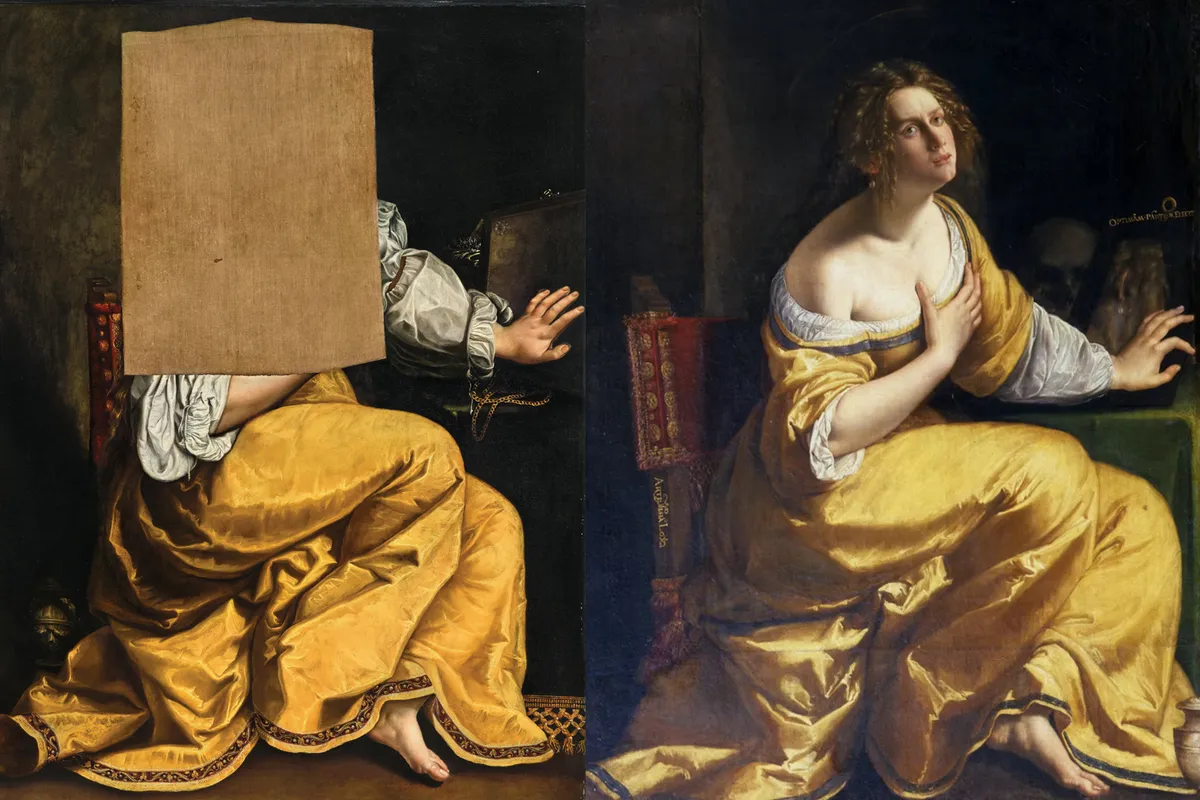
A painting by Baroque artist Artemisia Gentileschi, found rolled up in a Berlin cellar, is now up for auction. The artwork, which depicts Mary Magdalene, is missing the saint's head and chest. Experts believe the damage likely happened during the chaotic period after World War II.
Despite the large hole, the painting is expected to sell for $120,000 to $180,000. It dates back to between 1615 and 1618, when Gentileschi lived in Florence, Italy.
A Unique Depiction of Mary Magdalene
This painting shows Mary Magdalene in a more traditional style. She is seen pushing away a mirror, symbolizing her rejection of vanity. This contrasts with another Gentileschi portrait, Mary Magdalene in Ecstasy, recently acquired by the National Gallery of Art. That painting shows the saint in a "deeply and unmistakably eroticized" way, with her eyes closed in rapture.
We're a new kind of news feed.
Regular news is designed to drain you. We're a non-profit built to restore you. Every story we publish is scored for impact, progress, and hope.
Start Your News DetoxThe auction house, Dorotheum, noted that the damaged painting "retains the technical quality and psychological depth of Artemisia’s authorship." It is a slightly different version of a 1620 portrait at the Pitti Palace in Florence. Both works show Mary seated, holding her hand to her breast. They also include objects linked to the saint, like a mirror and a jar of ointment.
Art historian Roberto Contini confirmed the painting as Gentileschi's work in 2011. Compared to the Pitti version, the faceless portrait has more dynamic drapery in Mary's yellow skirt and white blouse. There are also small differences in her left hand, the ointment jar, and the chair. The Pitti portrait includes a skull behind the mirror, a symbol of life's fleeting nature, which is absent in the auction piece.
These variations offer insight into Gentileschi's creative process. They suggest her artistic choices were not just for commercial reasons. She likely experimented with new techniques and compositions, possibly influenced by Venetian painters or the Medici family's art collections.
Artemisia Gentileschi's Life and Legacy
Artemisia Gentileschi was born in Rome in 1593. Her father, Orazio Gentileschi, was also a Baroque painter and trained her. As a teenager, she was sexually assaulted by an artist in her father's workshop. Her father took the man to court.
During the seven-month trial, Gentileschi was tortured and intensely questioned. Yet, she consistently stuck to her story. Despite the court finding her rapist guilty, he was never imprisoned.
After the 1612 trial, Gentileschi moved to Florence with her new husband. There, she became a well-known artist. Her patrons included the powerful Medici family. She often painted women in powerful roles. For example, her Judith Beheading Holofernes (circa 1620) shows the biblical heroine cutting off a general's head with a determined expression.
Her Self-Portrait as the Allegory of Painting shows her as a strong, dynamic figure. Art critic Jonathan Jones noted that she depicted herself as "the maker of her own image, the hero of her own life," centuries before feminism.
Mark MacDonnell, an old master expert at Dorotheum, sees a connection between the damaged Mary Magdalene painting and Gentileschi's life. He calls the painting "the embodiment of survival against the odds," reflecting the artist's own struggles and resilience.
Deep Dive & References
- National Gallery of Art Acquires Mary Magdalene in Ecstasy - National Gallery of Art
- On Gentileschi's Mary Magdalenes - Cleveland Review of Books, 2023
- The Dramatic Histories Behind the Artworks - Dorotheum
- Lot Listing for Artemisia Gentileschi's Mary Magdalene - Dorotheum
- Artemisia Gentileschi: Mary Magdalene - Uffizi Gallery
- Saint or Sinner: How to Spot Mary Magdalene in Art - Art UK
- Who Was Mary Magdalene? - Smithsonian Magazine, 2006
- Repentant Magdalen - National Gallery of Art
- Exceptional Emotion: Artemisia Gentileschi's Mary Magdalene in Ecstasy - National Gallery of Art
- Artemisia Gentileschi - National Gallery, London
- Why So Violent? - National Gallery, London
- Artemisia in Her Own Words - National Gallery, London
- A Fuller Picture of Artemisia Gentileschi - The New Yorker, 2020
- Judith Beheading Holofernes - Uffizi Gallery
- Artemisia Gentileschi: Painter Beyond Caravaggio - The Guardian, 2016