A small plaque in central London marks the general area where William Shakespeare bought a house in 1613. This was just three years before he died. For a long time, no one knew the exact spot of this house, which was torn down centuries ago.
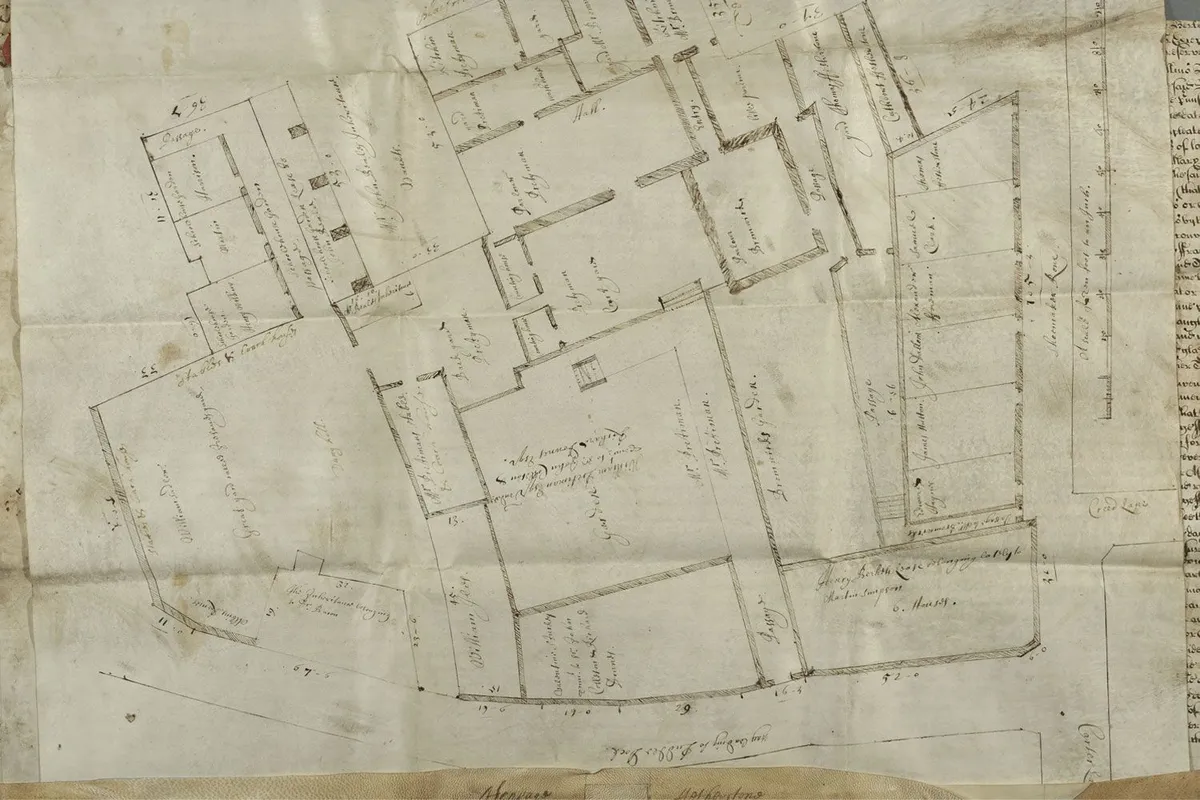
Now, a literary expert named Lucy Munro from King's College London has found a map. She says it shows the precise location of Shakespeare's lost London home.
Munro was researching the Blackfriars theater, where Shakespeare's acting group, the King's Men, performed. She found the map in old property records at the London Archives.
We're a new kind of news feed.
Regular news is designed to drain you. We're a non-profit built to restore you. Every story we publish is scored for impact, progress, and hope.
Start Your News Detox"I couldn’t believe it when I realized what I was looking at—the floorplan of Shakespeare’s Blackfriars house," Munro said in a statement. She noted that people thought there wasn't more to learn about the house, so research on it had stopped.

Shakespeare's London Life
Shakespeare mostly lived in Stratford-upon-Avon, about 100 miles from London. He was born there in 1564 and died there in 1616. He traveled between Stratford, where his family lived, and London, where he worked in theater.
"It’s good, I think, to think of Shakespeare as a literary commuter," Paul Edmondson, head of research at the Shakespeare Birthplace Trust, said in a 2015 podcast. He explained that Shakespeare's work life was centered in London.
Shakespeare likely started traveling to London in the 1580s. His family stayed in Stratford while he wrote and performed plays in the city. He usually rented homes in London until he bought the Blackfriars house in 1613.
That same year, the Globe Theatre, where Shakespeare's company performed, burned down. After this, Shakespeare is thought to have stepped back from his career and returned to his family.
The Globe Theatre fire started on June 29, 1613, during a play called All Is True (now known as Henry VIII). Cannons fired on stage set the wooden roof on fire.
New Insights into Shakespeare's Later Years
Munro's discovery challenges the idea that Shakespeare simply retired to Stratford. "It makes us think again about his relationship with London," she told the New York Times.
The newly found map, from the mid-17th century, shows Shakespeare's property was a large, L-shaped building. The ground floor was 45 feet wide.
Around the time he bought the house, Shakespeare was working on Henry VIII and The Two Noble Kinsmen. These were his last plays. Munro wonders if he wrote parts of them in this new London home.
Munro believes the purchase shows Shakespeare was still involved in his professional life in London in 1613. She also found two other documents about the property's sale. Shakespeare's granddaughter sold the house in 1665, and it burned down in the Great Fire of London the next year.
Chris Laoutaris, a scholar at the Shakespeare Institute, told the Times that the house might have been a financial investment or a base for Shakespeare to continue working.
Munro argues that Shakespeare chose this house near the Blackfriars theater and the Globe for reasons beyond profit.

The Blackfriars area was once a monastery. After King Henry VIII closed monasteries in the 16th century, the buildings were used differently. When Shakespeare moved in, his neighbors were mostly wealthy people who didn't like London's theaters.
"There are still a lot of important people living there, people who make protests against the playhouses," Munro told the Associated Press. They saw the playhouses as a "public nuisance."
The Blackfriars theater was torn down in the 17th century. Today, a street called Playhouse Yard is the only reminder of its presence.
Munro wrote in the Times Literary Supplement that the blue plaque marking Shakespeare's house is now known to be "on the very spot" of his former home, not just "near" it.