
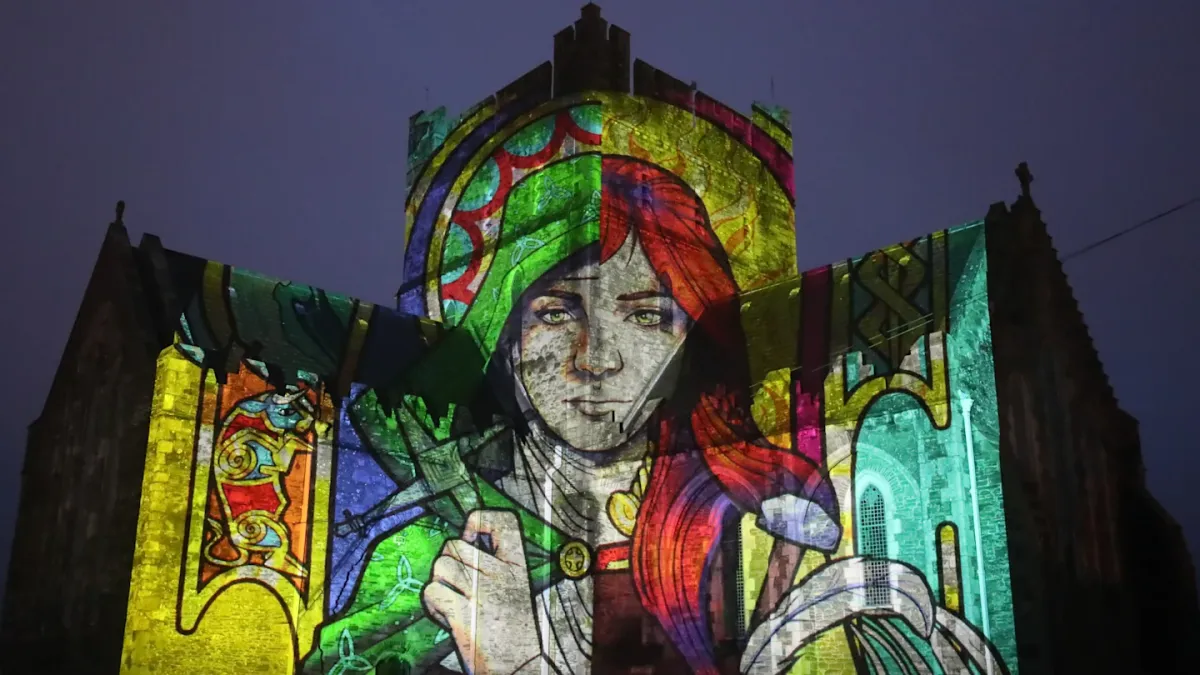
The story goes like this: A young woman in 5th-century Ireland kept giving away everything she owned. Her frustrated father tried to sell her to a king. During the transaction, she handed the king's jeweled sword to a leper. The king saw something in that gesture—a kind of clarity—and let her go free.
That woman became St. Brigid, and she's now one of Ireland's three patron saints, remembered not just in churches but woven into the fabric of how people mark the turning of seasons.
We don't know much for certain about Brigid's life. Legend says she was born in 451 in Dundalk to a Christian slave and a wealthy pagan father, and that she spent her early years in servitude. What the stories consistently agree on is her radical generosity and her refusal to accept the life that was assigned to her. After gaining her freedom, she became a nun and established monasteries and learning centers across Ireland, most notably at Kildare, which became a major hub of scholarship and spiritual life.
We're a new kind of news feed.
Regular news is designed to drain you. We're a non-profit built to restore you. Every story we publish is scored for impact, progress, and hope.
Start Your News DetoxShe became the patron saint of beer, dairy farmers, midwives, and blacksmiths—a surprisingly practical range of people. Some legends describe her as a great lover of ale. Others suggest she may have shared her life with a woman. Nearly all the stories speak of her compassion, her strength, and her ability to perform miracles. What emerges is a figure who lived by her convictions in a way that made her memorable centuries later.
The goddess and the saint
But here's where it gets interesting. Long before Christianity arrived in Ireland, there was a Celtic goddess named Brigid—or Bríg—who represented fertility, poetry, wisdom, healing, and protection. In some traditions, she appeared as three sister-goddesses, each embodying one of these gifts. Historians believe she may have been worshipped across Europe, possibly with roots stretching back to pre-recorded history.
Around February 1st, before Christianity took hold, Irish pagans celebrated Imbolc in Brigid's honor. It marked the midpoint between winter solstice and spring equinox—a moment of hope, when people gave thanks for surviving the cold and prayed for the land's rebirth.
Many scholars believe that as Christianity spread through Ireland in the 5th century, the saint and the goddess gradually merged into a single figure in people's minds and hearts. Whether this happened through deliberate effort, cultural overlap, or simple human need to hold onto what mattered—the result is that Brigid became something both: a historical person whose generosity resonated deeply, and a symbol of fertility, femininity, and seasonal renewal that reaches back to something much older.
How people remembered her
Families celebrated Brigid by feasting together, often on buttery potatoes, giving thanks for the crops that had kept them alive through winter. They wove Brigid's Cross—a four-pronged design made from wood or straw plaits—and hung them in barns and near animals, believing they brought protection and good fortune. Different regions developed their own variations, sometimes adding reeds, feathers, or drops of holy water.
Children carried Brigid-inspired dolls from house to house, collecting donations for festivities. People left out bread and cake wrapped in cloth as offerings. Those who could made pilgrimages to holy wells dedicated to Brigid, convinced that the water held healing power, especially for infertility.
These practices never fully disappeared. Across Ireland and beyond, people have revived them in recent years—weaving crosses, lighting candles, gathering to mark the turning of the year. In doing so, they're honoring not just a historical figure or an ancient goddess, but the continuity of something that has mattered to people for over 1,500 years: the promise that winter ends, that generosity has power, and that some things are worth remembering.