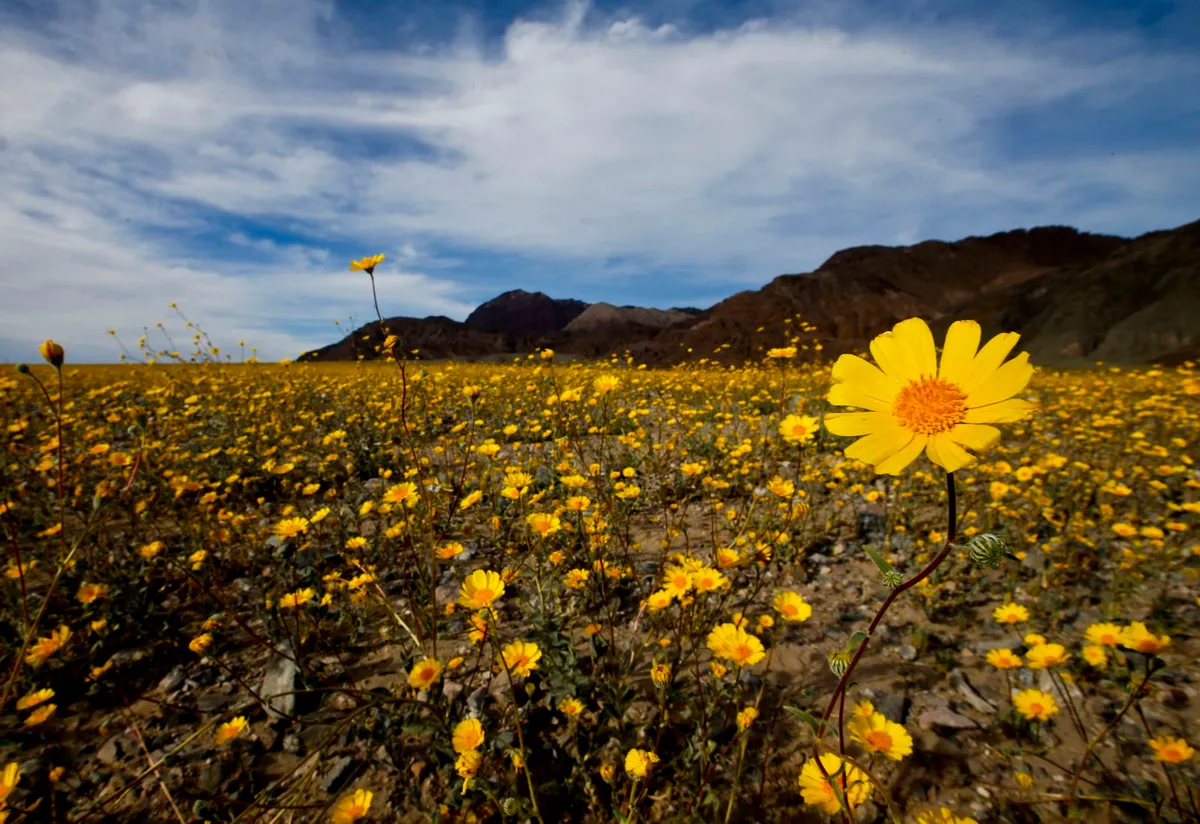
Death Valley hasn't seen a proper superbloom since 2016. But this year, the conditions might finally align again.
A superbloom isn't just a good wildflower year — it's what happens when the desert decides to show off. The National Park Service is already seeing early signs: fields of blooms along Badwater Road, sprouts emerging across the Mojave that suggest something bigger is coming. "Based on the sprouts we see, it looks quite possible there will be a superbloom," the NPS told AccuWeather meteorologist Brian Lada.
These events are rare because they demand precision. The desert needs three things in exact sequence: well-spaced rainfall throughout fall, winter, and spring; enough warmth from the sun; and winds that stay calm. Miss one, and you get a normal spring. Get all three, and suddenly the driest places in California turn into seas of color.
We're a new kind of news feed.
Regular news is designed to drain you. We're a non-profit built to restore you. Every story we publish is scored for impact, progress, and hope.
Start Your News DetoxThe 2016 superbloom followed an El Niño pattern that dumped rain across the region. Before that, Death Valley had to wait until 2005 and 1998 for its last major shows. More recently, superblooms have erupted elsewhere in California — 2023 brought blooms visible from space, and 2019 drew tens of thousands of visitors to Walker Canyon in Lake Elsinore.
If conditions hold, you'll see desert gold, brown-eyed evening primrose, golden evening primrose, sand verbena, and phacelia spreading across the landscape. The Antelope Valley California Poppy Reserve expects peak bloom between mid-March and May, and they've even set up a live feed so you can watch the landscape transform in real time. Anza-Borrego Desert State Park, Carrizo Plain National Monument, and Red Rock Canyon State Park are already showing early color.
The Beauty and the Problem
There's a catch. When superblooms happen, people come — tens of thousands of them. In 2019, the crowds got so intense that Walker Canyon had to close to protect the flowers themselves. Wildflowers might look resilient, but they're fragile when trampled at scale. "They're one of the most important resources we have to ensure the resilience of California's grasslands," says ecologist Valerie Eviner.
Conservationists see this tension differently. They argue that superblooms work like nature's megaphone — a reminder of what we're capable of protecting. "Nature is screaming through a megaphone, 'Look how amazing I am; come and connect with me,'" said Evan Meyer, executive director of the Theodore Payne Foundation. The hope is that people who witness these blooms will care more about preserving them.
If this spring delivers, officials are asking visitors to keep their distance. Stay on trails, don't pick flowers, and let the landscape breathe. The superbloom won't last long — it never does. But that's partly what makes it worth protecting.