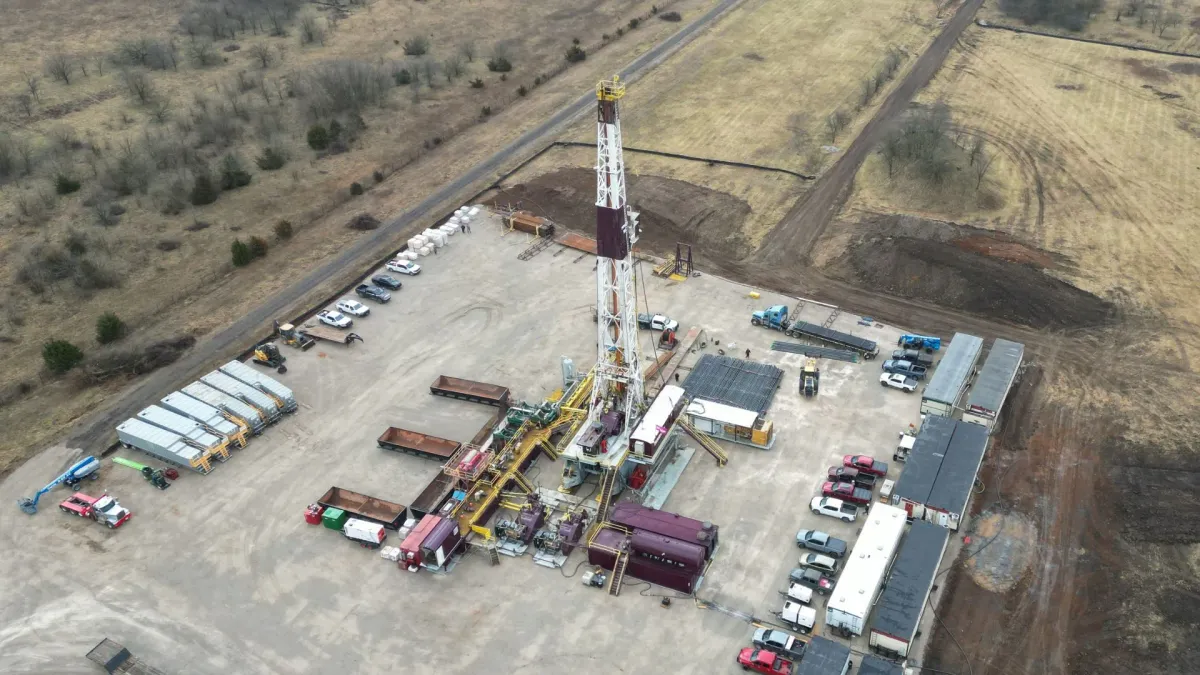
Deep Fission, a nuclear startup based in California, has started drilling for its "Gravity" reactor project. This marks a shift from planning to construction for the innovative underground nuclear pilot.
The Gravity reactor is a 15-megawatt (MWe) small modular reactor (SMR). It is designed to operate one mile beneath the Earth's surface.
First Steps Underground
The first well is being drilled at the Great Plains Industrial Park in Parsons, Kansas. It will go about 6,000 feet deep and be eight inches wide. This initial drilling will collect important geological, hydrological, and thermal data.
We're a new kind of news feed.
Regular news is designed to drain you. We're a non-profit built to restore you. Every story we publish is scored for impact, progress, and hope.
Start Your News DetoxLiz Muller, CEO and Co-Founder of Deep Fission, called the drilling a major step. She said it shows a new way to deploy nuclear energy.
Natural Protection
Deep Fission's design uses the Earth's natural geology instead of large surface containment structures. Placing the reactor deep underground offers two key benefits.
At one mile deep, the water column above the reactor naturally creates the 160 atmospheres of pressure needed for operation. This removes the need for expensive surface pressure vessels.
Also, the surrounding bedrock provides billions of tons of natural shielding. This greatly reduces the project's surface footprint and improves security. The company noted that this approach reduces the need for large above-ground structures.
Powering the Future
This drilling campaign follows other quick developments for Deep Fission. The company recently partnered with Urenco USA to buy low-enriched uranium (LEU). This fuel will power the testing and demonstration phases.
The project also received $80 million in new funding. This money will help scale production for AI-driven data centers and US electricity grids.
The system's modular design allows for significant growth. One borehole produces 15 MWe. However, 100 reactors at a single site could produce 1.5 GWe. This is enough power for large industrial areas or massive data centers. It would also use much less land than traditional surface plants.
This project is part of the Department of Energy’s (DOE) Reactor Pilot Program. The program aims for advanced reactors to become operational by July 4, 2026. Deep Fission believes its method can cut nuclear plant construction costs by up to 80 percent.
The company stated that by using existing supply chains and methods, construction costs could be reduced by 70–80 percent compared to traditional nuclear plants. The three-well program will gather subsurface data for final engineering designs and regulatory planning as Deep Fission moves towards commercial use.