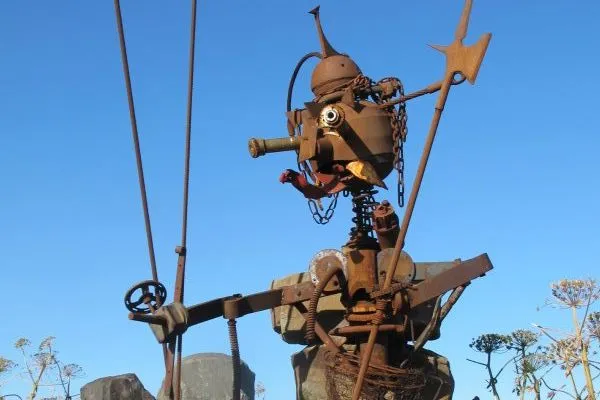
For eons, humanity has been pretty good at one thing: making trash. From ancient Roman aqueducts to today's sprawling landfills, we've innovated countless ways to discard things. But what happens when that discarded detritus lands in the right hands? It becomes, surprisingly, art.
Turns out, one person's overflowing bin is another's masterpiece. Artists worldwide are looking at old car parts, scrap metal, glass bottles, and even broken beach chairs not as junk, but as raw material. They're reimagining waste, sometimes to make a grand environmental statement (like a giant whale made of plastic), and sometimes just because it's a Tuesday and they felt like it. Either way, the results are always a little unexpected, and entirely inspiring.
The Art of Not Throwing Things Away
What is recycled art? It's often called upcycled or eco-art, and it's essentially the alchemy of turning everyday garbage — plastic, glass, metal, fabric, paper — into something beautiful, or at least thought-provoking. These are materials that were destined for the landfill, now transformed into imaginative forms that make us question what's truly valuable.
We're a new kind of news feed.
Regular news is designed to drain you. We're a non-profit built to restore you. Every story we publish is scored for impact, progress, and hope.
Start Your News DetoxHere are a few of our favorite examples of taking out the trash, artistically speaking:
The Tire Whisperer of Pennsylvania
Noah Russell, an employee at Breighner’s Tire Center in Littlestown, Pennsylvania, once built a huge lion out of tires for a local parade. It won first place. The next year? An eight-foot, fire-breathing dragon made from coat hangers and more tires. Another win. His creations, including a headless horseman and a horned stag, now guard Breighner’s, turning a tire shop into a landmark. Because why not?
Desert Dreams and Mariachi Bands
Near the U.S./Mexico border in New Mexico's Chihuahuan desert, artist Taras Mychalewych created the Frontera Sculpture Oasis. He started it after his car broke down in the desert. Because apparently that's where we are now. Built from scavenged bricks and bottles, it's a tribute to Mother Earth, featuring everything from a colorful mariachi band to structures reminiscent of L.A.'s Watts Towers. It's a celebration of nature, and a pretty direct warning against messing with it.
The Containbow of Fremantle
In a Perth suburb in Australia, nine sea containers form a 29-foot-tall arch between two bridges. Locals call it "The Containbow." Artist Marcus Cannin painted them in rainbow colors, transforming industrial relics into a vibrant beacon celebrating Fremantle's revitalized creative scene. It's tough to miss, which is probably the point.
The Swimmer's Silent Statement
Imagine nearly 200 discarded chairs, parasols, and general beach detritus forming a sculpture in a Swedish parking lot. The Swimmer - Traces of Man is a stark, slightly depressing, and entirely effective reminder of how every single product we consume leaves a mark, from its creation to its eventual, often endless, disposal.
Volkswagen Spider-Car, Volkswagen Spider-Car
Outside a former auto repair shop in Palm Springs, California, now called Hole in the Wall, stands a 28-foot-tall metal spider with a Volkswagen Beetle for a body. Robert Miner, the shop's longtime owner, built it. He eventually moved onto the property, adding a spider-motif treehouse. Because in the desert, anything goes, especially if it has eight legs and a German engine.
Iceland's Raven's Nest
On the edge of Reykjavik, Iceland, filmmaker Hrafn Gunnlaugsson has been turning his oceanside property into a surreal sculpture park since 1977. His name, Hrafn, means raven, and he blames his collecting habit on it. Rusty Viking warriors, global deities, totem poles from ship parts, and a giant eyeball made from a buoy now pepper the landscape. It's like a yard sale, if the yard sale was curated by a slightly unhinged genius.
The Auto Art of Erie
For over 25 years, Schaefer’s Auto Art in Erie, Pennsylvania, has been turning a quiet country road into a must-see. Richard Schaefer uses reimagined automobiles to create everything from a bumblebee to an "automan" and a two-headed dinosaur. It's folk art that drives by itself.
The Blenko Man's Two Right Feet
When the Museum of American Glass moved in 2007, they needed a mascot. Enter Blenko Man, a glass figure made from collector Rock Wilson's pieces by sculptor John Zidek. He greets visitors in Weston, West Virginia, overseeing a vast collection of glass, including a five-foot dollhouse. His iconic quirk? Two right feet, a tribute to a similar flaw in the original Blenko glassware. Let that satisfying detail sink in.
Che Guevara, Reimagined
In El Alto, Bolivia, a 30-foot-tall statue of Ernesto Che Guevara stands, made from engines, cogs, and wheels. Sculptor Felix Duran gave him two unique features: he's stepping on a bald eagle (symbolizing his anti-American views), and his face is distinctly indigenous. This has sparked various interpretations, from cultural tribute to a rather bold act of identity appropriation. Either way, it makes a statement.
The Cider Tree of Gijón
Asturias, Spain, is famous for its tart apple cider. In Gijón, a large artistic tribute, the Árbol de la Sidra, was unveiled in 2013, illuminated nightly. A plaque explains it represents the tree of life and shows how natural resources can be saved by reusing everyday objects. Which is a very poetic way to say, "This is made of old stuff."
Ethyl the Whale, Desert Dweller
Meet Ethyl, an 82-foot-long whale holding the Guinness World Record for the largest recycled plastic sculpture. Designed by San Francisco artists Yustina Salnikova and Joel Stockdill to raise awareness about plastic pollution, Ethyl (named for her polyethylene body) was first built for the Monterey Bay Aquarium. In 2019, the New Mexico art collective Meow Wolf acquired her and moved her to the middle of the desert. Because a giant plastic whale in the desert definitely gets your attention.
The Roadrunner of Las Cruces
At a scenic rest area in Las Cruces, New Mexico, a 20-foot-tall roadrunner made from old shoes, cell phones, and bike parts perches on a boulder. Local artist Olin Calk designed it in 1993, originally placing it at the local landfill to highlight poor consumption habits. Now it just looks cool, and still makes you think twice about what you're tossing. Which, if you think about it, is both impressive and slightly terrifying.