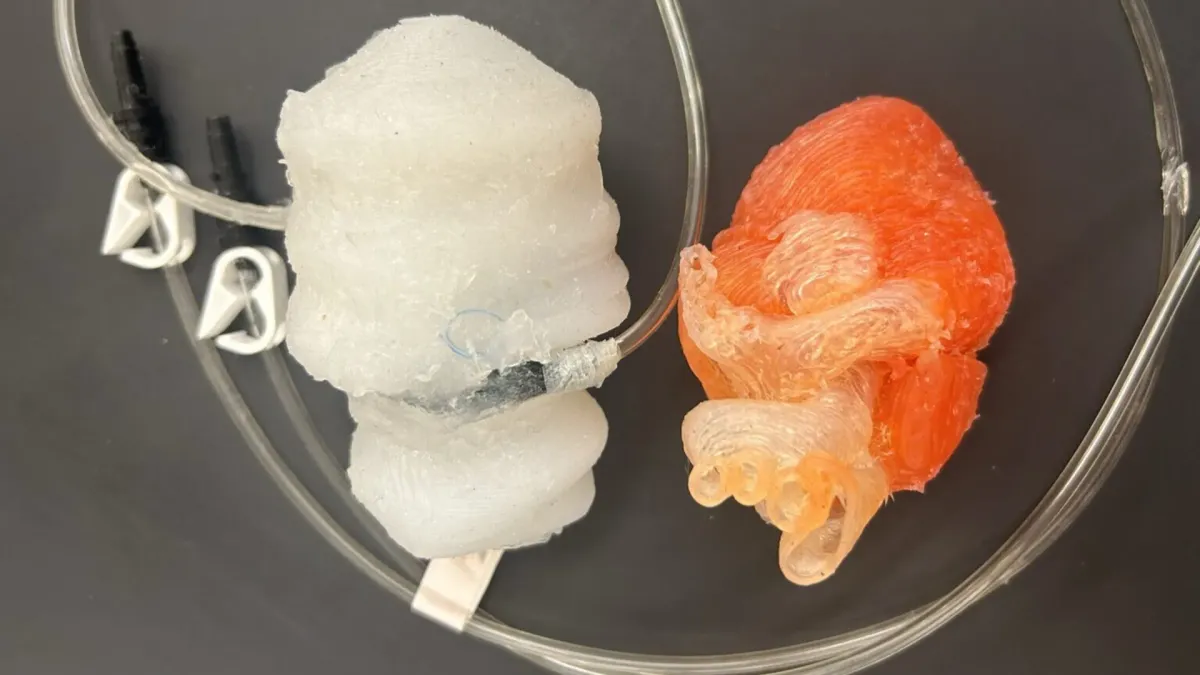
A surgeon's first attempt at repairing a leaking heart valve shouldn't be on an actual patient. Yet for decades, that's essentially what happened—doctors trained on animal tissue or cadavers, or they simply learned by doing. Now researchers have built a synthetic heart that beats like the real thing, complete with contracting walls and moving valves, giving surgeons a chance to rehearse before the stakes are life and death.
The model is soft, flexible, and eerily lifelike. It has a left atrium and ventricle, a mitral valve held in place by synthetic "heartstrings" (the medical term is chordae tendineae), and tiny robotic muscles embedded in the walls that contract and relax just like living tissue. Pressure sensors inside track blood flow dynamics in real time. When a surgeon practices repairing a leaking valve on this model, they're working with something that behaves almost identically to what they'll encounter in the operating room.
Why This Matters Now
Heart disease kills more people globally than any other single cause. Valve repairs are delicate work—a surgeon's hand position matters, the angle of each stitch counts, and the consequences of mistakes are severe. Traditional training methods have always been crude by comparison. Animal hearts don't match human anatomy perfectly. Cadaver tissue degrades. And both raise ethical questions that hospitals and regulators have increasingly questioned.
We're a new kind of news feed.
Regular news is designed to drain you. We're a non-profit built to restore you. Every story we publish is scored for impact, progress, and hope.
Start Your News DetoxThe breakthrough here is combining two technologies that, separately, have been around for years. Soft 3D printing can create flexible, anatomically accurate structures. McKibben actuators—soft robotic components that contract like muscles—have existed in robotics labs. But getting them to work together inside a printed heart model, in a way that actually replicates the chaos of a beating organ, took real engineering.
What makes this different from earlier synthetic models is the fidelity. Previous attempts either looked realistic but didn't move like real hearts, or they moved but didn't capture the anatomical precision surgeons need. This one does both. The mitral valve doesn't just open and close—it moves with the exact mechanics of the real valve, including the subtle flex of those supporting "heartstrings."
The research focuses specifically on edge-to-edge repair, a technique for fixing atrioventricular valve leakage. It's the kind of procedure that's becoming more common as populations age, and it's exactly the kind of surgery where practice makes a measurable difference in outcomes. A surgeon who's rehearsed the repair ten times on a model that behaves like a real heart will be more precise, more confident, and statistically more likely to get it right the first time.
There's a broader shift happening here toward what's called patient-specific medicine. Ideally, before operating on you, your surgeon would practice on a model of your specific heart—printed from your CT scans, with your exact anatomy. That's not routine yet, but it's becoming possible. As it does, complication rates drop and recovery times improve.
The next step is scaling this beyond valve repair to other cardiac procedures, and making patient-specific models routine enough that they're cost-effective. We're not there yet, but for the first time, we're looking at a training tool that's ethical, realistic, and reproducible.