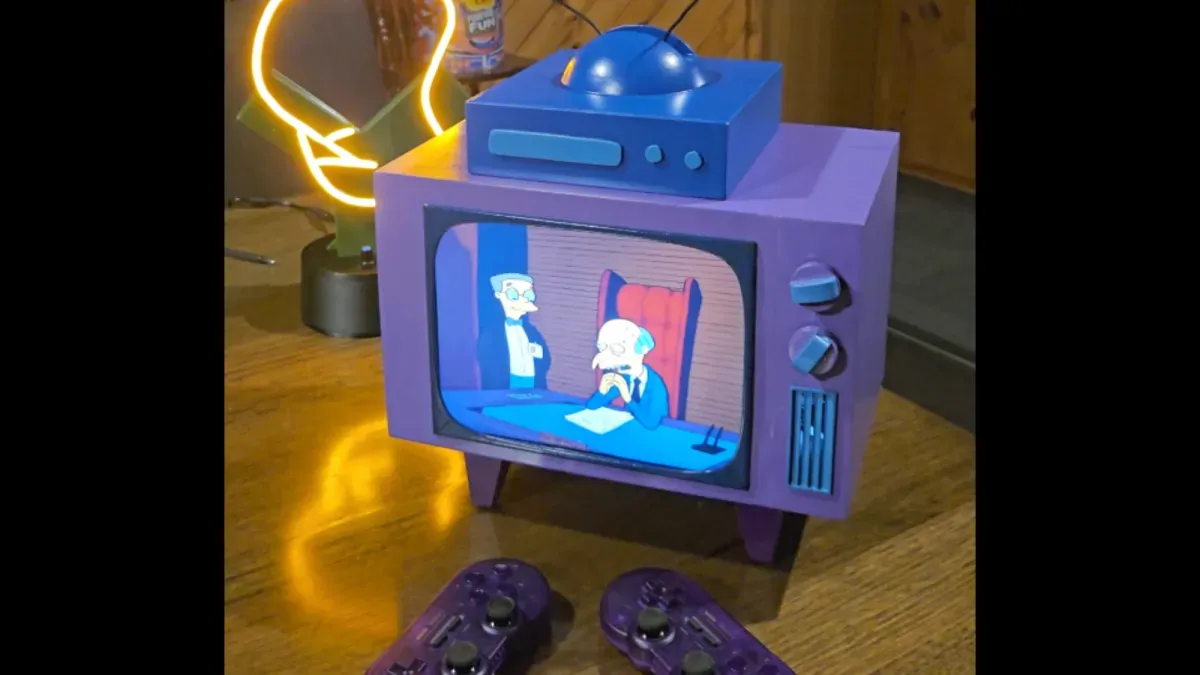
That boxy purple TV sitting in the Simpson family's living room has been there for over 35 years—visible in almost every episode, usually within the first few seconds of the opening credits. With its rabbit ear antennae and dial knobs, it's instantly recognizable. It's also completely obsolete by today's standards.
But one person on Reddit's 3D printing community figured out how to build a working replica that plays actual episodes.
Posted in early March, the miniature TV is fully functional. It streams the first 11 seasons of The Simpsons across four separate channels that constantly play in the background, mimicking a real broadcast. The creator even included authentic details: one dial controls volume with a push-to-mute option, the other switches channels, and there's show-accurate static when you change stations.
We're a new kind of news feed.
Regular news is designed to drain you. We're a non-profit built to restore you. Every story we publish is scored for impact, progress, and hope.
Start Your News DetoxThe hardware is surprisingly modest. It runs on a Raspberry Pi 4b (a credit-card-sized computer that costs about $60) paired with a few storage cards and a low-cost HDMI screen originally designed as a car display. The 4:3 aspect ratio of that screen was actually the perfect choice—it matches how The Simpsons looked in its early seasons.
The real charm is the hidden feature. Flip a switch on the back from "Good" to "Evil," and the TV switches from playing episodes to running the 1991 Konami Simpsons arcade game. The exterior is 3D-printed and painted with primer and acrylic spray to nail that vintage look.
The creator hasn't shared full design files yet, but the Reddit comments suggest it's only a matter of time. When they do, expect to see dozens of these pop up in living rooms across the internet—because honestly, this is the kind of project that makes people think, "I want to build that."
It's a small thing: a novelty TV that plays a show from the 1990s on hardware from the 2020s. But it's also exactly the kind of silly, thoughtful engineering that makes DIY communities worth following.