Water scarcity affects 2 billion people today. By 2050, that number could double. But a growing group of engineers and entrepreneurs have started solving it in an unexpected way: by extracting drinking water directly from humid air.
Atmospheric water generators (AWGs) sound like science fiction, but they're already working. A machine pulls moisture from the air, cools it until it condenses into liquid, then filters and mineralizes it into safe drinking water. No wells. No long supply chains. No plastic bottles. Just air, physics, and engineering.
The technology addresses something deeper than thirst. In drought-prone villages, remote islands, and disaster zones where traditional water infrastructure doesn't exist or has failed, an AWG can mean the difference between rationing and reliability. Even in humid cities where bottled water dominates, these machines could cut the carbon cost of shipping water thousands of miles.
We're a new kind of news feed.
Regular news is designed to drain you. We're a non-profit built to restore you. Every story we publish is scored for impact, progress, and hope.
Start Your News DetoxThe companies building this future
AirJoule, based in Delaware, is using metal-organic frameworks (MOFs) — materials engineered at the molecular level — to capture water vapor without refrigerants or chemicals. Once the MOF is saturated, a vacuum releases the moisture and condenses it into liquid. It's energy-efficient and works in both arid climates and humid cities where traditional AWGs struggle.
Aqua Ubique in Australia takes a different angle: they're building machines that handle the entire process from air intake to drinkable water, then mineralizing it for taste. They're explicitly targeting the plastic bottle problem — designing systems that eliminate both single-use containers and the carbon footprint of transporting water across continents.
Untap!, headquartered in Sweden, focuses on off-grid solutions powered by solar, wind, and bioenergy. Their machines combine condensation-based extraction with multi-stage UV sterilization. For rural communities or areas hit by disaster, where the power grid is unreliable or nonexistent, this autonomy matters.
ATMOS in Hyderabad, India, is scaling up. They build everything from residential units to industrial-sized systems, using UV treatment, ultrafiltration, and disinfection to remove contaminants and microbes. Given that India faces both severe water scarcity and high humidity across many regions, solutions like this could reduce dependence on groundwater that's being depleted faster than it refills.
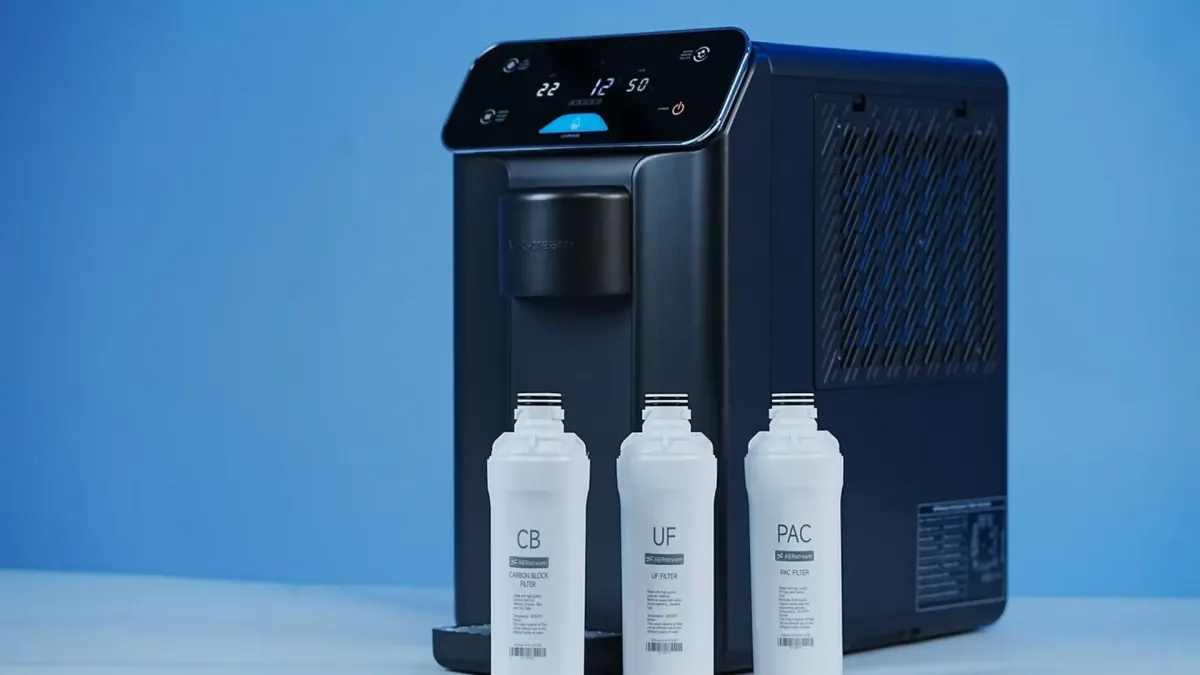
AERstream in Miami is taking AWG into homes and offices with countertop machines. They're proving the technology doesn't have to mean massive installations — it can be compact, user-friendly, and as simple as replacing a filter cartridge.
Hydrexa in Dubai combines AWG with air conditioning systems, harvesting water vapor while regulating humidity. Using AI and IoT sensors, their machines adjust performance in real time and track water quality and energy use — a glimpse of smarter buildings that manage water and cooling as an integrated system.
ExaWater in Seattle is focused on the efficiency problem that has historically limited AWG adoption. By dramatically reducing power demands, they're making the technology viable for remote and infrastructure-limited regions where electricity is already scarce.
Each company approaches the challenge differently — through advanced materials, renewable energy integration, home-scale design, or industrial capability. Together, they're shifting water scarcity from an unsolvable crisis into an engineering problem with multiple working solutions.
As freshwater stress intensifies globally, AWGs are moving from niche innovation toward mainstream infrastructure, especially in places where traditional water systems were never built or have begun to fail.