There's a particular kind of silence in an old forest—the kind that makes you feel like you've stepped sideways into another world. Europe still has them: places where the trees have been growing for centuries, where the light filters through in ways that seem to shift the ordinary into something stranger and more beautiful.
These forests didn't just inspire the stories we grew up with. They're still here, still growing, still doing what they've always done—making people feel small and wonder-struck enough to believe in things they wouldn't believe in anywhere else.
Germany's Black Forest
The Black Forest in Baden-Württemberg is where the Brothers Grimm found their shadows. Hansel and Gretel, Snow White, Rapunzel—the tales that taught us to fear the woods and be grateful for home all came from walking through these mountains. The forest is real in a way that matters: you can visit Triberg's waterfalls, stay in villages like Schiltach that still feel like they've stepped out of a storybook, eat at restaurants that have been feeding travelers for generations. But the draw has always been the trees themselves—dense, old, full of the kind of quiet that makes you understand why people invented ghosts.
We're a new kind of news feed.
Regular news is designed to drain you. We're a non-profit built to restore you. Every story we publish is scored for impact, progress, and hope.
Start Your News DetoxPortugal's Fanal Forest
On the island of Madeira, the Fanal Forest lives in perpetual mist. Its laurel trees are over 500 years old, and they grow in shapes that seem almost deliberately strange—curved and contorted as if they're dancing. The fog doesn't lift much, especially in the mornings, so the trees emerge from the mist like figures that might move if you weren't looking directly at them. The ferns and moss are so thick the ground itself seems alive.
Poland's Crooked Forest
No one knows why the 400 trees in Poland's Crooked Forest all bend at a 90-degree angle near their roots. Some say heavy snow bent them as saplings. Others think they were planted that way on purpose. A few blame tanks from World War II. The mystery is part of the point—this is a forest that refuses to explain itself, and it's become beautiful because of it.
Northern Ireland's Dark Hedges
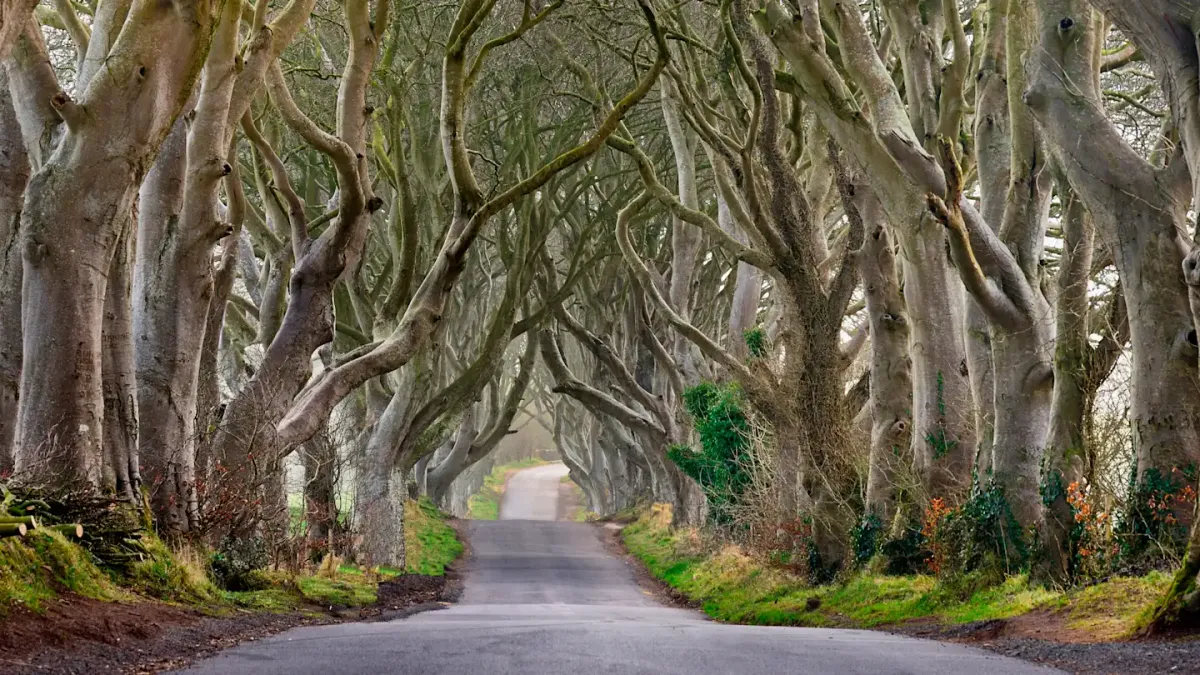
These beech trees were planted in 1775 to mark the entrance to a house, but they've become something else entirely. If you watched Game of Thrones, you've seen them—a tunnel of branches that local legend says is haunted by a woman called the Grey Lady. Whether you believe the ghost stories or not, walking between them feels like passing through a threshold.
Romania's Hoia-Baciu Forest
Romania's Hoia-Baciu has a reputation. People have gone missing here. A farmer disappeared along with 200 sheep, and the forest took his name. In 1968, a military technician named Emil Barnea photographed something in the woods he called a UFO. Tour guides still tell these stories. The forest trades in mystery—it's the kind of place where rational people start wondering about portals and dimensions, where the ordinary rules feel like they might not apply.
Belgium's Hallerbos Forest
For a few weeks each spring, usually between late March and early May, the Hallerbos Forest near Brussels fills with bluebells. The flowers blanket the ground so completely that the forest becomes something from another world—blue as far as you can see, soft and dreamlike. The rest of the year it's oak, ash, pine, and beech, full of songbirds and the ordinary magic of a working forest. But those weeks in spring are when people understand why forests made it into fairy tales in the first place.
Spain's Otzarreta Forest
In Basque Country, the beech trees at Otzarreta are so covered in moss they look like they're made of green. The branches stretch upward like the arms of forest gods. In autumn, when the leaves turn orange and gold, the contrast with the moss makes the whole place glow. Local legend says the Basajuan—a huge, hairy creature—wanders these woods protecting them. It's easy to believe when you're there.
France's Brocéliande Forest
Brittany's Paimpont Forest inspired the legends of King Arthur—Merlin, the Lady of the Lake, all of it. You can walk the same woods, drink from the Fountain of Youth (said to be a Druidic holy site), visit the ruins of the Abbey of Notre-Dame. The ancient oaks are still there. The lakes still exist. The stories didn't fade because the place stopped being magical. They endured because standing in these woods, you understand why people needed magic in the first place.
These forests aren't relics. They're still growing, still offering that particular silence, still making people feel like they've stepped sideways into somewhere else. That's not myth. That's just what happens when you walk into a forest old enough to remember the stories it inspired.