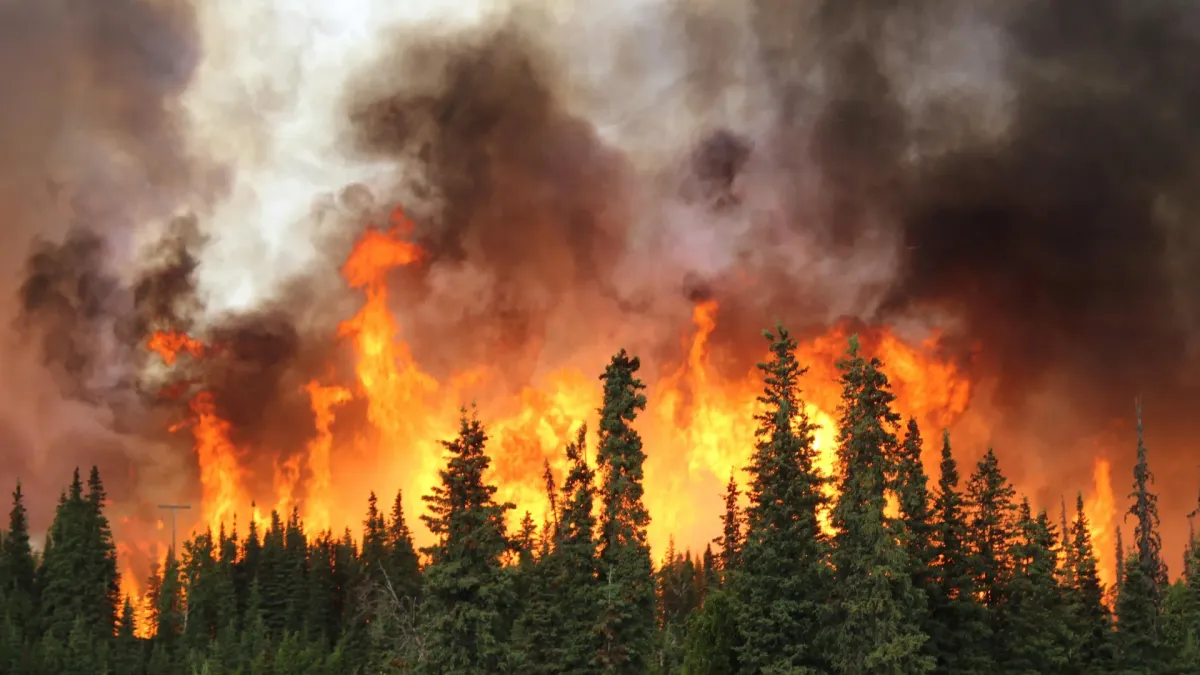
Alaska's Arctic tundra is burning at levels not seen in three millennia. An international team of researchers—pulling together experts from Germany, Poland, the UK, Romania, and the University of Alaska Fairbanks—has reconstructed 3,000 years of fire history by examining peat cores from nine locations north of the Brooks Range. What they found is stark: recent fire activity has surged to unprecedented heights, driven by two interconnected shifts that warming temperatures have set in motion: the spread of woody vegetation and increasingly parched soils.
To piece together this deep history, the team extracted peat cores about half a meter deep from tundra sites along the Dalton Highway between Toolik Lake and the Franklin Bluffs. Each layer told a story. Charcoal fragments, pollen, and plant remains acted as markers of past fire activity, vegetation patterns, and moisture levels. Using radiocarbon and lead dating, the researchers mapped wildfire patterns stretching back to around 1000 B.C.
The Long Quiet, Then the Shift
For most of that 3,000-year span, fires were rare. Between A.D. 1000 and 1200, activity ticked up modestly as soils began to dry, but then subsided again—staying low for the next seven centuries. This stability held until around 1900, when something changed. Fire activity began climbing again, and by 1950, it had surged to levels unmatched anywhere in the entire record.
We're a new kind of news feed.
Regular news is designed to drain you. We're a non-profit built to restore you. Every story we publish is scored for impact, progress, and hope.
Start Your News DetoxSatellite data from the latter half of the 20th century confirmed what the peat cores revealed: the late 1960s, the 1990s, and the 2000s-2010s all saw frequent fires sweeping across the region. The trend has only intensified. As soils continued drying through 2015—when the samples were collected—fire activity kept rising.
What's particularly concerning is how these fires are burning. Randy Fulweber, a study co-author at the University of Alaska Fairbanks, points out that recent large fires show signs of burning hotter and more intensely, consuming more fuel and leaving behind less charcoal. It's a subtle but significant shift: a fire regime that's not just more frequent, but fundamentally more severe.
The breakthrough came from collaboration. At Toolik Field Station, specialists in paleoecology, GIS, and remote sensing worked side by side, combining satellite imagery with charcoal data from the peat cores to see the full picture. That integration revealed something the data alone might have missed: the Arctic isn't just experiencing more fire—it's entering a new era of fire altogether, one shaped by a warming climate that's making the tundra both more flammable and more vulnerable to the flames.