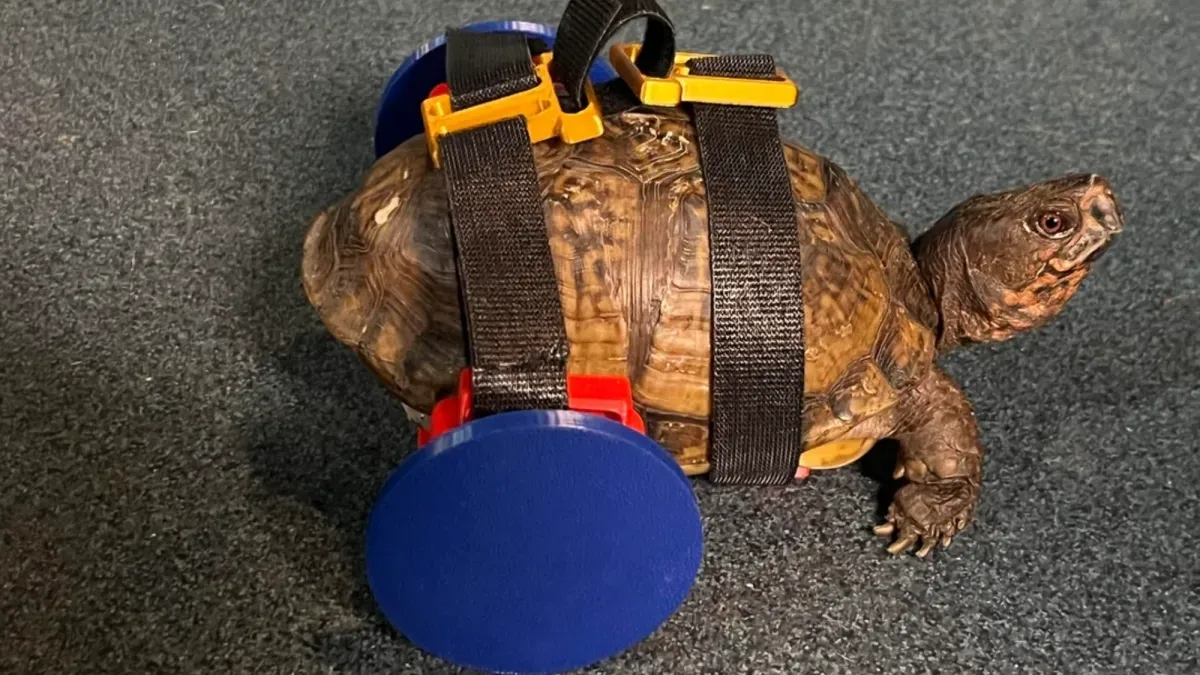
Moses, a Gulf Coast box turtle missing both back legs, spent his days immobilized until an aquarist named jawscritters spent 24 hours designing a custom wheelchair. Now the soccer-ball-sized reptile is moving around the Mississippi Aquarium in Gulfport on his own.
The design started simple: an orange toy truck axle and wheels strapped to Moses's shell with a harness. But jawscritters knew it could be better. After posting the prototype on Reddit, he refined the wheels, shortened the axles, and added grooves to improve traction. A front bumper he tried to add actually made things worse, so it came off. Each iteration brought Moses closer to genuine mobility.
"This has been a fun and challenging project and I'm very happy to see this little guy zooming around," jawscritters wrote. The real breakthrough came when he shared the design files online—anyone with access to a 3D printer can now adapt the design for their own injured turtle.
We're a new kind of news feed.
Regular news is designed to drain you. We're a non-profit built to restore you. Every story we publish is scored for impact, progress, and hope.
Start Your News DetoxWhen innovation meets animal care
Moses isn't the first turtle to get wheels. In 2018, veterinarians at the Maryland Zoo faced an injured Eastern box turtle with fractures on its shell. They needed to keep the shell lifted while allowing movement. A LEGO enthusiast and the zoo's vets collaborated to build a colorful LEGO frame on wheels, secured with plumber's putty. The turtle took off immediately and eventually made a full recovery, returning to the wild.
A year later, LSU veterinarians took a different approach with a pet turtle named Pedro who'd lost his back legs. Instead of a wheelchair, they built a removable axle-and-wheels system directly under his shell using a LEGO car kit—essentially a cyborg turtle hot rod.
What's shifted in the last few years is accessibility. The price of 3D printers has dropped dramatically, and the technology is now common enough that people like jawscritters—an aquarist with passion but not necessarily engineering credentials—can tackle problems that once required specialized veterinary equipment. In 2024, volunteers used 3D printing to create a weighted harness for Charlotte, a 30-year-old turtle struggling with buoyancy issues. The harness improved his swimming and gave him back a normal sleep posture.
There's something quietly powerful about this trend: it reveals how technology becomes truly useful not when it's flashy, but when it's shared. Jawscritters could have kept his design proprietary. Instead, he put it online for free. That decision means the next turtle in need—whether in Mississippi or Manitoba—has a starting blueprint. The caretaker still matters most (it takes someone who notices Moses struggling and decides to help), but now the tools are there too.